The Lagotto in Oregon Truffle Country
For Portland and Willamette Valley families — the water dog bred to find truffles, in the one corner of America where the truffle is a real harvest, a festival, and, for us, a crop of our own.
The Ground
Where the Truffle Is Actually Real
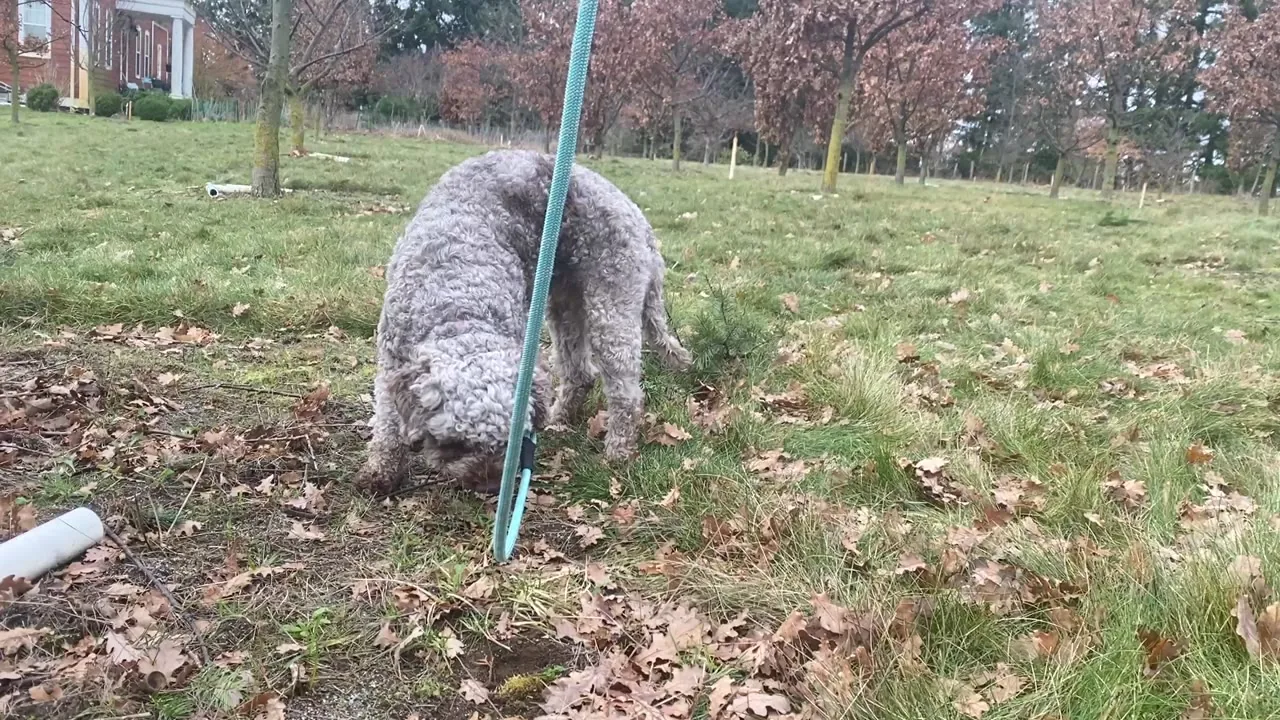
Oregon is one of the very few places on earth outside Europe where prized truffles come out of the ground as a genuine harvest rather than a curiosity. Four native species fruit in the Douglas-fir forests that run from the Coast Range through the Willamette Valley, each keeping its own season: the Oregon winter white (Tuber oregonense), the Oregon spring white (Tuber gibbosum), the Oregon black (Leucangium carthusianum), and the Oregon brown (Kalapuya brunnea, only named by science in 2010). Between them, they set a table across most of the year.
Here is why that matters for this particular breed. The Lagotto Romagnolo is the only dog on earth formally recognized for a single kind of work — finding truffles — and in Oregon that work is not a party trick performed with a scent kit. It is real, in the ground, in season, under the firs. We wrote about the breed and the harvest at length in our essay on the Lagotto and the truffle, and everything in it is true here in a way it simply is not in most of the country.
Most families who bring a Lagotto to Oregon never hunt a truffle for market, and not one of them needs to. The point runs deeper than the harvest: this is a nose-first breed, and Oregon is a place full of things worth finding. The scent foundations we begin before eight weeks give every puppy the start; what a family builds on it — backyard games, formal nose work, or a January morning in the Coast Range — is theirs to choose.
The Gathering
A Festival for the Truffle and Its Dog
In 2006, the forest mycologist Charles Lefevre and Leslie Scott founded the Oregon Truffle Festival in Eugene — the event, more than any other, that put North American truffles on the culinary map. It has grown into a winter institution of foraging walks, growers’ forums, and long tables of Oregon truffle cooking.
At its heart, for anyone who loves this breed, is the Joriad North American Truffle Dog Championship: dogs of every breed, from Chihuahuas to Lagotti, competing to locate scented targets against the clock. It is the only competition of its kind on the continent, and watching it is the fastest way to understand that truffle hunting is not a Lagotto’s parlour trick but a sport with a field of serious dogs.
We were there for the very first one. Long before we came down from Canada, this life — the truffle, and the dog that finds it — was already the plan, and standing at that inaugural festival was the kind of confirmation you do not forget. It is a rare thing to watch the breed you have set out to build a life around do the work it was made for, in a room where both are the guests of honour.
Our Own Ground
We Don’t Only Write About Truffles. We Grow Them.
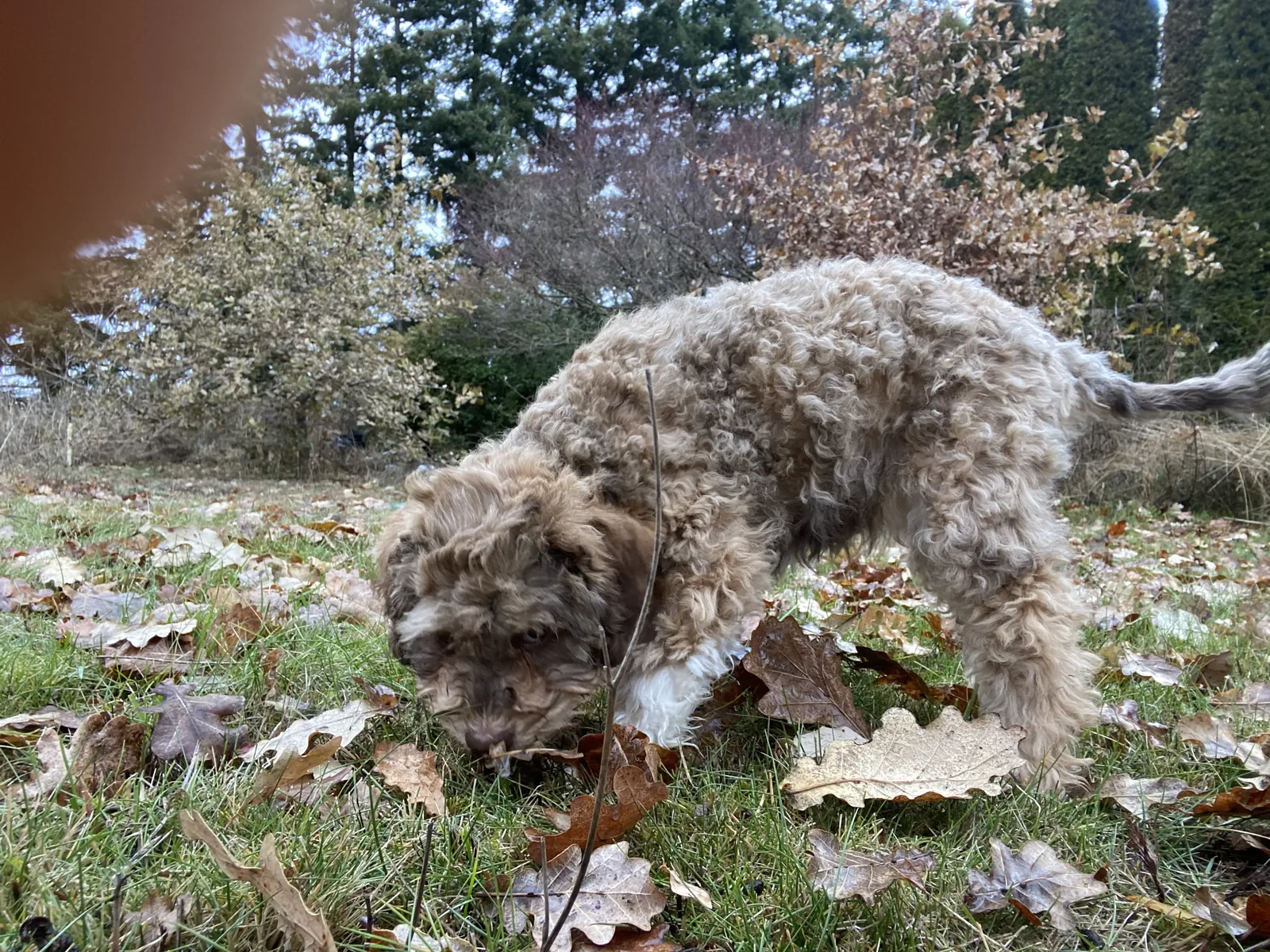
This is the part that keeps this page honest. We did not read about Oregon truffle country from a distance — we planted our own truffière, a truffle orchard, with inoculated trees bought from Charles Lefevre, the same mycologist behind the festival, whose company, New World Truffieres, grows truffle-inoculated seedlings for growers across North America.
Cultivated Périgord is a real and patient industry in this corner of the world. Oregon grows something close to ninety-nine percent of the United States hazelnut crop, almost all of it in the Willamette Valley, and hazelnut is one of the two classic trees a Périgord truffle partners with underground. We planted the other. Filbert blight is a real problem in our country, hard on the hazelnut, so we set our truffière to oak instead — the truffle’s other great host, and the sounder bet where blight is in the air. The first commercial crop of cultivated Périgord grown in Oregon came up near Corvallis within the last decade; our own oaks have taken, and after the long wait every truffle grower signs up for, the orchard is finally old enough to produce. This coming fall and winter, for the first time, it will be time to put a dog under the oaks and look — we may find our first truffles this season or the next, but the searching starts now, for the same reason we breed the dog: love of the whole picture, the forest and the nose and the find.
What it means for a family choosing a puppy is simple. When we talk to you about what this breed is for, we are not reciting lore. We are living it — the dogs, the trees, the season — and the puppy you bring to Oregon carries the nose that all of it depends on.
Daily Life
A Lagotto in Portland
Portland is a dog city with real room to move. Forest Park is one of the largest forested urban parks in the country — more than five thousand acres and over eighty miles of trail, with the thirty-mile Wildwood Trail running its length. It is leashed ground, so it is a place to walk a dog rather than to turn one loose, but for a breed that wants a job and a long green corridor to do it in, few cities offer anything close.
The climate is the other gift, and we will be honest about both sides of it. The Lagotto’s coat was made for a wet, temperate country, and western Oregon obliges — mild winters, real rain, a double coat doing exactly what it was bred to do. The same coat that sheds water does not shed mud, and a Portland winter will teach any family a towel-by-the-door routine and make the grooming rhythm matter more than it would in a dry climate. We would rather you know that here than discover it in November.
One happy coincidence for anyone who loves the breed: the Rose City Classic, one of the largest all-breed dog shows in the West, fills the Portland Expo Center every January — the same weeks the native truffles are fruiting. The dog and the harvest keep the same season here.
Practicalities
From Our Door to Yours
We should be straight about the distance, because it is the one real cost of choosing us from Oregon. We are in Lynden, in the far northwest corner of Washington, five minutes from the Canadian border. That is roughly two hundred and seventy-five miles from Portland — about five hours up I-5. It is not the day trip a Seattle family makes; it is a weekend, planned on purpose.
What it is not is a shipping problem, because we do not ship puppies as cargo, ever. Out-of-area placements are built around an in-person pickup — a drive folded into a long weekend, or a short flight into Bellingham or Sea-Tac with the puppy coming home in-cabin on your lap. We have sent enough dogs south that the path is well worn, and the Puppies & Process page walks through how placement works wherever you are starting from. Pickup day itself is deliberately slow: you meet the adults, sit with the litter, and leave with a puppy who has had a calm morning and a plan for the first ride and the first night.
If Oregon is simply where you are and the fit is here, that is the right order of operations. Distance is a logistics problem, and logistics problems have solutions; fit is the decision. Our Pacific Northwest page looks at why this whole region suits the breed, and our Washington page covers the home ground in detail.
Be notified about the autumn 2026 litter
Leave your email and we will let you know when placement decisions open. To reserve a place, a $500 deposit and a conversation put you on the waitlist.
Beginning the conversation is as simple as writing to us directly. We read everything ourselves.
Questions
Questions Oregon Families Ask
How far is Northwest Lagotto from Portland?
About two hundred and seventy-five miles — roughly five hours up I-5 — from our place in Lynden, in the far northwest corner of Washington. It is not a day trip the way Seattle is, but it is a manageable weekend, and we plan every out-of-area pickup carefully in advance.
Can a Lagotto really hunt truffles in Oregon?
Yes, genuinely. Oregon has four native truffle species fruiting in its Douglas-fir forests across most of the year, and the Lagotto Romagnolo is the one breed formally recognized for the work. Most families do it for enrichment rather than market, but the harvest is real. Our essay on the Lagotto and the truffle covers how to begin.
What is the Oregon Truffle Festival?
A winter festival founded in 2006 in Eugene by the mycologist Charles Lefevre, celebrating Oregon’s native and cultivated truffles. It hosts the Joriad, North America’s only truffle-dog championship. We were there for the very first festival, and the inoculated trees in our own orchard came from Lefevre’s company, New World Truffieres — so the connection is more than a visit.
Do you place puppies with Oregon and Portland families?
Regularly. We do not ship puppies as cargo; out-of-area placements are planned around an in-person pickup, whether that is a drive or a short flight with the puppy home in-cabin. Our Pacific Northwest page explains why this region suits the breed, and the Puppies & Process page covers how placement works.
Are there puppies available now?
Availability changes by season. An autumn 2026 litter — Blanca bred to MBIS NBISS GCHS Horizon All American — is currently open for inquiries. The announcement page carries the full details, and our waitlist page explains how placement works.