Around week three of every litter, the same messages begin to arrive.
Families studying the weekly photos start to fall for a color. The dark chocolate boy. The orange girl. And we find ourselves typing the same gentle warning we have typed for eleven years: the color you are looking at is not the color you will live with.
This is the whole picture — the palette the standard allows, what roan actually is, and the fade that surprises nearly every family. It is the conversation we have with every household before they choose a puppy, written down.
The Palette the Standard Allows
The Lagotto Romagnolo comes in five recognized colors: solid off-white, white with brown or orange patches, brown roan, brown in shades from light to dark (with or without white), and orange (with or without white). Some dogs carry a brown to dark-brown mask, and tan markings are allowed. Black — as a coat, as patches, or as pigmentation — is a disqualification in both the FCI and AKC standards. There is no black Lagotto, and there is no merle.
FCI Standard No. 298 · Colour Section
Federation Cynologique Internationale, the world's governing canine organization
"Off-white solid colour, white with brown or orange patches, brown roan, brown (in different shades) with or without white, orange with or without white. Some subjects have a brown to dark brown mask. Tan markings (in different shades) allowed."
Among the standard's disqualifying faults: "Black coat, black patches or black pigmentation."
Within that short list lives a remarkable range. Browns run from pale milk chocolate to deep espresso. Orange runs from rich apricot to a cream so light it can read as white in summer sun. And roan — the color most people picture when they picture a working Lagotto — is less a color than a behavior, which is why it gets its own section below.
Off-White
Solid, Warm White
Never an icy white — a warm, old-ivory tone, usually with the breed's brown nose and eye pigment showing through. Often the woolliest, tightest-curled coats in the breed.
White & Brown · White & Orange
Patched
A white base with defined brown or orange patches, most often across the ears, eyes, and saddle. In many puppies this is roan-in-waiting: the white fills in as the dog matures.
Brown Roan
The Working Classic
Brown and white hairs intermingled through the same coat — flecked, weathered, and wonderfully forgiving of forest dirt. The pattern keeps developing for months after birth.
Brown
Light to Dark, With or Without White
From milk chocolate to espresso, often with a white chest spot or toes. This is the color that fades most dramatically between puppyhood and the adult coat.
Orange
Apricot to Cream
With or without white, sometimes under a brown mask. Rich apricot as a puppy, frequently softening toward cream in adulthood — an orange adult in summer coat can pass for white at a distance.
Roan, Explained
Roan is a pattern, not a pigment. In a roan coat, colored hairs and white hairs grow intermingled through the same areas, producing that flecked, salt-and-pepper-in-brown look that reads as "truffle dog" to anyone who has spent time around the breed in Italy.
The part that matters when you are choosing a puppy: roan develops. Roan puppies are typically born looking white with defined brown patches. Over the first weeks and months, the white areas fill in with colored hairs, and the crisp puppy patches soften into the mottled adult pattern. A litter photographed at three weeks and again at three months can look like two different sets of dogs.
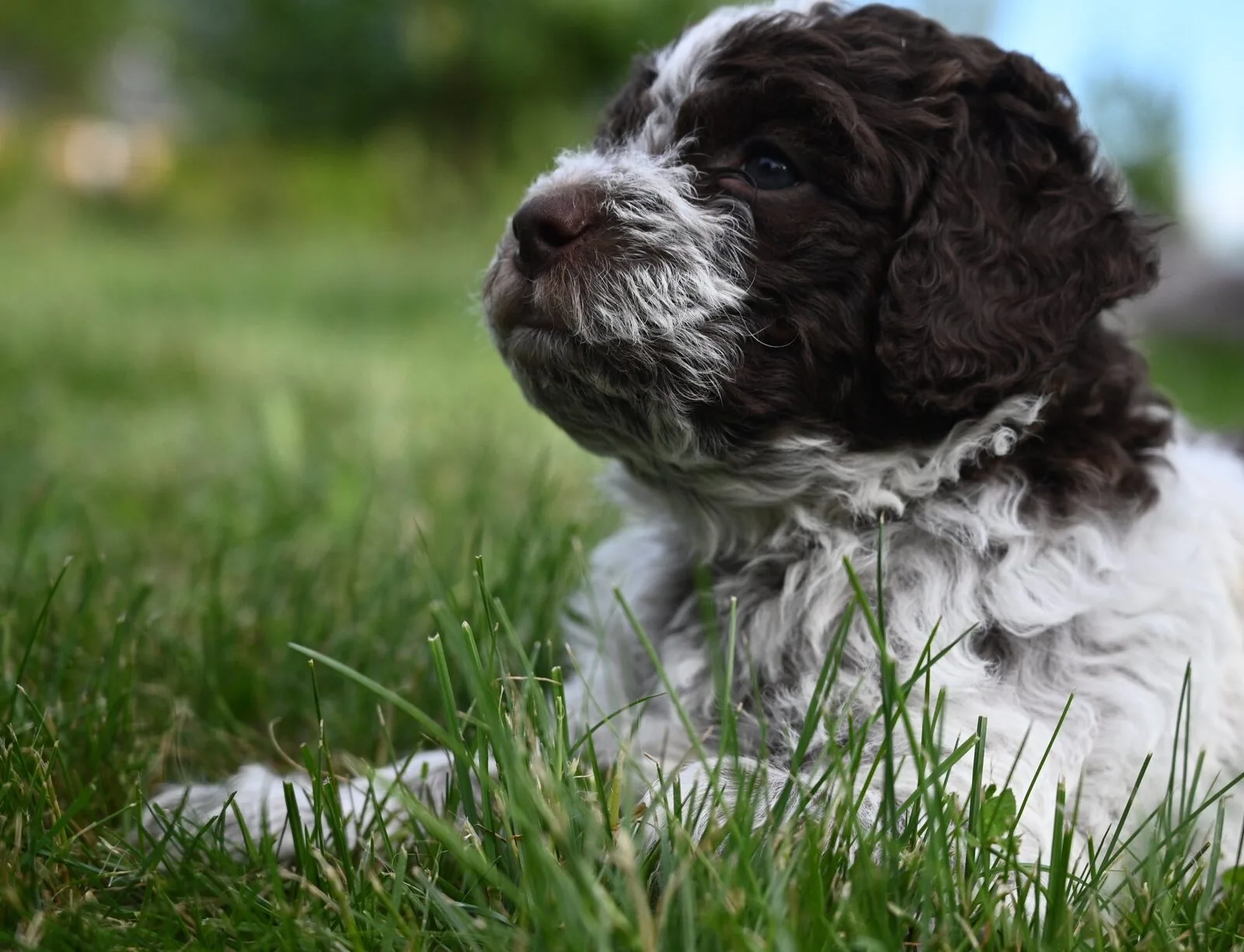
Standalone facts worth keeping: roan Lagotti are born looking patched, not roan. The roaning fills in over the first months. The final pattern cannot be fully read at eight weeks. None of this is unusual or a fault — it is how the pattern works.
The Fade Nobody Believes Until They See It
Here is the sentence we repeat more than any other on this subject: most Lagotti lighten — noticeably — between puppyhood and the adult coat. A puppy born the color of dark espresso commonly matures into a much lighter brown. Orange puppies often soften toward cream. Even the intensity of a roan pattern shifts as the coat turns over. The change is genetic, it is characteristic of the breed, and it is entirely normal.
The mechanism arrives with the coat transition itself. Somewhere around nine to eighteen months, the soft puppy coat gives way to the adult coat — a process with its own grooming implications, which we cover in our essay on the Lagotto coat — and the new coat frequently grows in several shades lighter than the one it replaces. By around the second year, the color has largely settled into what the dog will wear for most of its life, though clipping, sun, and season will keep nudging it at the margins for years.
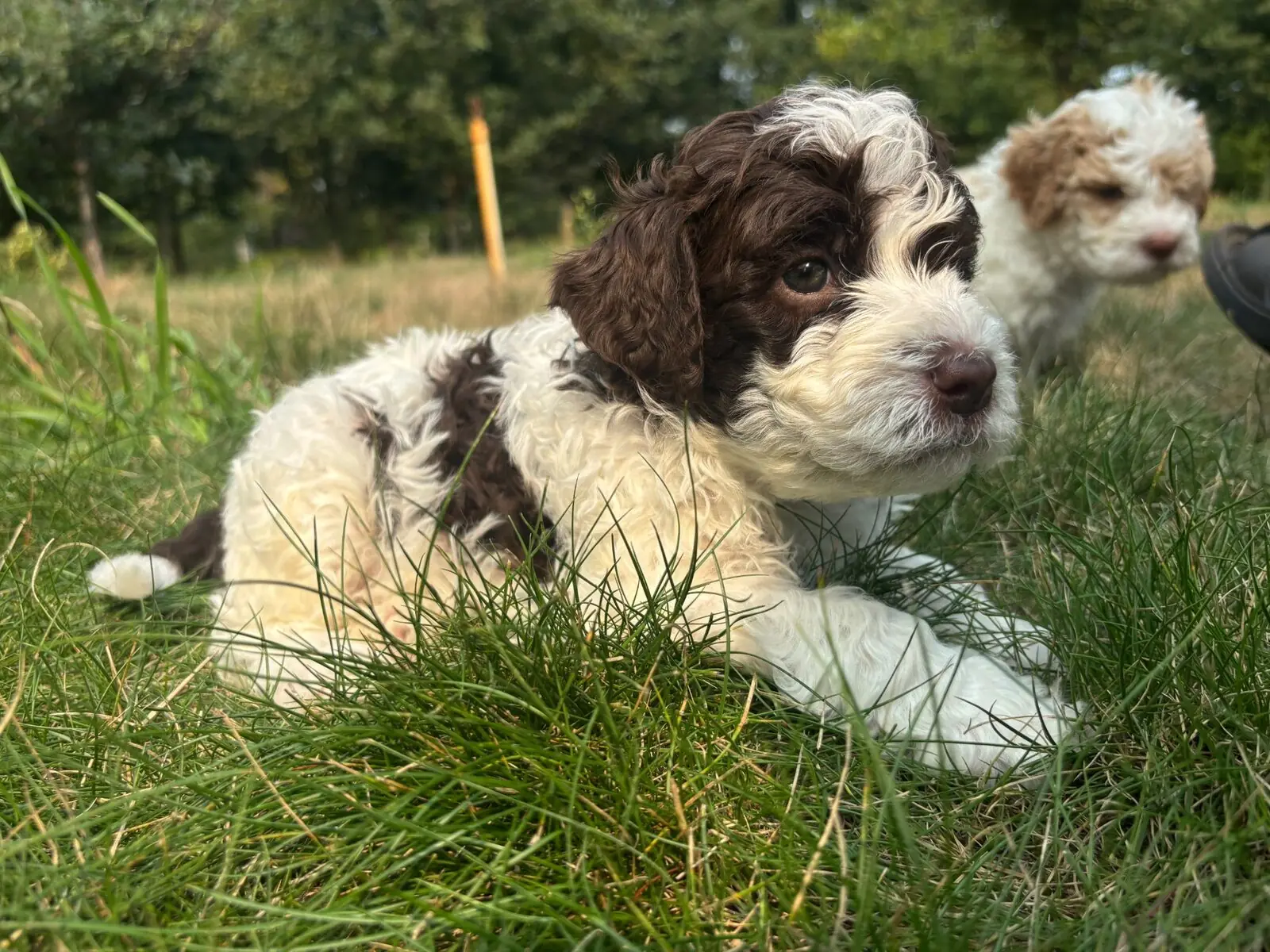
We have watched this happen litter after litter for eleven years, and it still catches families off guard. It is part of why we send weekly photos: not just so you can watch your puppy grow, but so you can watch the color you fell for at week three become the different, and usually lovelier, color the dog actually keeps.
Choosing a Puppy by Color — and Why We'll Talk You Out of It
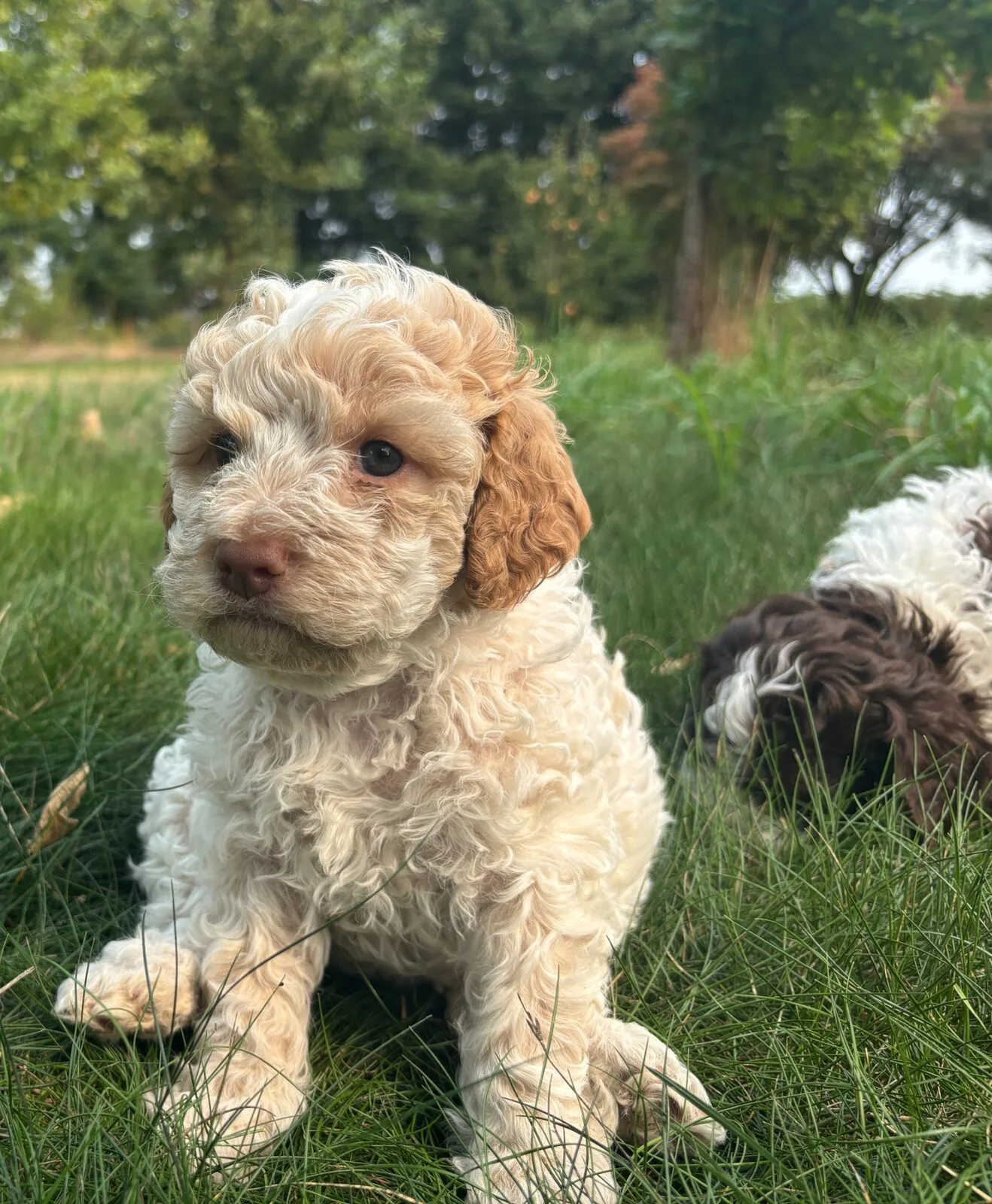
Every breeder knows the message: "We'd love the orange girl." We understand it — the heart wants what the eye lands on. But color is both the least stable and the least important thing about a Lagotto puppy, and we place puppies accordingly.
When families come to us, we ask them to hold color loosely and let temperament lead. By seven to eight weeks, we have spent hundreds of hours with a litter and can see what the photographs cannot: which puppy is bold, which is thoughtful, which needs a quieter household and which could thrive amid the chaos of young children. Matching that to your family is the part of our job that determines the next fifteen years — our puppies and process page explains how the matching works. The color question sorts itself out, usually within a day of the puppy coming home, when nobody can imagine the dog being any other color.
So our honest advice, from eleven years of placements: fall in love with the dog, not the color of the moment. The color of the moment is leaving anyway.
What Color Does — and Doesn't — Tell You
What color doesn't tell you: anything about temperament, and, as far as the record shows, anything about health. We are aware of no documented color-linked health condition in this breed, and the Lagotto standard contains none of the patterns — merle chief among them — that carry known risks in other breeds. The palette is honest that way. If you are curious how color is actually inherited, and why two brown parents can produce an orange puppy, our essay on Lagotto genetics walks through how recessive traits move through generations.
What color does tell you, a little: how the coat will behave. Texture varies subtly with color — paler coats tend to be woollier and tighter-curled, browns often carry a looser, more open ringlet — which changes the grooming rhythm, not the dog. The coat essay covers what that means in practice. Eye color follows coat color loosely too: lighter dogs tend toward warm gold eyes, darker dogs toward rich hazel and brown. And whatever the coat, the nose and pigment stay in the browns — never black.
The Lagotto you meet at eight weeks is wearing a color it will not keep. Fall in love with the dog underneath it.
If you are watching a litter's weekly photos and wondering what your favorite puppy will actually look like at two, ask us. Predicting it is one of the small pleasures of this work — and we have been wrong often enough to stay humble about it.
MarkWe Are Here for the Life of the Dog
Every family that takes home a Northwest Lagotto puppy has direct access to us — for color questions during the fade, for grooming guidance through the coat transition, for anything that comes up in the years ahead. We would rather field a curious question at month six than have a family wonder quietly whether something is wrong with a coat that is doing exactly what Lagotto coats do.
Want to See the Palette in Person?
Photographs flatten this breed’s colors more than most. Our own dogs run from brown roan to orange, and we welcome visitors to our property in Lynden by appointment — you can also meet the whole family on our dogs page.
Arrange a Visit →