I place only a few puppies a year, and I send each one home under a small mountain of instruction: a full Puppy Culture foundation from birth, manding, and a specific set of handling tools I build into every dog before it leaves my hands. Because of all that, most of them never meet real trouble. The exceptions are rare, and they share a face. Twice now a dog I bred has come back to me, and both times the story was nearly the same: a capable, experienced owner, certain the dog was deficient, who had spent months correcting a soft breed deeper into the exact problem they were trying to solve.
Almost never is the dog the problem. What goes wrong is that a skilled owner reaches for the toolbox that worked on every dog before this one, and this is not that kind of dog.
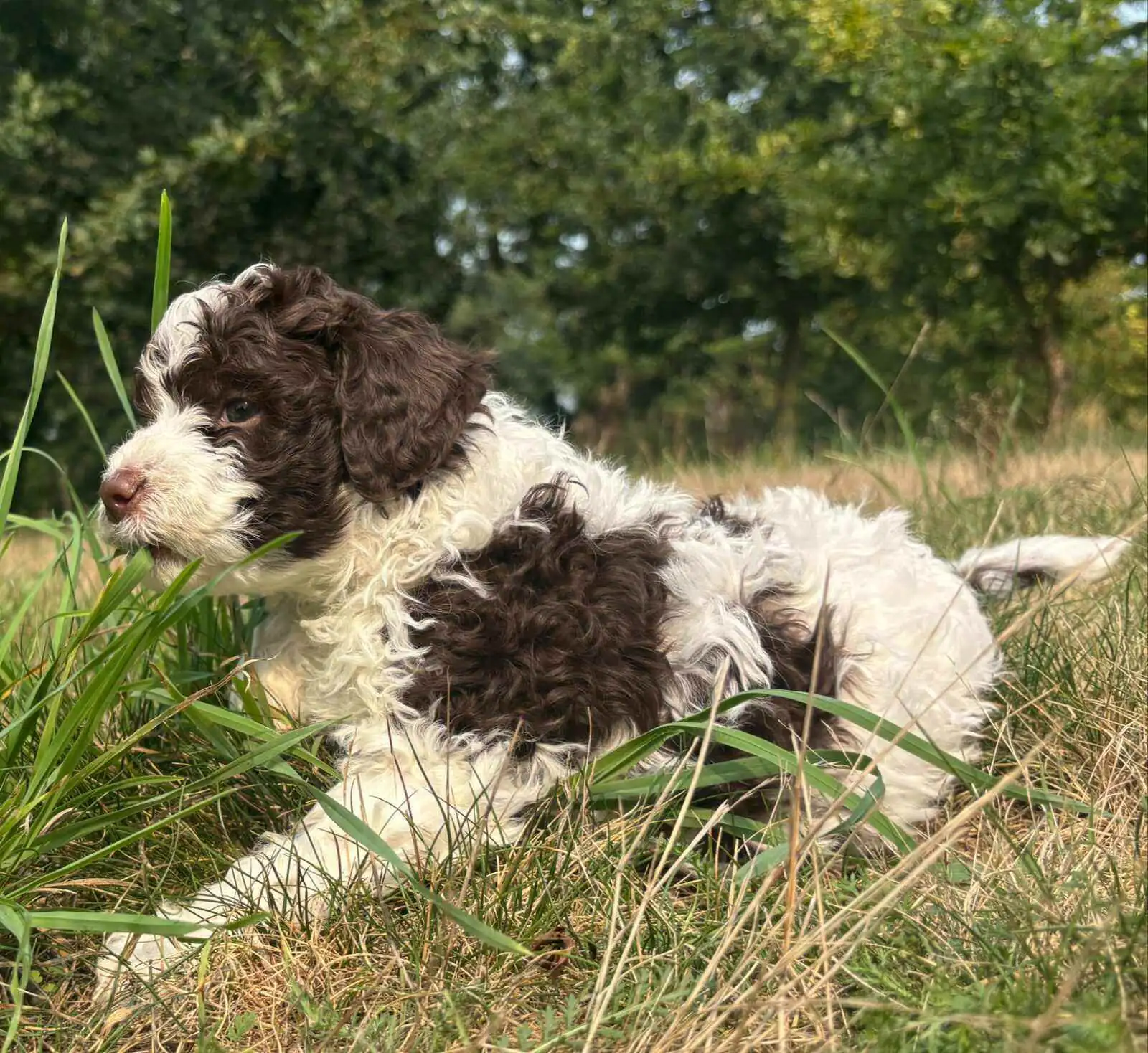
The breeds bred to read you closely are the ones a heavy hand hurts most.
The Most Surprising Risk Factor Is a Good Track Record
If you have owned and trained dogs for years, you have earned a reasonable confidence, and most of the time it serves you. You read dogs faster than a first-timer. You are consistent. You know that training is a long game and you do not panic at week three. Those instincts are worth a great deal, and I want to be careful not to talk you out of them, because by the end of this you are going to need them.
But with a soft, purpose-bred breed, a Poodle, a Lagotto, a Water Dog, or one of the curly working breeds people land on when they want a clever dog that does not shed, experience carries a specific hazard that inexperience does not. The hazard is not that you will do too little. It is that you will reach, reflexively and with the best intentions, for methods that were normal when you learned to train, that worked on the robust breeds you cut your teeth on, and that this breed cannot absorb the way those dogs did.
I am not describing cruelty. The owners I am thinking of are kind, devoted people. I am describing a leash correction at the wrong moment, a stern “no” that lands harder than intended, a roll onto the back to “settle” an over-aroused adolescent, a scruff shake, a general posture of I need this dog to know I am in charge. None of it reads as harsh from the human end. All of it lands differently on a dog that was bred, for centuries, to watch a person closely and take direction from the smallest cue.
Three things stack up to make this happen, and they are worth pulling apart.
Why Your Experience Is the Risk Factor
The breeds you trained before were forgiving. If your earlier dogs were Labradors, retrievers, many of the working and sporting lines. Those are robust, resilient, often almost relentlessly cheerful dogs. They tolerate a clumsy correction and bounce back. You could make real training mistakes with them and never see a cost, because the dog simply shook it off and carried on loving you. That tolerance taught you that the method was fine. It was not that the method was fine; it was that the dog was built to withstand it.
The era you learned in was built on a mistake. If you learned to train any time in the last forty or fifty years, you almost certainly absorbed some version of dominance theory, the idea that a dog is angling to be “pack leader,” that misbehavior is a bid for rank, and that your job is to win the contest and be the alpha. It is everywhere, in old books and television and the advice of well-meaning strangers at the park. It is also wrong, and we have known it is wrong for a long time. I will come back to where it came from, because the story is worth knowing.
The breed you have chosen amplifies every one of these. The curly working breeds were not selected to be robust and indifferent. They were selected to partner: to read a handler, take subtle direction, and work in close cooperation with a person. That sensitivity is the whole point of the breed. It is what makes them feel like they are reading your mind on a good day. And it is exactly what makes a heavy hand land so much harder than it would on a dog bred for a thatched-down nervous system.
Put those three together and you get the trap: a capable person, applying a discredited paradigm through methods their forgiving old dogs taught them were safe, to a dog uniquely built to be hurt by them.
Where “Be the Pack Leader” Actually Came From
It is worth knowing this, because once you see the foundation you cannot un-see it, and the whole edifice of correction-based “leadership” gets much easier to set down.
The alpha-wolf idea began with a researcher named Rudolph Schenkel in the 1940s, studying wolves in a zoo: unrelated adult animals thrown together in an enclosure. Under those artificial conditions the wolves did form a tense, competitive hierarchy, and Schenkel described a top-ranking “alpha” pair holding the rest in check by force. The picture then got passed along: wolves live in dominance hierarchies, dogs descend from wolves, therefore dogs are wired to compete with you for rank.
The biologist who did the most to popularise the alpha framing for a general audience was L. David Mech, in his 1970 book The Wolf: Ecology and Behavior of an Endangered Species. And here is the part that almost nobody who quotes “alpha” at a dog ever hears: Mech spent the following decades taking it back. After years observing actual wild wolves, on Ellesmere Island in the Canadian Arctic among other places, he found nothing like the captive prison-yard hierarchy. In the wild, a wolf pack is a family: a breeding pair and their offspring from the last few years. The “leaders” are not contest winners. They are the parents. In 1999 Mech published a formal correction in the Canadian Journal of Zoology arguing the term should be retired, and he has repeatedly asked his own publisher to stop printing the 1970 book; it was finally taken out of print in 2022.
So the entire chain is broken at every link. The captive hierarchy was an artifact of captivity. Wild wolves do not live that way. And dogs are not wolves besides. They are a species that has spent fifteen thousand years evolving specifically to cooperate with us. “Be the pack leader” is advice built on a retracted premise about an animal your dog is not, observed in a setting that does not exist in nature. There is no throne to claim. Your adolescent Lagotto pulling on the lead is not staging a coup. He is eight months old and has the impulse control of a toddler with a caffeine problem.
What the Corrections Actually Do
When you set the dominance frame down, the question stops being how do I win and becomes what does this method do to the dog and the relationship. On that question the evidence is not close.
The most pointed study for our purposes asked a simple thing: when ordinary owners apply confrontational, correction-based techniques, how does the dog respond? Researchers at the University of Pennsylvania surveyed dog owners about the methods they had tried and what happened. A cluster of the classic “show him who’s boss” techniques each provoked an aggressive response (a growl, snap, or bite) from at least a quarter of the dogs they were used on: the alpha roll, around a third; the “dominance down,” close behind; grabbing and shaking the dog by the scruff or jowls, about a quarter; hitting or kicking, the worst at over four in ten. The reward-based and non-confrontational methods, by contrast, produced aggression in the low single digits, close to none. The confrontational methods did not establish calm authority. They manufactured exactly the danger they were supposed to prevent.
And that is just the bite risk you can see. Underneath it sits a quieter cost. A controlled study published in 2020 compared dogs trained with aversive methods against dogs trained with rewards, and found the aversive-trained dogs showed more stress behaviors during training, higher cortisol afterward, and, tested weeks later in an unrelated setting, a more pessimistic cast to how they read an ambiguous situation. The dogs were not just unhappier in the moment. They had become, measurably, more inclined to expect things to go badly. The American Veterinary Society of Animal Behavior reviewed this whole body of work and reached the plain conclusion: reward-based methods should be the standard, and aversive tools carry risks (fear, anxiety, aggression) that are not worth running. A broader review of the literature found the same pattern across study after study.
Now layer the breed back on. Every one of those costs (the fear, the cortisol, the pessimism, the eroded trust) lands harder on a dog that was bred to be exquisitely attentive to you. A Labrador might shrug off the same correction that sends a Lagotto into a shell for the rest of the session. The very sensitivity you fell in love with is what turns a method that “never caused problems before” into one that does real damage here.
What “Handler-Sensitive” Really Means
Sensitivity is a slippery word, and people sometimes hear it as fragile or neurotic, which is not what I mean and not what these breeds are. A well-bred Lagotto is not a nervous dog; at its best the breed is calm, deeply bonded, and reserved with strangers rather than fearful. What I mean is closer to high-bandwidth. These breeds were developed to take direction from small signals and to care a great deal about getting it right for their person. That is a feature. It is also a liability if the signals you are sending are corrections.
A robust, lower-bandwidth dog filters a lot of your noise. It does not take your frustrated tone to heart, it does not generalise one bad afternoon into a belief about you, and it keeps offering behavior because the cost of a mistake feels low to it. A high-bandwidth partnership breed does the opposite. It reads your frustration accurately, it remembers, and when offering behavior starts to feel risky, because offering the wrong thing sometimes gets it corrected, it does the rational thing and stops offering. The brilliance and the breakability are the same trait pointed in two directions.
This is why trust is not a soft, optional extra with these dogs. It is the working mechanism. A Lagotto that trusts you will throw behavior at you all day trying to find the thing that earns the reward, and that willingness is the engine of everything you will ever teach it. Spend that trust on corrections and you are not just being unkind; you are disabling the one tool that makes the breed trainable in the first place.
How the Trap Shows Up
When an experienced owner runs the old playbook on one of these dogs, it rarely looks like a dramatic blow-up. It looks like a slow dimming, and because it is slow, it gets misread.
The first thing to go is offering. The dog that used to volunteer sits and tricks and ideas goes quiet and waits, because volunteering has become a gamble. Then comes avoidance: a beat of hesitation before it comes to you, a slightly lower posture, a checking-out. Owners often read this as the dog being stubborn or blowing them off, which leads to firmer corrections, which deepens the avoidance. It is a loop, and the dog is losing it.
The most expensive casualty is usually recall. If a dog has ever been called and then corrected, even for something unrelated, even just an irritated tone when it reaches you, it learns that coming back sometimes ends badly, and a clever dog files that away. The rule that protects recall is unforgiving: every return should be for great things and never for correction. Recall is the one command that can save a dog’s life, and it stays reliable only as long as coming back has, in the dog’s whole experience, paid every single time. Correction-based handling poisons it faster than almost anything.
And at the far end of all this is the outcome that breaks my heart, because it is so avoidable: a dog that has tipped over into real fearfulness or reactivity, and an owner who concludes the breed is unstable. The Lagotto carries an informal piece of folklore called “rage syndrome,” which is not a recognized veterinary condition and which, where it appears at all, describes a small reactive minority produced by poor breeding and thin socialization, not an inherent breed trait.
This is not theoretical for me. Both dogs I have taken back came home for exactly this reason: capable owners who had, month by month and with every good intention, corrected a soft dog into a corner, then read the result as proof the breed was unstable. The breed was not unstable. The method was wrong for it, and each dog did the only thing the method had left it.
Your Experience Is Not Wasted, Just Misfiled
Here is the turn, and it is the reason I do not want first-time owners to be the only ones who do well with these dogs. Almost everything experience gave you is exactly what a soft breed needs. It is one specific tool that has to go.
Keep your timing, the soft breeds are more responsive to well-timed reinforcement, not less. Keep your consistency, which matters more here, not less, because a high-bandwidth dog notices every inconsistency you let slide. Keep your patience and your long view. Keep, above all, your ability to read a dog, because you are going to need to read this one closely enough to catch the difference between can’t and won’t. With these breeds it is almost always can’t, or don’t understand yet, or am too aroused right now, far more often than the defiance the old frame trained you to see.
What changes is the answer to a single question. When the dog does the wrong thing, the old paradigm asked how do I correct that. The working question is how do I make the right thing easier and more rewarding than the wrong thing. In practice that means you manage the environment so the dog rarely gets to rehearse the mistake, you reward the behavior you want generously enough that the dog wants to repeat it, and you build a long history of offering pays off so the dog stays willing. It starts with one skill, manding, and the rest of the training philosophy follows from it. It means you never call your dog to you and then do something it dislikes. It means you treat a “stubborn” moment as information (the dog is confused, or under-motivated, or over-aroused) rather than an insult to answer.
For the experienced owner this is mechanically simple and psychologically hard, and I will not pretend otherwise. You already know how to train a dog. The work is not learning a new technique so much as noticing the old reflex before it fires, the hand that wants to reach for the lead, the “no” already forming, and choosing the other thing. The good news is that this breed gives you immediate, almost embarrassing feedback that you have chosen right. Drop the corrections and a Lagotto will come back on in days. The willingness was never gone. It was waiting to be safe.
The Hardest and Most Worthwhile Thing
The single most useful posture I can recommend to a seasoned owner is the one that is hardest to adopt: be willing to be a beginner again. Not with everything, since your foundation is real, but with this one dog and this one toolkit, hold your decades lightly enough to learn the part you did not learn the first time around.
I say this as someone who had to make the same trip. I raised Rottweilers as a teenager in the 1980s, trained the way everyone trained then, on the common wisdom of the day, and it was a different craft entirely: correction-first, leadership-as-dominance, the whole apparatus this essay argues against. The Lagotto asked me to unlearn nearly all of it. The breeds that ask this of us give back something specific in return: a dog working with you because it wants to, watching you not because it fears the consequences of looking away but because looking at you has, in its whole experience, only ever paid. That is not a lesser kind of control. It is the only kind worth having, and the curly working breeds will hand it to you the moment you stop trying to take it.
If you are choosing one of these breeds and you have a long history with dogs, that history is an asset, once you set down the single tool the breed cannot absorb. For where these dogs sit among the purpose-bred alternatives, and what each one asks of an owner, the companion guides are Beyond the Doodle and the athletic non-shedding framework. For the training itself, start with manding and the training philosophy; the reading list takes you the rest of the way.
Common Questions
I’ve trained dogs for thirty years. Why would this breed be any different?
Isn’t force-free training just permissive, with no rules or boundaries?
What about an e-collar or a prong collar for a reliable recall?
Is dominance theory really debunked, or is that just a training fashion?
My last dog needed corrections to listen. Why not this one?
How do I unlearn habits I’ve used for decades?
Does this mean the breed is fragile or neurotic?
Mark Nelson
Northwest Lagotto · Lynden, Washington
If This Is the Dog You Want
None of this is meant to warn you off a remarkable breed. It is meant to make sure the experience you bring helps the dog instead of working against it, because the people who do best with these dogs are very often the ones who have done it before and were willing to do one thing differently.
If you’re weighing one of the purpose-bred curly breeds, you can read the breed in full on The Breed, see the full breed-by-breed in Beyond the Doodle, and start the training side with manding and the reading list.