Many of the families who reach out to me didn’t come looking for a Lagotto. They came looking for an alternative to something — and often that something is a doodle they love but wouldn’t choose again.
Here is what I tell them, and it’s the reason I wrote this instead of another “why a Lagotto beats a doodle” piece: the dog you actually wanted probably already exists, and it isn’t a 1990s invention. What follows is an honest map of the whole category — including the breeds that fit you better than mine.
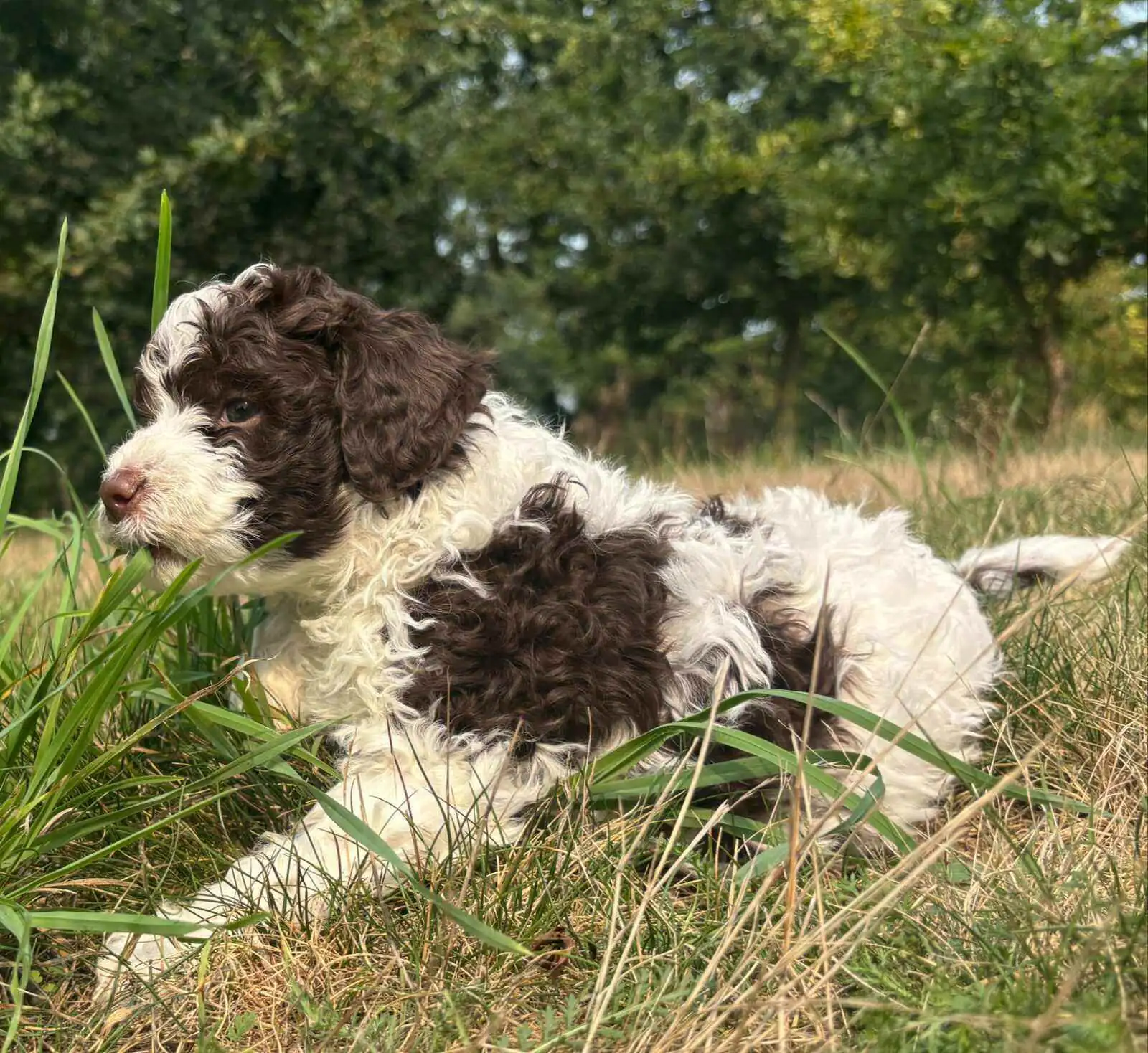
The Lagotto is one honest answer here. It is not the only one.
What “I Want a Doodle” Usually Means
When someone tells me they want a doodle, they’re almost never describing a Golden Retriever crossed with a Poodle. They’re describing a bundle of traits: a coat that doesn’t shed all over the house, a dog that’s friendly and good with kids, a medium-ish size, enough energy to join an active life without running the household, and — very often — a household member with allergies who needs the shedding to be real.
That’s a reasonable, specific wish list. The trouble is that the doodle is only one way to try to assemble it, and it’s the way with the least built-in predictability, because a crossbreed has no breed standard governing how any of those traits turn out. The doodle was an attempt, beginning in earnest in the 1990s, to manufacture a dog that the dog world had, in various forms, already spent centuries developing on purpose.
I’ve written the full, research-backed case on the doodle itself elsewhere: the temperament studies, the “hybrid vigour” question, the health-testing gap. I won’t repeat it here. If you want that head-to-head, read Lagotto Romagnolo vs Goldendoodle: What a Breeder Wants You to Know. This guide does the opposite job: instead of comparing one breed to the doodle, it lays out the whole category the doodle is reaching for, and helps you find the breed in it that actually fits you.
Two Truths to Get Straight First
No dog is truly hypoallergenic. Allergens — chiefly the protein Can f 1 — come from dander, saliva and urine, not from hair itself. When researchers measured those allergens in the coats and homes of breeds marketed as hypoallergenic, including the Poodle and the Spanish Water Dog, the levels were no lower than a Labrador’s, and in the coat were actually higher. What people with allergies actually need is a dog that sheds less, because less loose hair means less of the dander it carries gets spread around. Every breed below delivers that to some degree. But low-shedding is not allergen-free, and anyone who tells you a dog is hypoallergenic is either misinformed or selling. If allergies are a medical reality in your home, the honest move is the same for every breed here: spend real time around an adult of the breed, and test your reaction first. We go deeper into this in Are Lagottos Hypoallergenic?
Low-shedding is not low-maintenance. A coat that doesn’t drop hair is a coat that keeps growing, and where it goes, if you don’t manage it, is into mats. Every breed in this guide needs regular brushing and professional grooming, most every four to eight weeks for life. This is the single most common thing doodle owners tell me they weren’t prepared for, and it’s just as true of a Poodle or a Lagotto. The curly-coat world runs on grooming. For the real picture of what one of these coats asks of you, see The Lagotto Coat: What It Is, What It Needs, and What Nobody Tells You. The grooming authority I point everyone to is Katrien van Gemert, the first person to win Crufts with a Lagotto.
The Purpose-Bred Curly Landscape
Each of these is a real, established breed with a written standard, a breeder community, and a coat selected for over generations — which is exactly the predictability a crossbreed can’t promise. I’ve tried to be fair to each, including where it would be more dog, or less dog, than most families want. None of them is “the best.” The best one is the one that matches your actual life.
Lagotto Romagnolo — the one I raise
The breed I know best, so I’ll hold it to the same honesty as the rest. The Lagotto is an ancient Italian water-and-truffle dog, medium-sized at roughly 24–35 lb, with a dense, woolly, waterproof double coat that’s consistently non-shedding because it’s been bred that way for centuries. What sets it apart from most of this list is the temperament: bred to work methodically alongside a handler, a well-raised Lagotto is engaged but not frantic, with a real “off switch” in the evening. It is also deeply velcro and quite sensitive.
This is your dog if: you want a medium, predictable companion for an active-but-not-extreme life; you’ll do the grooming and the daily mental engagement; you want a dog that’s devoted and discerning rather than indiscriminately friendly; and someone is home reasonably often.
Not your dog if: the house is empty all day, you want a wash-and-wear coat, you want either a high-octane sport prospect or a true couch potato, or you plan to train with corrections and dominance. Already comparing it to one breed? See vs Goldendoodle, vs Standard Poodle, vs Portuguese Water Dog, or vs Spanish Water Dog.
Standard Poodle — the answer for more families than will admit it
If I’m being straight with you, the Standard Poodle is the breed I’d point a lot of doodle-seekers toward, because it’s one half of what they were already reaching for, without the genetic gamble. Forget the show-ring topiary: the Poodle was developed as a water retriever, and a well-bred Standard is athletic, exceptionally trainable, and reliably low-shedding. They’re larger than a Lagotto, roughly 40–70 lb, very intelligent, and they need a job, because boredom is where Poodle mischief comes from. The breeder pool is deep, which makes a health-tested, well-raised puppy more achievable than for the rarer breeds here.
This is your dog if: you want a larger, highly trainable, athletic non-shedding dog; you’re an active or sporty household; and you want the most established, easiest-to-source option in this category. For a great many people who think they want a doodle, this is the dog they actually want.
Not your dog if: you want something small, or a lower-drive dog that doesn’t need much mental work.
Miniature Poodle — the Poodle profile, smaller
Everything good about the Standard — the trainability, the athleticism, the consistent non-shedding coat — in a smaller, more apartment-compatible package. Still smart, still needs engagement; small does not mean low-energy here.
This is your dog if: you want the Poodle temperament and coat in a smaller footprint, and you’ll still provide real mental stimulation.
Portuguese Water Dog — for the genuinely high-activity, water-loving home
A sturdy, athletic working breed (roughly 35–60 lb), bred to work in the water alongside fishermen, with a curly or wavy non-shedding coat. PWDs are high-energy and need a serious daily outlet, more than a Lagotto and well beyond a walk around the block. As youngsters they can be intensely mouthy and exuberant, and the breed is known for counter-surfing and jumping. In the right home they’re magnificent; in the wrong one they’re a lot of unspent energy looking for an outlet.
This is your dog if: you’re a truly active, ideally water-oriented family that wants a strong working companion and will meet a large exercise need every day.
Not your dog if: “active” for your household means weekend walks. This breed will out-energy you.
Spanish Water Dog — usually more dog than a pet home wants
I’m including the SWD because it keeps coming up as a doodle look-alike, and because honesty requires it: for most families, it’s too much dog. A herding and working breed with very high drive (roughly 31–49 lb), the SWD wears a curly or corded non-shedding coat and needs experienced handling, structure, and a lot of work. It can be a superb dog for the right active, dog-experienced owner, and a source of real struggle for an average pet home that picked it for its looks.
This is your dog if: you want a working or herding-drive dog, you have the activity and experience to direct it, and you’re not looking for a low-key family pet.
Not your dog if: you want a companion first. This is a working dog first.
Soft-Coated Wheaten Terrier — friendly, but a real grooming and health commitment
A cheerful, sturdy medium terrier (roughly 30–40 lb) with a soft, silky, low-shedding coat. Wheatens are friendly and people-oriented, but two honest cautions. The coat is high-maintenance and mats easily without consistent work. And the breed carries a well-documented predisposition to two serious protein-wasting conditions — protein-losing nephropathy and protein-losing enteropathy — that affect a meaningful share of the breed and can be fatal if missed, so careful health screening and a frank conversation with any breeder matter here more than usual. There’s also a classic terrier streak of strong-willed independence that rewards early, consistent training.
This is your dog if: you want a friendly medium dog, you’ll commit to serious coat upkeep, and you’ll do the homework on breed health and the training a terrier asks for.
Curly-Coated Retriever — the large, low-fuss-coated athlete (if you can find one)
One of the oldest retriever breeds, large (roughly 60–95 lb) and athletic, with a distinctive coat of tight, crisp curls that’s low-shedding and, for a curly coat, relatively low-fuss. Curlies tend to be a touch more independent and aloof than the average retriever. The main catch is rarity: they’re genuinely hard to find.
This is your dog if: you want a large, athletic, low-maintenance-coated retriever, you appreciate a slightly more independent temperament, and you’re willing to wait for a well-bred one.
Barbet — the original French water dog (also rare)
The Barbet is a medium French water dog (roughly 30–60 lb) with a dense, woolly, low-shedding coat, close in spirit to the Lagotto and the PWD, and even-tempered. It’s an old breed thought to sit behind several others, the Poodle among them. Like the Curly, the honest caveat is availability: there aren’t many, and a good one takes patience to find.
This is your dog if: the Lagotto and water-dog profile appeals but you want to explore the whole family, and you’re prepared to wait for a responsibly-bred puppy.
And, honestly, a well-bred doodle from the rare breeder doing it right
I won’t pretend the doodle is never the answer. There are responsible doodle breeders. Not many, but they exist: they health-test both parents, place puppies thoughtfully, and stand behind them. The behavioural variability the research documents comes overwhelmingly from the unregulated middle of the doodle market, not from the small minority doing the work seriously. If a particular doodle, from a genuinely health-testing breeder, is what’s drawing you, that can be a fine dog — as long as you go in eyes-open about the coat unpredictability and you vet the breeder hard. How to tell a serious breeder of any of these breeds from a careless one: What Makes a Great Breeder.
Where the Lagotto Is the Wrong Choice, and I’ll Say So
Because this guide is mine, let me be especially clear about my own breed’s limits. Over eleven years, the placements that didn’t work were rarely about money or even about inexperience. The most common pattern wasn’t a first-time owner in over their head. It was an experienced owner who assumed there was nothing new to learn.
A Lagotto is a soft, sensitive breed. The training many lifelong dog owners learned decades ago — corrections, dominance, “showing the dog who’s boss” — is exactly wrong for this temperament. Applied to a sensitive dog, those methods don’t establish control; they produce a feedback loop where the dog grows anxious or shut-down, the owner corrects harder, and the behaviour deteriorates on both ends. The dogs that thrive go to homes willing to learn this particular breed, and a committed first-timer who’ll do that beats a set-in-their-ways veteran who won’t, every time.
So if you want a low-involvement, independent dog you can largely leave to its own devices; if your home is empty most of the day; if you want a wash-and-wear coat; or if you’re certain you already know how to train any dog and don’t intend to adapt — a Lagotto is the wrong dog, and one of the breeds above will serve you better. On the velcro question specifically, see Separation and Being Alone. I’d rather tell you that now than place a puppy that struggles.
The Decision That Matters More Than the Breed
If you take one thing from this guide, make it this: once you’ve narrowed to a breed that genuinely fits your life, the breeder matters more than the breed. A health-tested, well-socialised puppy from a careful breeder of any breed on this list will almost always make a better family dog than a poorly-bred one from the breed that looked perfect.
Across all of these breeds, the questions are the same, and a serious breeder of any of them will welcome them. Which health tests did you run on both parents, and can I see the results? What conditions are known in this breed, and how do you screen for them? How are the puppies raised in their first eight weeks? What support do you offer after the puppy goes home? Will you take the dog back, at any point in its life, if I can’t keep it? The breeders worth buying from answer these readily. The ones who get defensive are telling you something. The full version of what to ask covers why each question matters.
Common Questions
What’s a good alternative to a goldendoodle?
Is there a purebred dog that looks like a doodle?
Do these breeds really not shed?
Are any of these dogs hypoallergenic?
Which of these breeds is best for a family with kids?
I had a doodle and don’t want another. Where do I start?
Mark Nelson
Northwest Lagotto · Lynden, Washington
If a Lagotto Is the Right Fit — and When It Isn’t
This guide is meant to help you make the right decision, not necessarily the one that benefits us. If a Standard Poodle, a Portuguese Water Dog, or any other breed here is better suited to your family, I’d rather you choose it confidently than bring home a Lagotto that doesn’t match your life.
But if what you’ve read confirms what you suspected — that the Lagotto’s size, temperament, coat, and longevity are what your family needs — the next step is a conversation. You can read the breed in full on The Breed, or compare it directly with the Goldendoodle, Standard Poodle, Portuguese Water Dog, or Spanish Water Dog.