This is the comparison people expect to be simple. Both dogs have curly coats, both are intelligent, both are marketed as hypoallergenic. How different can they be?
Very. And the differences matter in ways that will affect your daily life, your annual budget, and your family’s experience for the next decade and a half. I breed Lagottos, not Poodles, but I respect the Poodle deeply, and what follows is an honest accounting of where each breed excels and where each one asks something of you.
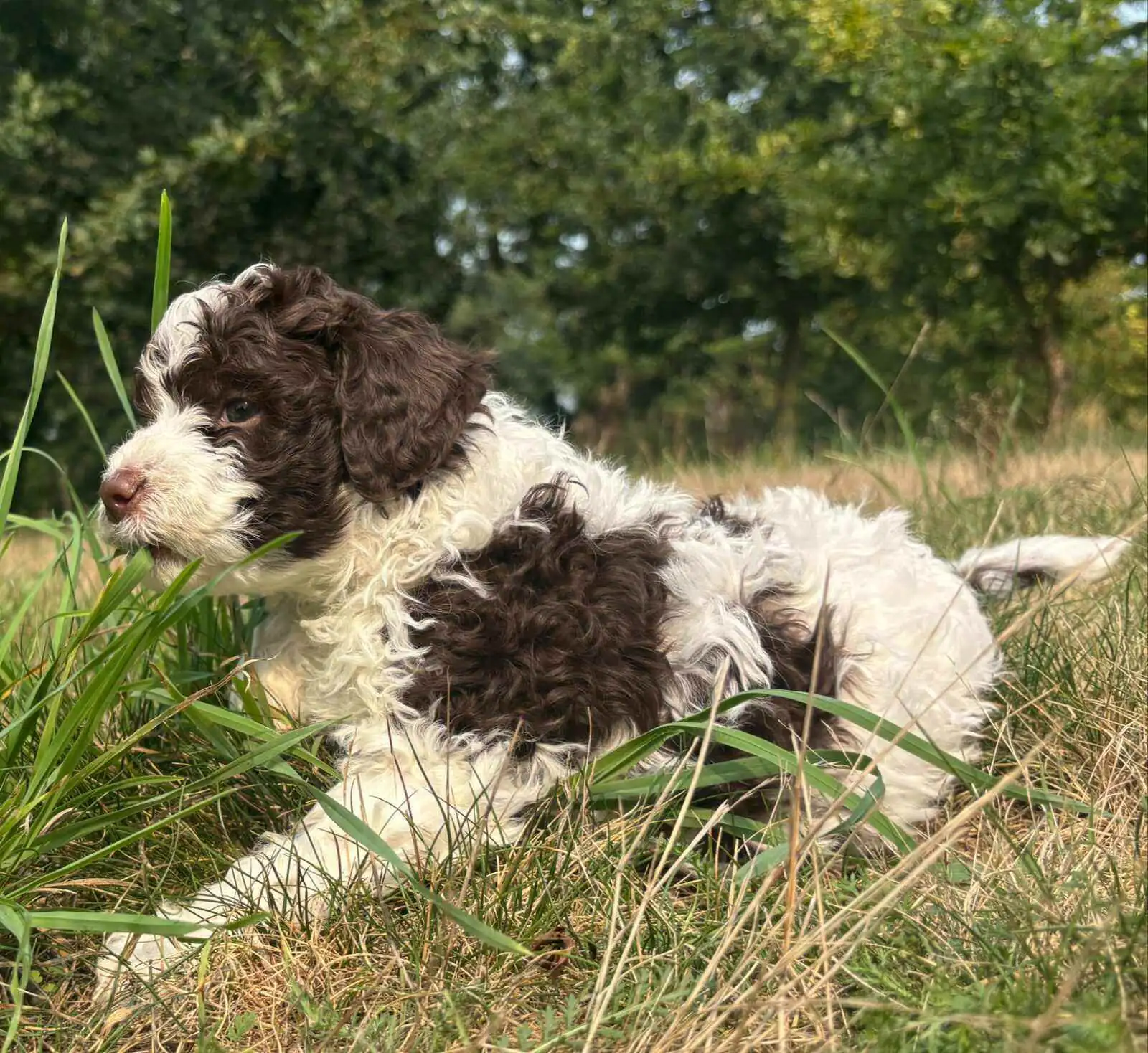
Nine hundred years of purpose. That is what you are comparing against.
Two Purebreds, Two Completely Different Philosophies
The Lagotto Romagnolo is an ancient Italian breed that spent centuries as a water retriever in the marshes of Romagna before transitioning to its modern role as the world’s only FCI-recognised truffle-hunting dog. Every generation was selected for scent drive, water work, independent decision-making, and a dense waterproof coat that could handle icy marshland.
The Standard Poodle originated as a German or French gun dog, also a water retriever, also intelligent, also curly-coated. But over the last century, the Poodle’s breeding trajectory diverged sharply. It transitioned from field work to companion, show ring, therapy, and performance. The modern Standard Poodle is bred for versatility, trainability, and adaptability across roles.
This difference in breeding philosophy cascades into everything else: coat maintenance, behavioural baseline, health testing priorities, and what your daily life looks like with each dog. If you have already read our Lagotto vs Goldendoodle comparison, that article covers purebred vs crossbreed. This one is different. This is purebred vs purebred, and the distinctions are subtler but just as consequential.
The Number Nobody Talks About: Grooming Costs
Both breeds have curly, non-shedding coats. Both need professional grooming. But the cost difference over the life of the dog is staggering, and most comparison sites skip right past it.
This is not a trivial difference. It is the cost of a car. Families who budget carefully for their first year with a Poodle and then discover the ongoing grooming commitment are often caught off guard. With a Lagotto, the coat is more forgiving, the frequency is lower, and the annual cost is a fraction.
Temperament: Where the Breeding Divergence Shows Up
Both breeds are intelligent. Both bond deeply with their families. But the type of intelligence is different, and this matters more than most people expect.
The Lagotto thinks independently. Centuries of truffle work (ranging ahead of the handler, making decisions about where to dig, when to circle back) produced a dog that evaluates before it complies. This is not stubbornness. It is discernment. A Lagotto that is well-trained is a partner, not an employee. It responds brilliantly to positive reinforcement and communication-based training like manding, but it will not perform on command like a circus dog.
The Poodle thinks cooperatively. Its modern breeding trajectory selected for eagerness to please, responsiveness to direction, and versatility across tasks. This makes the Poodle arguably the most trainable breed in the world, and genuinely excellent for therapy work, service roles, and competitive obedience. If you want a dog that learns a new trick in three repetitions and performs it happily on the hundredth, the Poodle is hard to beat.
Here is where the research introduces something most people do not know:
Up to 50% of Standard Poodles show noise reactivity, with up to 30% showing strong or extreme fear of fireworks, according to studies published in Applied Animal Behaviour Science. The heritability is estimated at 9–16%, meaning this is partially genetic and tends to increase with age. Dogs fearful of noise also show higher rates of separation anxiety, a multi-anxiety pattern.
Lagottos are generally reported as calmer in this regard. The breed’s working heritage, functioning in unpredictable outdoor environments, selected for steadiness rather than reactivity.
Neither breed is perfect for every family. A Lagotto in a loud, chaotic household with screaming toddlers may become anxious. A Poodle in a sedentary household with no mental stimulation may develop boredom-driven behaviours. The question is which set of traits aligns with your actual life, not your ideal life.
Size, Lifespan, and What Daily Life Actually Looks Like
The lifespan difference is worth sitting with. A Lagotto at 15–17 years is one of the longest-lived breeds for its size. A Standard Poodle at 12–15 years is respectable but meaningfully shorter. For a family making a 15-year commitment, those 2–5 extra years matter. They are more hikes, more holidays, more evenings on the couch. This is one reason we invest so heavily in genetic health and diversity. The decisions made before breeding affect the quality of a very long life.
The Lagotto is a specialist. The Poodle is a generalist. Neither is better. But one will fit your life, and the other will ask you to change it.
— Mark Nelson, Northwest LagottoHealth Testing: Different Breeds, Different Protocols
Both breeds require comprehensive health testing before breeding. The specifics differ because the breeds carry different genetic risks. Our Goldendoodle comparison article covers why health testing matters and what the Lagotto CHIC panel includes. I will not repeat that here. The key difference for this comparison:
The Lagotto CHIC panel focuses on 3–4 primary conditions: BFJE, LSD, hip/elbow dysplasia, and annual eye certification. The breed’s recent FCI recognition (1995) and smaller population mean the known genetic risks are concentrated and well-characterised.
The Standard Poodle requires testing for 12+ conditions including progressive retinal atrophy, sebaceous adenitis, thyroid disease, cardiac screening, and the conditions shared with the Lagotto. The broader genetic palette is both a strength (larger gene pool) and a burden (more things to screen for).
In both cases, the standard is the same: a breeder who cannot show you verifiable health testing results should not be breeding. The tests differ. The principle does not.
Where I have changed my mind about Poodles. Earlier in my breeding I held a low opinion of the Standard Poodle, partly aesthetic, partly because the show-style grooming patterns struck me as ridiculous, partly because the Lagotto buyers I most wanted to reach were looking for something explicitly not Poodle. That position was uninformed. The Standard Poodle is one of the finest breeds in the world. The dogs that succeed in service work, in therapy work, in competitive obedience at the highest levels are disproportionately Poodles, and there is a reason. What I was reacting to was a specific aesthetic culture around the breed, not the breed itself. If your life calls for a Poodle, get a Poodle. Just get one from a breeder who tests for the conditions listed above and has thought as carefully about what they are producing as the best Lagotto breeders have.
Which Breed Fits Your Home
Choose aLagotto if…
- You want a smaller, compact dog with a specific working heritage.
- You are drawn to a dog bred for a purpose, truffle hunting, scent work, water retrieval, and want to engage that drive.
- You prefer lower grooming costs ($400–600/yr vs $3,000–5,000).
- You value the predictability of generations of selective breeding, and want a very long-lived companion.
- You are comfortable with a dog that thinks for itself and needs consistent, patient training, and willing to give it a job, even a backyard nose-work game.
Choose aStandard Poodle if…
- You want a larger, more versatile companion that adapts to many roles.
- You have young, active children and need a dog with high tolerance for chaos.
- You want exceptional trainability for therapy work, competitive obedience, or show.
- You are comfortable with significantly higher grooming costs.
- You value the broader genetic diversity of an established breed, and understand the noise-sensitivity research, prepared to manage it if it appears.
Common Questions
What is the biggest practical difference between a Lagotto and a Standard Poodle?
Are Lagotto Romagnolos or Standard Poodles better with children?
Do Standard Poodles have noise anxiety?
Which breed lives longer, a Lagotto or a Standard Poodle?
Is a Lagotto Romagnolo basically a small Poodle?
Mark Nelson
Northwest Lagotto · Lynden, Washington
If the Lagotto Is the Right Fit
This comparison is meant to help you make the right decision, not necessarily the decision that benefits us. If a Standard Poodle is better suited to your family, I would rather you make that choice confidently than bring home a Lagotto that does not match your life.
But if what you have read here confirms what you suspected, that the Lagotto’s purpose, temperament, coat, and longevity are what your family needs. The next step is a conversation. (Our temperament essay covers the Lagotto side in full.)