I get asked about Goldendoodles constantly. Families reach out after months of research, and somewhere in the conversation they'll say, "We were looking at Goldendoodles, but then we found the Lagotto."
Sometimes they've already owned a doodle. Sometimes a friend has one. Either way, the question is always some version of the same thing: what's actually different?
I've been breeding Lagotto Romagnolos for over eleven years. What follows is what I've learned, what the research says, and what I think most people get wrong about this decision.
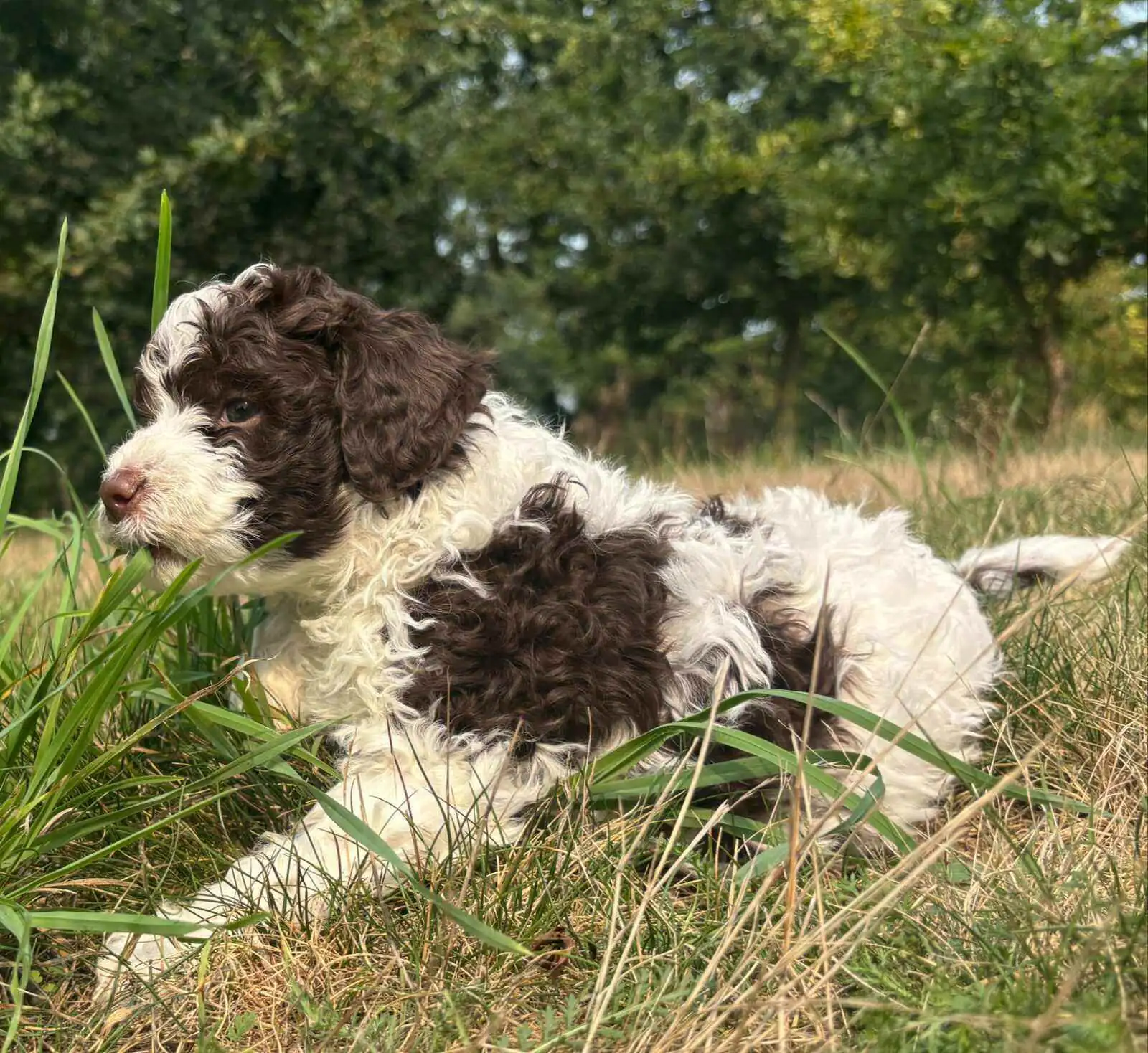
The Lagotto Romagnolo. Centuries of purpose behind every curl.
Two Very Different Dogs That Look Vaguely Similar
At a glance, a Lagotto Romagnolo and a Goldendoodle share curly coats and friendly faces. That's roughly where the similarity ends.
The Lagotto Romagnolo is an ancient Italian breed with centuries of documented history, originally a water retriever in the marshlands of Romagna, later refined as the world's only breed specifically developed for truffle hunting. Recognized by the AKC in 2015, the Lagotto has been carefully preserved by Italian breeders for generations. They're medium-sized dogs, typically 24 to 35 pounds, with a dense, woolly, waterproof double coat.
A Goldendoodle is a cross between a Golden Retriever and a Poodle, first intentionally bred in the 1990s. They are not a recognized breed by any major kennel club. Goldendoodles vary significantly, anywhere from 15 to 90 pounds depending on the Poodle parent, and their coats range from straight to wavy to curly, even within the same litter. There is no breed standard governing what a Goldendoodle should look or act like, because they are not a breed. They are a cross.
That distinction matters more than most people realize.
Side-by-Side Comparison
The Predictability Question
When you choose a purebred dog from a responsible breeder, you're choosing from a population that has been selectively bred for generations, not just for looks, but for temperament, working ability, health, and structural soundness. Over time, this produces dogs with consistent, predictable characteristics. You know roughly how big your puppy will be. You know what kind of coat to expect. And critically, you have a reasonable sense of what that dog's temperament will be like.
With a crossbreed, that predictability disappears. A first-generation Goldendoodle can inherit any combination of traits from either side. You might get a dog with a Poodle's reserved, watchful nature, or a Golden's exuberant friendliness, or something in between, and there's no reliable way to know in advance.
When families visit us in Lynden, I can tell them with confidence what to expect from a Lagotto: a loyal, intelligent dog with a strong nose, moderate energy, and a calm self-assurance that develops naturally with proper socialization. That confidence comes from knowing the breed, knowing my lines, and knowing the parents. A Goldendoodle breeder, no matter how well-intentioned, cannot offer that same level of certainty because the genetic dice are being rolled differently with every litter.
What the Science Says About Temperament
This is where I want to be careful, because the anecdotal evidence I hear from families aligns with the research, but the research deserves to speak for itself.
Peer-Reviewed Research · Click to expand
I want to be fair. These are population-level studies. They describe trends across thousands of dogs, not guarantees about any individual animal. There are wonderful, well-tempered Goldendoodles, just as there are difficult Lagottos. But when you're choosing a puppy that will be part of your family for the next 14 to 17 years, trends matter. And the trend lines point clearly toward purebred dogs from selective breeding programs producing more reliably stable temperaments.
Where I Have Changed My Mind
Earlier in my career I assumed that anyone considering a Goldendoodle was uninformed. That position was wrong, and the research has helped me see why.
I have met responsible Goldendoodle breeders. Not many, but they exist. They health-test both parents. They place puppies thoughtfully. They support their families after placement. Their litters are not the ones the research is describing. The behavioural variability that the studies document is mostly a function of the unregulated middle of the doodle market, backyard breeders, puppy mills, brokers, and not of the small minority of people who are doing the work seriously.
My frustration is not with crossbreeds as a category. It is with the absence of community standards. A Lagotto buyer can ask any responsible breeder the same set of questions and get answers measured against the same standard. A Goldendoodle buyer cannot. That is the actual problem, and it is the one I want families to understand before they choose.
The “Hypoallergenic” Question
This is probably the most common reason families consider both of these breeds. Many of the people who contact us have an allergy sufferer in the household, and coat type isn't a preference. It's a medical necessity.
No dog is truly hypoallergenic. What families actually need is a dog that produces less dander and doesn't shed heavily, because dander, not fur itself, is what triggers most allergic reactions.
The Lagotto Romagnolo has a dense, woolly double coat made of hair rather than fur. It does not shed in the way most dogs do. You won't find clumps of hair on your couch or clouds of fur drifting through your house. The coat grows continuously and requires regular grooming, trimming every six to eight weeks to keep it at a manageable length, with occasional spot-combing to loosen mats before they tighten. A Lagotto coat should never be fully combed out, just gently worked where a mat is forming to keep it from becoming unmanageable. This coat type is consistent across the breed because it's been selected for over centuries.
We routinely send coat clippings to families so they can test their sensitivity before committing, and we always welcome people to visit our home in Lynden to spend real time with our dogs, playing, snuggling, getting their face right into that curly coat. If you're going to make a 15-year commitment, you should know how your body responds first.
With Goldendoodles, coat type is a gamble. Some inherit a Poodle-like coat that sheds minimally. Others inherit the Golden Retriever's double coat and shed substantially. Even within a single litter, you can see different coat types. If low shedding is a medical necessity for your family, this unpredictability is a serious concern.
Health Testing: The Gap Most Families Don't Know About
This is where I feel most strongly, and it's where the difference between a purebred breeding program and most crossbreed operations becomes most consequential.
Responsible Lagotto Romagnolo breeders follow health testing protocols established by the Lagotto Romagnolo Club of America. That means OFA hip and elbow evaluations, CERF eye examinations, patellar luxation screening, and DNA testing for breed-specific conditions including Benign Familial Juvenile Epilepsy, Lagotto Storage Disease, and hyperuricosuria. This is standard practice. It's what the breed community expects of its breeders.
I also invest significantly in genetics at the front end. Stud fees for quality pairings run as high as $7,000, and importing dogs from European programs to strengthen our lines has cost as much as $11,000 per dog. Every breeding decision we make is aimed at producing puppies that are healthy, temperamentally sound, and true to the breed's heritage.
The Goldendoodle world operates differently. Because Goldendoodles are not a recognized breed, there is no breed club setting testing standards and no code of ethics breeders are expected to follow. Some Goldendoodle breeders do health test, and I respect the ones who do, but many don't, and buyers often have no way of knowing the difference.
When families ask us about our health testing, we're always happy to share everything, every test, every result, every clearance on both parents. We don't lead with paperwork because I'd rather first help families understand why testing matters and what questions to ask any breeder. But the documentation is there, and it's comprehensive. That paper trail exists because the breed community demands it.
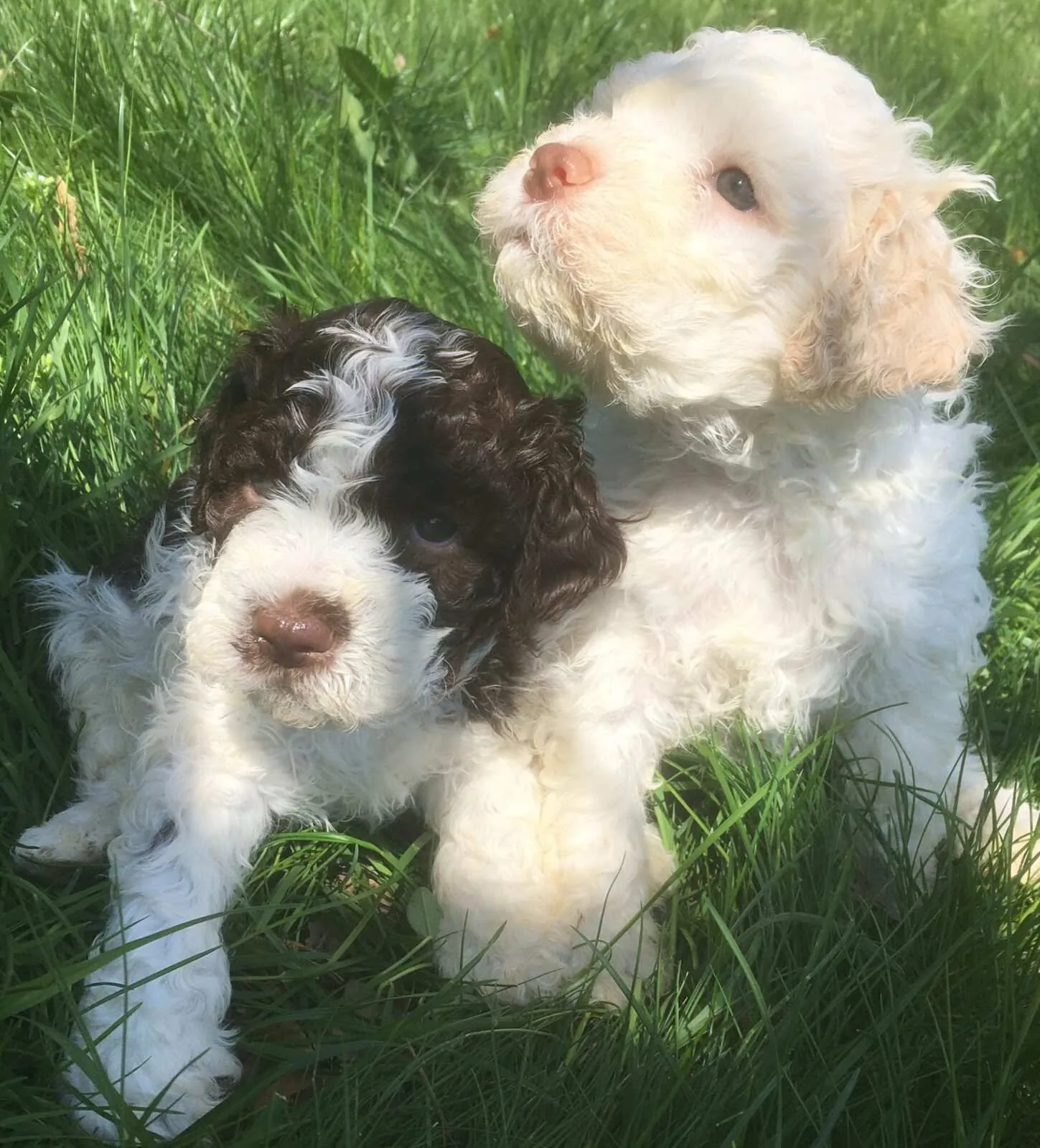
The part that matters most. This is what the research is protecting.
Living With Each Dog: Daily Life
Beyond the science and the health testing, there's the practical question of what it's actually like to share your home with each of these dogs.
| Lagotto Romagnolo | Goldendoodle | |
|---|---|---|
| Type | Purebred, a recognised breed with a written standard and a breeder community. | Crossbreed, Golden Retriever × Poodle, with no breed standard. |
| Predictability | High. Size, coat, and temperament are consistent litter to litter. | Variable. Peer-reviewed studies find more behavioural variation than either parent breed; traits differ within a single litter. |
| Coat & shedding | Consistently non-shedding wool, selected over centuries. | Ranges from minimal to considerable shedding, even between littermates. |
| Adult weight | 24–35 lb. A predictable small-to-medium. | 15–90 lb. Toy, mini, and standard lines span an enormous range. |
| Lifespan | 15–17 years. | 10–15 years, depending on size and lines. |
| Energy & daily life | Engaged but not frantic; a genuine “off switch” in the evening. | Tends to run higher; many owners describe wonderful-but-exhausting first years. |
| Health testing | A defined CHIC panel and a breed community holding breeders to it. | No breed body; testing depends entirely on the individual breeder. |
| Typical price | $4,000–5,000 (up to ~$10,000 for exceptional lines). | $2,000–5,000+, often uncorrelated with health testing. |
Lagottos are workers. They were bred to spend hours searching for truffles underground, a task that requires focus, independence, and a willingness to work methodically in partnership with their handler. That working heritage shows up in daily life as a dog that's engaged but not frantic, active but not hyperactive. Lagottos have what I describe as an "off switch". They can go hard on a hike or a scent-work session, then settle calmly at your feet in the evening. They need mental stimulation more than they need constant physical output, though they enjoy both.
A well-socialized Lagotto is confident and self-possessed, not anxious. They warm up on their own terms. For families who value a dog that's devoted rather than indiscriminate, this temperament is deeply satisfying.
Mark Nelson, Northwest LagottoLagottos are genuinely loyal in a way that goes deeper than surface friendliness. They bond closely with their family and can be reserved with strangers until they've taken your measure. This isn't shyness. It's discernment.
Goldendoodles, drawing from both the Golden Retriever and the Poodle, tend to run higher energy overall. The Golden side brings exuberance and eagerness to greet everyone as a potential best friend. The Poodle side brings intelligence and, sometimes, a nervous sensitivity that can manifest as reactivity if not well-managed. Combined, you often get a dog that's intensely social, sometimes to the point of struggling with separation, and that requires significant daily exercise to stay balanced.
Many Goldendoodle owners I've spoken with describe their dogs as wonderful but exhausting, especially in the first two to three years. Mouthiness, jumping, leash-pulling, and separation anxiety are commonly reported. These aren't flaws unique to Goldendoodles. They're what happens when two high-energy, highly social breed profiles combine in a dog that's also very smart and very strong.
Cost and Value
Lagotto Romagnolo puppies from responsible breeders typically range from $4,000 to $5,000, with some programs charging up to $10,000 for dogs from exceptional lines. Our puppies are $5,000, which reflects European bloodlines, comprehensive health testing, genetic screening, early neurological stimulation, puppy culture socialization, and the intensive hands-on raising we do for the first eight weeks.
Goldendoodle puppies range more widely, from $2,000 to $5,000 or more. The price often does not correlate with the level of health testing performed.
I'd encourage any family to think about cost not as a purchase price but as a long-term investment. A well-bred puppy from health-tested parents, raised with proper socialization, is dramatically less likely to develop the behavioral or medical problems that drive up costs over a dog's lifetime. Emergency veterinary visits, behavioral training to address anxiety or aggression, and medications for preventable genetic conditions can easily exceed the initial purchase price many times over.
Who Should Choose Each Dog
I'm not here to tell anyone that Goldendoodles are bad dogs. They aren't. In the right home, with the right training, with a dog from a breeder who genuinely health tests, a Goldendoodle can be a fine companion.
But I think families deserve honest information. If you're looking for a dog with a predictable temperament, a consistent non-shedding coat, a heritage of working partnership with humans, and the backing of a breed community that holds its breeders to documented standards, a Lagotto Romagnolo from a responsible breeder offers all of that.
If you value knowing exactly what you're getting, not hoping, not guessing, but knowing. That's what a breed standard and a rigorous breeding program provide. It's what I've spent eleven years building, and it's what every puppy that leaves our home carries forward.
Choose aLagotto if…
- You want a predictable temperament, size, and coat, not a roll of the genetic dice.
- A consistently non-shedding coat matters to your household or your allergies.
- You value a documented health-testing panel and a breed community that enforces it.
- You want a working heritage and a dog with a genuine off switch at the end of the day.
- A 15–17 year companion, and knowing rather than hoping, is worth the investment to you.
Consider aGoldendoodle if…
- You are drawn to the Golden-Retriever exuberance and openly social temperament.
- You accept real variability in size, coat, and shedding, even within one litter.
- You have the energy for what many owners call a wonderful-but-exhausting first few years.
- You will do the work to find a breeder who genuinely health-tests, since no breed body requires it.
- A specific look or a particular breeder's line is what's drawing you, eyes open to the trade-offs.
Frequently Asked Questions
Is a Lagotto Romagnolo more hypoallergenic than a Goldendoodle?
Are Goldendoodles really less predictable than purebreds?
Do Lagotto Romagnolos get along with kids?
Why are Lagotto Romagnolo puppies so expensive?
Can Lagotto Romagnolos be trained as truffle hunting dogs?
Can I visit to see how I react to a Lagotto's coat before buying?
Considering a Lagotto for Your Family?
We'd love to hear from you. Whether you're ready to join our waitlist or just have questions about the breed, reach out, no pressure, just a real conversation.
If you have allergies and want to test your response before committing, we're happy to send coat clippings or welcome you to visit our home in Lynden.