The families who find their way to this question usually started somewhere else. They pictured the outdoor life with a dog in it — hiking, the lake, the dog in the back of the truck — and the breed that came to mind first was a Lab, or a Golden, or a Vizsla.
Then they learned what those dogs leave on the couch, the car, and every black sweater they own, and they started looking for something that could keep up without the fur. That’s a reasonable thing to want. The trouble is what you find when you search for it.
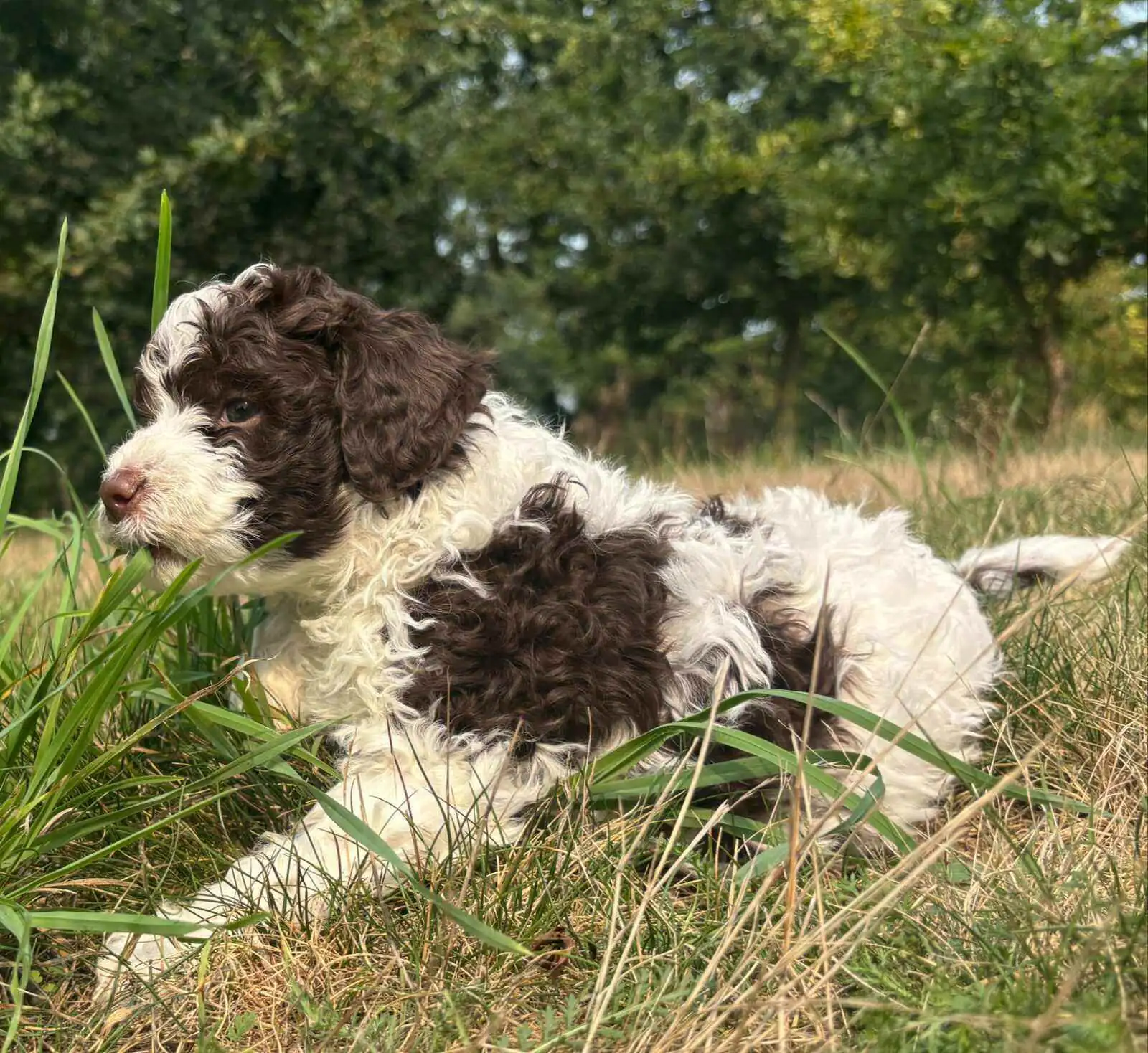
Athletic, and non-shedding. The combination is real — but it asks more of you than the lists admit.
The Two Lists That Don’t Overlap
Search “best hiking dogs” or “best running dogs” and you get athletic breeds, almost all of which shed heavily: Border Collies, Golden Retrievers, Vizslas, Weimaraners, Huskies, Australian Shepherds. Great dogs, wrong half of the question.
Search “dogs that don’t shed” and you get the opposite failure. The lists fill up with low-energy companions, including Whippets (one guide cheerfully calls them “forty-mile-an-hour couch potatoes”), Maltese, Basenjis, Shih Tzus, and Chinese Cresteds, most of which would look at a six-mile trail day with quiet horror. One popular guide aimed at families literally advises active searchers to avoid high-energy working breeds, then recommends a Labradoodle as its top pick.
The dog that is genuinely both, athletic enough for a real outdoor life and non-shedding enough to spare your house, does exist. But it lives in the gap between those two lists, and the gap is where the useful information should be and usually isn’t. The few guides that try to fill it tend to default reflexively to a Standard Poodle, or pad the list with breeds that are technically low-shedding but temperamentally wrong for the job — an aloof Afghan Hound, a small terrier. Almost none of them tell you what owning one of these dogs actually asks of you.
That’s the rest of this guide. I’m not going to re-run the breed-by-breed here; I’ve written the full profiles of the purpose-bred non-shedding breeds in Beyond the Doodle: The Purpose-Bred Curly Breeds Worth Knowing, which covers the Poodle, Portuguese Water Dog, Lagotto, Wheaten, Curly-Coated Retriever and more. What this guide does instead is help you answer the harder question the lists skip: can you actually live with one of these dogs, and which one fits the life you really have?
What an Athletic Non-Shedding Dog Actually Demands
The marketing tells you about the coat. Here’s what it leaves out.
“High energy” is a daily obligation, not a quirk. An athletic dog doesn’t need a walk around the block. It needs real physical exercise and real mental work, most days, for the twelve-to-fifteen-year life of the dog. That’s easy to picture on a bright Saturday in June. The real test is the second week of February, dark at five, raining sideways, when the dog still needs an hour of something or it will find its own entertainment in your house. A bored athletic dog isn’t being difficult. It’s doing exactly what it was bred to do, with nowhere to put it. The question to ask yourself isn’t “are we an active family,” because almost everyone says yes. It’s “are we active on the days we don’t feel like it.” The real daily load is laid out in the exercise guide.
They are, mostly, velcro dogs, and that asks something specific of you. The athletic non-shedding breeds were nearly all developed to work in close cooperation with a handler — water retrieving, truffle hunting, herding — which selected for intense human focus. The Poodle, the Portuguese Water Dog, the Lagotto were bred to do a job alongside a person, and that heritage shows up as a dog that wants to be with you. In a life that includes the dog, that’s the whole reward: a partner, not an ornament. It doesn’t mean the dog can never be left. It means two pieces of early work aren’t optional: thorough socialisation, and patiently teaching the dog to settle and to be comfortable on its own. The most common stumble I see has nothing to do with exercise. It’s in that early work, and especially in one quiet habit: greeting the puppy with big, excited energy at every hello and goodbye and winding it up, when calm, low-key comings and goings are exactly what teach a dog that settling and being alone are normal and safe. For most households the real question isn’t whether you’re ever gone; it’s whether you’ll do that calm, deliberate teaching. I’ve written separately on helping a velcro breed learn to be alone.
The non-shedding coat runs hot. Here’s a tradeoff no list mentions. The coats that don’t drop hair are often dense, woolly, and warm, built to insulate a working dog in cold water. That same coat can make a hot-weather hike genuinely risky, since these dogs overheat more readily than a short-coated shedder, and the answer is not to shave the coat down, which removes the protection and can damage how it regrows. You avoid the fur on your floor; you take on shade, water, and timing your summer activity for the cool hours. Worth it for most people, but worth knowing. The coat in full is in The Lagotto Coat: What It Is, What It Needs, and What Nobody Tells You.
Off-leash freedom depends on prey drive and recall, not just energy. The fantasy is a dog running free beside you on the trail. Most athletic breeds, though, carry some prey drive, and a dog that bolts after a deer is a dog you can’t trust off-leash until you’ve put in serious recall training, and some breeds may never be fully reliable. This is one place the working heritage actually helps a scent breed like the Lagotto: its drive is a nose-down, cooperative, find-it-and-check-back drive rather than a chase-and-vanish prey drive, which makes a reliable recall more achievable. But “achievable” still means work. No breed comes off-leash-ready.
And one truth the lists never connect: no dog is hypoallergenic, and low-shedding is not the same as low-maintenance. Every dog here needs regular grooming, and if anyone in your home has allergies, the only reliable test is time with an adult of the breed before you commit. The allergy question gets its own treatment in Are Lagottos Hypoallergenic?
The First Year Is for Patience, Not Miles
If there’s one thing I press hardest with active owners, it’s this: do not start running with a young dog, and don’t rush the build-up when you finally do.
A puppy’s long bones grow from soft growth plates at their ends, and those plates don’t finish closing until around a year of age in a medium breed like the Lagotto, later in larger breeds. The long-standing orthopaedic precaution is to keep forced, repetitive, high-impact exercise — running at your pace, jogging on pavement, long forced distances, repeated jumping — off a dog whose plates are still open, because that kind of damage, unlike a pulled muscle, doesn’t heal back. It can mean malformed joints and arthritis for life. And there’s good evidence that what a puppy does early genuinely matters: in a Norwegian study that followed more than five hundred large-breed dogs from birth, those that went up and down stairs daily in their first three months had a higher rate of hip dysplasia, while those given free exercise on soft, uneven ground had a lower one. The harm tracked with forced, repetitive impact; the benefit, with self-paced movement.
The distinction that matters is forced versus free. A puppy romping in the yard, setting its own pace and flopping down when it’s tired, is doing exactly what it should. The danger is the exercise you set the pace for, the run where the dog has to keep up and can’t choose to stop.
Which brings me to the hardest part, and the reason I labour the point: a young dog will not tell you when it’s had enough. Its drive to stay with you overrides its own fatigue and the early ache of overdoing it. Being beside you matters more to it than the discomfort, so it will run itself well past its limit. By the time it shows you it’s done, lagging, lying down, stiff the next morning, it has already gone too far. You can’t use “she’s keeping up happily” as your gauge, because she always will. You have to be the one who calls it, because she won’t.
When you do start, after a year, and ideally with your vet’s nod, build slowly, the way you’d condition any athlete: begin short, add distance and pace gradually over weeks, favour soft ground over pavement, and watch for stiffness the next day. With a growing dog, later is always the safer error.
Match the Dog to the Life You Actually Live
“Active family” covers an enormous range, and the right answer shifts completely across it. Place yourself where you actually are, not where you are on your best weekend.
The weekend-walker. You like the idea of an active dog, and you’ll get out on a good Saturday, but the weekday default is a short walk and an evening on the couch. Most of the athletic non-shedders are too much dog for that, and you’d both be happier with a lower-energy non-shedding breed. The couch-potato breeds the other lists pad with aren’t a punchline for you; they’re the fit. The one way into the athletic breeds from here is a dog with a real off-switch, and even then only if you’ll put in the daily mental work on the days you’d rather not.
If you’re a genuine hiker or active outdoor family. You’re out most weekends, you move most days, and the dog comes along. This is the sweet spot for an athletic non-shedder that participates in family life, a dog that hikes hard and then settles by the fire. It’s the band most of these breeds were built for.
If you’re a runner clocking real mileage. You want a true endurance athlete for daily multi-mile runs. Among non-shedders, the Standard Poodle and Portuguese Water Dog are your serious candidates. Some of the heavy-shedding sporting breeds, a Vizsla or a German Shorthaired Pointer, will out-mile most non-shedders, and that tradeoff is yours to weigh. Not every athletic non-shedder is a distance dog.
Active on weekends, gone all week. A dog left alone ten hours a day, every day, spends most of its life by itself, and these people-bonded breeds take that hard no matter how big the weekends are. Alone-training helps, but it has limits, and a careful breeder will ask about your weekdays before they ask about anything else. This is the “not this dog, or not yet” answer. Far better to hear it now than to learn it from an unhappy dog a year in.
Where the Lagotto Fits — and Where It Doesn’t
Since this is my breed, let me set it inside that framework rather than at the top of it.
The Lagotto’s particular gift is that it is athletic but not extreme, with a genuine off-switch. An adult will hike all day, work a scent for hours, and then settle quietly at your feet in the evening. It doesn’t carry the relentless, must-be-working motor of a Border Collie or the big exuberant engine of a Portuguese Water Dog. For the active-but-not-marathon family that’s home reasonably often, that combination is close to ideal: enough dog to share a real outdoor life, not so much that it runs the household.
Where it’s the wrong call: if you’re a serious-mileage runner who wants a tireless distance machine, the Lagotto isn’t quite that dog. If your home is empty all day, the velcro attachment becomes real distress. And if you want a wash-and-wear dog you can largely leave to itself, this isn’t the breed, or really the category. One of the breeds in the breed-by-breed guide may suit you better, and I’d rather point you there than oversell mine.
A Word on Training the Athletic Non-Shedder
The active-dog corner of the internet is saturated with “balanced” trainers and e-collar advice, often attached to the same off-leash-freedom fantasy that draws people to these breeds. I want to be direct about this, because it matters more for non-shedding breeds than the advice ever admits: the curly, woolly, purpose-bred non-shedders tend to be soft, sensitive dogs, and correction-and-compulsion methods don’t make them reliable. They make them anxious, and an anxious sensitive dog gets less reliable, not more.
You can absolutely have a trustworthy off-leash athletic dog. You get there with the right breed, genuine time, and force-free, relationship-based training, not a shock collar on a dog bred to read your every move. The evidence on this isn’t subtle: controlled work on companion dogs finds that those trained with aversive methods show more stress behaviour, higher cortisol, and a more pessimistic outlook than dogs trained with rewards, both during training and after it, which is why the veterinary behaviour bodies now recommend reward-based methods only. The owners who struggle most with these breeds are very often experienced dog people applying the harder-handed methods they learned decades ago to a temperament those methods quietly damage. The methods and resources I actually recommend are in Training Resources.
The Shortlist — Then Go Deeper
So which dogs are genuinely both? Briefly, and as a pointer rather than a profile: among the purpose-bred non-shedders, the real athletes are the Standard Poodle and Portuguese Water Dog (the two biggest engines), the Lagotto Romagnolo (athletic-but-not-extreme, with the off-switch), the Soft-Coated Wheaten Terrier and Curly-Coated Retriever, and the Barbet. A few outside the curly family belong in the athletic-non-shedding conversation too: the Airedale and Standard Schnauzer (wiry coats, real working drive) and the Irish Water Spaniel, each with its own demands worth researching carefully.
I’m not profiling them here; that’s a separate job, and I’ve already done it elsewhere. For the full breed-by-breed — temperament, size, coat, health, and who each one is and isn’t for — see Beyond the Doodle: The Purpose-Bred Curly Breeds Worth Knowing. And the same rule from that guide applies here: once you’ve found the breed that fits your life, the breeder matters more than the breed.
Common Questions
What dog is athletic but doesn’t shed?
Is there a non-shedding dog that can hike all day?
Can I run or hike with my puppy?
Are high-energy dogs that don’t shed low maintenance?
I’m active on weekends but work full-time. Is an athletic dog right for me?
Do I need an e-collar to train an athletic dog for off-leash?
What’s a good low-shedding dog for a not-very-active family?
Mark Nelson
Northwest Lagotto · Lynden, Washington
If the Lagotto Is Your Kind of Athletic
This guide is meant to help you choose the right dog for your real life, not necessarily mine. If you’re a serious-mileage runner, or your home sits empty all day, another breed here will serve you better, and I’d rather you choose it confidently.
But if you’re the active-but-home-sometimes family this breed was made for — a dog that shares the trail and then settles by the fire — the next step is a conversation. You can read the breed in full on The Breed, see the full breed-by-breed in Beyond the Doodle, or compare the Lagotto directly with the Portuguese Water Dog or Standard Poodle.