This property began with truffles.
Before the dogs, before the flights to Italy, before the kennel name, a man stood in the damp spring air of a Pacific Northwest morning and planted the first of three hundred inoculated oaks into freshly turned soil. Three European truffle species were distributed through their roots. Melanosporum. Aestivum. Borchii. The names belonged to another continent. The soil was ours.
Three years later he was walking a hillside in Lugo di Romagna, in the province the breed takes its name from, to pick up a black-and-white Lagotto puppy. She would become the foundation of a program. She had never seen Washington state. But in a sense, she was already coming home.
What follows is the essay I wish someone had handed me before any of this began, the biology, the chemistry, the forests, the history, the harvest methods that are quietly destroying an industry, and the simple hide-and-seek game any family can play with a puppy from the day it comes home. All of it true. All of it connected. All of it, in the end, about one of the oldest working partnerships between an animal and a human on the planet.
Before the Dog, the Fungus
To understand why a Lagotto Romagnolo does what it does, you have to begin somewhere that has nothing to do with dogs at all.
A truffle is not a root, not a tuber in the botanical sense, not a vegetable. It is the sexual fruiting body of an ectomycorrhizal fungus, the reproductive organ of an underground organism that lives, year after year, as an invisible web of threads woven through the soil around the roots of specific trees. The threads are called hyphae; the network they form is the mycelium. The mycelium is the organism. The truffle is only its fruit.
What makes this fungus remarkable is not that it exists underground. Many fungi live in soil. What makes it remarkable is that it cannot live alone. Every culinary truffle species on earth, European, North American, Asian, Australian, survives only by forming a specific kind of partnership with the roots of a specific host tree. The fungus wraps itself around and into the fine root tips, forming a structure called a mycorrhiza: a living, cellular interface where the tree and the fungus meet and trade.
The tree gives the fungus sugars, carbohydrates produced above ground by photosynthesis, which the fungus cannot make for itself. In return, the fungus gives the tree water, phosphorus, nitrogen, and other mineral nutrients that its thread-like hyphae can reach far more efficiently than any root. The relationship is so old that it predates flowers. Many of the oaks and hazels and Douglas firs in our forests cannot thrive, and sometimes cannot survive, without their fungal partners.
This is the first thing most people do not know about truffles: you cannot farm them the way you farm carrots. You can only create the conditions in which the partnership might form, plant the right host tree, inoculate its roots with the right fungal spores, and wait. The wait is long, typically four to ten years for a cultivated European black truffle to begin producing, sometimes more. The partnership either takes or it doesn’t. There is still real mystery in why.
The second thing most people do not know is why truffles smell the way they do. Ordinary mushrooms, the kind that push up through leaf litter and wait to be eaten by deer or disturbed by wind, release their spores above ground, where air currents carry them away. Truffles cannot do this. They fruit below the soil. Their spores cannot catch a breeze. For the fungus to reproduce, something has to find the truffle, dig it up, and eat it, passing the spores through its digestive system and depositing them, with a convenient dose of fertiliser, somewhere else in the forest.
The truffle’s aroma, in other words, is not a gift to chefs. It is an advertisement to animals. Every volatile molecule rising from a ripe truffle is a signal directed at the nose of a squirrel, a deer, a wild pig, a flying squirrel, or, in our particular ecological moment, a dog.
The Brûlé
Around a productive European black truffle tree, a striking feature often appears: a zone, typically three to eight metres across, where almost nothing grows on the ground. The French word for it is brûlé, “the burn.” The fungus produces volatile metabolites that suppress competing vegetation, creating a bare ring that is visible from above even when the truffle itself is not.
The brûlé is a marker of a mature, productive colony. Growers look for it. Dogs trained on one orchard often alert more readily inside it. It is one of the most striking visible signs of an organism that otherwise spends its entire life out of view.
Streiblóva et al., 2012, FEMS Microbiology Ecology; García-Montero et al., 2024, Plant and Soil
Everything that follows in this essay, the dogs, the hunters, the markets, the Italian flights, the English oaks in Lynden, the Douglas firs of Oregon and British Columbia, flows from this single evolutionary fact. The truffle smells because it needs to be found.
Why the Nose Found It Before the Fork
Humans have been eating truffles for at least three thousand years. The Romans wrote about them. The Greeks speculated about them. Pliny the Elder, in the first century, recorded a widely-held view that they were produced by autumn thunder, the kind of origin theory people reach for when the thing in question appears, unaccountably, out of the ground.
For almost all of that history, truffles were found by pigs.
It is easy to understand why. The domestic pig, particularly the sow, is a rooting animal with an extraordinary sense of smell and an innate willingness to push its snout into the soil looking for food. It also happens, for reasons that took science a long time to work out, to find the aroma of certain ripe truffles irresistible. In 1981 the researcher Claus published a paper proposing that what was attracting the pigs was 5α-androstenol, a pheromone-like steroid found both in mature truffles and in the saliva of boars. The theory was elegant: the sow smelled what she mistook for a suitor, and dug. For nine years this was accepted as the explanation.
It was wrong. In 1990 Thierry Talou, working in Toulouse, ran a careful experiment. He buried three substances in soil: androstenol, synthesised truffle aroma, and real truffles. The pigs ignored the androstenol. They made straight for the real truffles and for the synthetic aroma, which had no androstenol in it at all. The molecule the pigs were actually tracking, the key signal above the background noise of the forest floor, was a simple sulphur compound called dimethyl sulphide.
The chemistry matters because it explains something practical. A truffle produces very little DMS while immature. The concentration rises sharply as the spore-bearing tissue matures, the signal the fungus is broadcasting, in effect, is I am ready; come and disperse me. A trained dog detects the ripe signal and largely ignores the unripe one. A raking hunter, by contrast, detects nothing: the rake cannot tell mature from immature and drags up both. We will return to the cost of that difference, which is considerable.
Pigs worked for centuries despite three serious problems. The first was weight: a 180-kilo sow is difficult to move through undergrowth and worse to load into a vehicle. The second was appetite: the sow liked the truffle as much as her owner did, and in the seconds between her indication and his spade she was often faster to the food. The third was the one that, in the end, finished the pig as a truffle-hunting animal: they are enthusiastic diggers. A sow excavating a truffle does not work the way a trained dog does. She rips open the soil. She breaks the mycelium. She destroys future crops in the process of harvesting this one.
In 1985 Italy made it illegal to hunt truffles with pigs. The reasons stated in the law were ecological. The practical effect was to cement a transition that was already under way across Europe: from pig to dog, from destructive rooting to precise indication, from the tartuficoltore who tolerated his pig to the tartufaio who worked with one.
And among the dogs, one breed had been preparing for the job for a very long time.
What Dogs Are Actually Smelling
More recent work has refined Talou’s 1990 finding. Researchers using gas chromatography alongside canine olfactometry have identified a small cluster of volatile sulphur compounds, dimethyl sulphide and dimethyl disulphide most prominent among them, as the signature that trained dogs converge on most consistently across multiple truffle species.
Other compounds matter too. Tuber melanosporum releases 2-methylbutanal and 3-methylbutanal; Tuber magnatum, the Italian white, is characterised by bis(methylthio)methane. The dog is not tracking one molecule in isolation. She is reading a concentration gradient across a complex aromatic fingerprint, and distinguishing it from the enormous background chemistry of a living forest.
Talou et al., 1990; Splivallo et al., 2011, New Phytologist; Strojnik et al., 2022, Molecules
The Only Breed Bred for This
There is a painting by Andrea Mantegna on the west wall of the Camera degli Sposi in Mantua, finished around 1474. In the lower corner of the fresco, behind the family of Cardinal Francesco Gonzaga, a small curly-coated dog is watching the viewer. If you put that dog beside a photograph of a modern Lagotto Romagnolo, the resemblance is not approximate. It is exact. The dog has not changed.
The breed comes from the Romagna, the eastern strip of the Italian province now called Emilia-Romagna, where the River Po once drained into a vast system of brackish marshlands and lagoons called the valli. The local people who worked those marshes were called the Vallaroli, and their dogs, from the local word lago, meaning lake, were Lagotti. For centuries their job was to retrieve waterfowl. They swam in cold water, worked through reeds, carried birds back to hunters in punts. The coat they still have today, a dense woolly double layer, naturally oily, largely waterproof, is the coat of a dog that was bred to be wet and cold without being cold and wet.
In the late nineteenth and early twentieth centuries, the marshes were drained. Agricultural land was more valuable than lagoon. The waterfowl left, and with them the working role that had justified the breed’s existence for centuries. What saved the Lagotto from simply disappearing, and what reshaped it into the dog we know now, was the fact that the same oak and poplar woodlands surrounding the drained marshes were also producing Tuber magnatum, the Italian white truffle, and Tuber aestivum, the summer black. The hunters needed a new partner. They had a curly dog with an exceptional nose, a tolerance for cold and mud, and a disposition that did not make it frantic when there was nothing to find.
Over the following generations, the Romagnoli shifted their selection pressure. The scenting ability that had located fallen ducks now located ripe fungi a foot underground. A trait that mattered especially in a wooded setting, low prey drive, so the dog did not chase deer or rabbits away from the search, was deliberately cultivated. The working Lagotto of the early twentieth century was not the working Lagotto of the sixteenth, but it was not a different breed either. It was the same animal, refined.
And then it almost disappeared again. After the Second World War the forestlands of southern Europe were damaged, truffle populations fell, and the Romagnoli began crossbreeding their Lagotti with other hunting dogs for reasons that seemed sensible at the time. By the 1970s the breed was visibly diluted, possibly beyond recovery. A small group of enthusiasts in Imola, south of Bologna, decided this was not acceptable.
In 1977 Quintino Toschi, the president of the Cynology association of Imola, began a systematic registry of every remaining dog he judged to be representative of the original type. Working with Gilberto Grandi, he spent eleven years tracking down dogs, cataloguing them, breeding the best to the best, and writing the standard that would eventually become the official one. In June 1988 they formed the Club Italiano Lagotto. The Italian Kennel Club granted official recognition in 1993. The FCI, the international body governing pedigree dogs in most of the world, recognized the breed provisionally in 1995 and fully in 2005. The American Kennel Club followed in 2015.
Today the Lagotto Romagnolo is the only purebred dog in the world recognized by the FCI as a specialised truffle-hunting breed. That designation is not a trophy. It is a description of what four centuries of selection have produced: a dog whose nose, drive, and temperament converge on a single job with a precision no cross can match.
The Lagotto was not trained into this work. The work was bred into the dog. What we do in an eight-week puppy is not teach a skill. We simply get out of the way of something that is already there.
Which is not to say the dog is a machine. A Lagotto that never meets a truffle will live a perfectly full life as a family companion and will never miss what it was never offered. But a Lagotto that is introduced to the scent, even as a game, even for fun, even once a week on a walk in the woods, tends to take to it in a way that is unmistakable. The tail goes up. The ears lean forward. The nose drops. Something happens that is older than the dog and older than you, and it is worth paying attention to.
Four Truffles, Four Terroirs
There is no such thing, botanically, as “the truffle.” There are dozens of culinary species worldwide and hundreds of non-culinary ones. For our purposes, the purposes of a Pacific Northwest kennel with a truffière on its property and a handful of native species in the surrounding forests, five species matter. Three are European fungi we have planted here. Two are native to the Pacific Northwest and grow wild within an hour’s drive of this house.
Each has a different host, a different season, a different aroma, and a different place in the world market. Tap through them.
The Interactive Terroir Table
The species the word “truffle” usually means when it is used without qualification. The most economically valuable black truffle in the world, and the species most European truffières are built around. Produces a characteristic brûlé, a bare zone around the host tree, when the colony is mature.
Market, 2026 · dog-harvested, fresh, winter peak
A few species that did not make this table, but should be mentioned: Tuber gibbosum, the Oregon spring white, is the winter white’s close relative and extends the Pacific Northwest white truffle season through June. Kalapuya brunnea, the Oregon brown truffle, was described as a new species in 2013 and remains rare but culinarily significant. And Tuber magnatum, the Italian white of Alba, the most expensive of all, has so far resisted every serious attempt at cultivation outside a narrow corner of Piedmont. It remains a creature of Italy. We did not try to plant it. Nobody else has reliably succeeded either.
The Year of the Truffle
One reason families new to this world get confused is that truffles are not a single crop with a single season. Different species ripen at different times, and in a well-managed orchard or a well-worked forest, something is in season for most of the year. Here is the annual cycle, laid out.
Seasonality
when each species is ripe enough to harvest
The most striking thing about this chart, to a Pacific Northwest reader, is the green ring. Tuber oregonense, a native Pacific Northwest species, growing in Douglas fir stands from Mendocino to Vancouver Island without any human help at all, is ripe through exactly the same months as the black winter truffle that made fortunes in Provence. The forest in Washington State is producing a culinary-grade truffle at the same time of year the markets of Périgueux are filling with theirs. It has been doing this for as long as there have been Douglas firs here, which is to say long before any human showed up to notice.
For most of the twentieth century, almost nobody did notice. That is the story of Section VII.
How This Property Began with Truffles
This is the part of the essay I have been circling around, and the part that probably ought to come with an honest disclaimer: what we did here was not conventional. A more sensible person would have bought a dog first and then, years later, if the dog had made it obvious enough, planted trees to give her something to do. I did it backwards.
In 2015 I took delivery of three batches of three-year-old inoculated oaks from a nursery that specialised in mycorrhized stock for prospective truffières. The trees had been started three seasons earlier and their roots had been inoculated with spores in the nursery greenhouse. The three species: Tuber melanosporum, Tuber aestivum, Tuber borchii. The host: English oak, Quercus robur, several hundred of them, all already carrying the European fungi I wanted to try to establish.
I should be candid about what the English oak is and is not. It is not the oak the French and Italians use. Cultivated European truffières overwhelmingly favour holm oak, Quercus ilex, for black truffles and a rotation of holm and downy oak for most commercial work. Holm oak does not grow reliably in Whatcom County, Washington; the climate is too wet and too cold and the summers are not hot enough. English oak does grow here. It is hardy to zone 5 and tolerates our winters without hesitation, and it is a documented natural host for all three of the species I wanted to try. I chose it because it was the right tree for this latitude, not because it was the ideal tree for these fungi. The trade-off was deliberate. We accepted a slower, less certain path to production in exchange for trees that would actually thrive.
We planted the rows in geometric lines. Every tree was tagged. Every row was mapped. The rows were laid out with enough spacing to run a mower between them in summer and, if a dog were one day to work the ground, to let her move in straight lines without losing track of where she had already searched. Looking at the property from the roof, which I did often, in those early years, when the young oaks were still thin enough that from any closer they looked like a field of sticks. The pattern was unmistakable. It was not a woodland. It was an orchard, and it was purposeful.
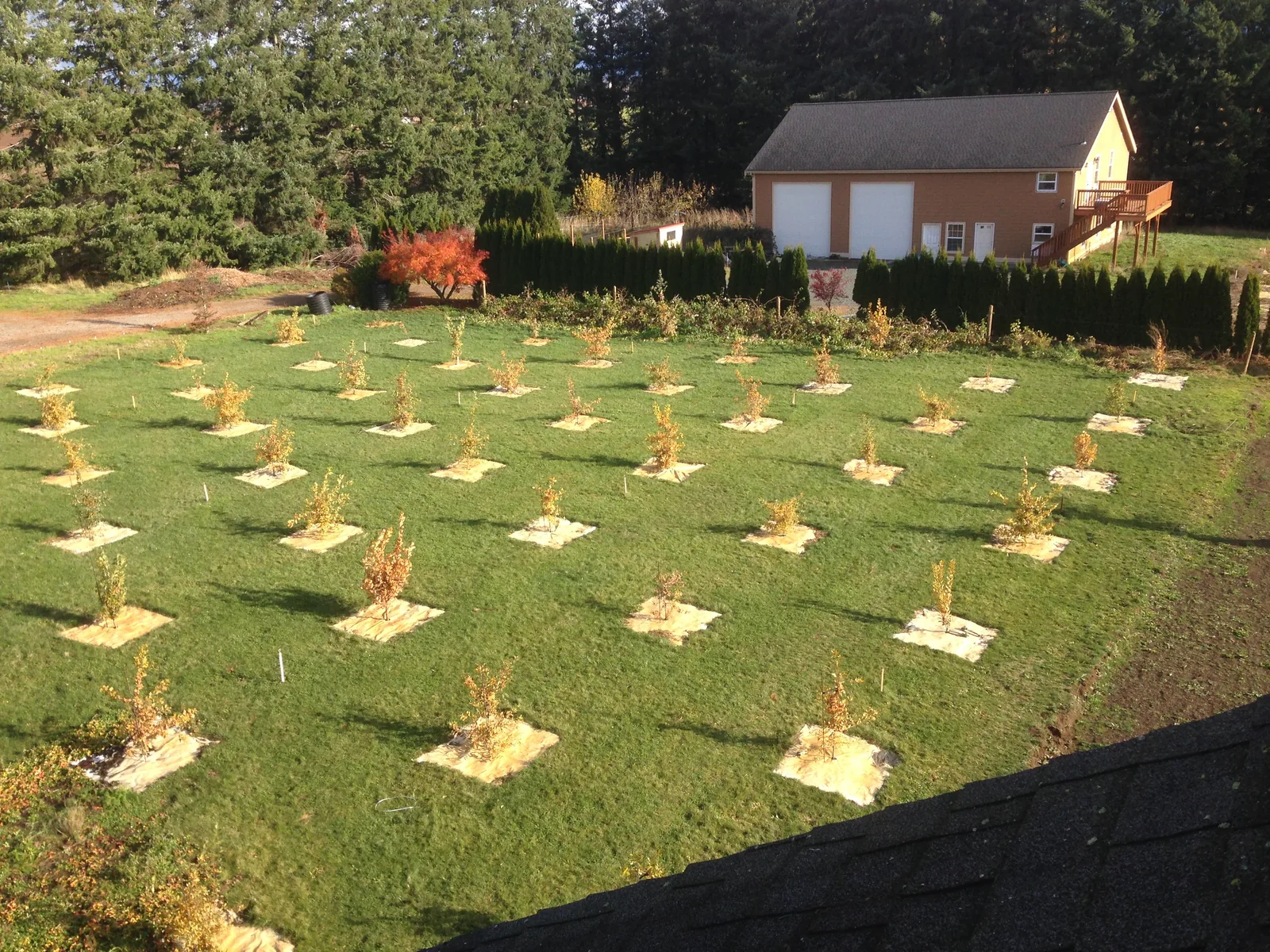
Then, in 2018, I flew to Italy.
The flights were not chosen casually. I wanted a breeder whose dogs were still working, not showing, working, and one whose lineage was traceable to the early Romagnolo registry, the bloodlines Toschi and Grandi had fought to preserve. I found one. We corresponded for months before the trip. When I finally drove the narrow roads into Lugo, it was the kind of moment pilots talk about without quite knowing how to describe: everything you have read and planned and imagined folds into a single afternoon in a kitchen with a woman who does not speak much English and does not need to, because she is showing you a litter of puppies on a tile floor and the oldest of them is watching you back.
Her name became Mocha. She was the foundation of everything we have built since. She has, in the years since, retired from breeding (she lives with friends in Lynden now, as full a life as any dog I know), but her daughters and her daughters’ daughters are the reason this kennel exists at all. And when she first came home to Washington, the first thing I did, weeks before any proper training, before the house was even done being puppy-proofed, was walk her through the rows of oaks. Let her sniff the base of each tree. Let her learn what it smelled like down there. Not because I was trying to train her, at eight weeks old, to find truffles. She was too young. But because it seemed, to me, like the right thing to do, to let the dog whose ancestors had worked European truffle woodlands for four hundred years meet the beginnings of a new one, on a different continent, in a cold Washington winter, at the start of her life.
The truffière is not a commercial operation. It is the setting this program was built inside. Every puppy raised here is raised on soil that is actively growing three European truffle species, a fact the puppy will not understand, but that will, in a small way, help shape the dog she becomes.
We are, at time of writing, eleven years in. The first small harvests of Tuber aestivum have been confirmed (aestivum is always the earliest producer in a mixed orchard); the borchii and melanosporum colonies are younger and slower. I am not a commercial truffle grower and we do not sell truffles. What we have instead is something I think is more valuable: a piece of land that is quietly becoming, year by year, what the Romagna marshlands became after they were drained, a woodland producing ripe truffles on its own schedule, tended by a curly dog whose ancestors were doing this work when the Americas were still someone else’s idea.
It is the long game. Eleven years in. Probably another five or ten before the orchard is doing what it was designed to do. The puppies we raise in the meantime get the benefit of being born into it. Which brings us, at last, to the forests around us.
The Pacific Northwest Has Its Own
A fact I find strange, and never quite get used to: you can drive ninety minutes south from this house into the Cascade foothills, or the same distance north into the fir stands of southern British Columbia, and walk into forests that produce the same calibre of culinary truffle the Italian Romagna produces, and for most of modern history, almost nobody cared.
The Pacific Northwest, in the technical mycological sense, is one of the most truffle-rich regions on Earth. The US Forest Service’s Pacific Northwest Research Station has documented more than 350 truffle species in the region. Four of them are culinarily significant: two Oregon whites (Tuber oregonense and T. gibbosum), one Oregon black (Leucangium carthusianum), and a rarer Oregon brown (Kalapuya brunnea, described as a new species as recently as 2013).
The Habitat
where Pacific Northwest culinary truffles grow
The native truffle-bearing zone runs from Mendocino County in northern California north through western Oregon, western Washington, and into the lower Fraser Valley of British Columbia, wherever Douglas fir grows west of the Cascade spine.
What these species all have in common is a single host tree: Douglas fir, Pseudotsuga menziesii, the dominant conifer of the Pacific Northwest. Every culinary truffle native to this region is a mycorrhizal partner of this one tree. Where there is Douglas fir, there may be truffles. Where there is no Douglas fir, there are almost certainly none.
The biology of the Douglas fir truffle association follows a predictable arc. A young stand, say, a plantation replanted after a clear-cut, begins colonising the soil with mycorrhizal fungi within its first few years. But productive truffle fruiting does not generally begin until the stand is around fifteen years old, peaks somewhere between twenty and forty, and tails off as the canopy closes and the forest floor is overtaken by deep duff and moss. The sweet spot for Pacific Northwest truffle hunting, counterintuitively, is not old-growth. It is the middle-aged second-growth forest, and especially the former Christmas tree plantation. Christmas trees are harvested at seven or eight years; the rootstock is left in the ground; the successor stand grows up on a disturbed soil that happens to be ideal for the fungi. Vast swaths of western Oregon and southwestern Washington that were Christmas-tree country in the 1970s and 1980s are now quietly producing the best truffle habitat in North America.
The industry around all of this started later than you might expect. Modern Pacific Northwest truffle cuisine really begins with the North American Truffling Society, founded by Dr. James Trappe and a small group of Oregon mycologists in 1977. In the same year, James Beard compared a dish made with Tuber gibbosum to its European counterparts and pronounced them essentially equivalent. A handful of chefs, Jack Czarnecki most prominently, spent the next three decades working out how to actually use the species in commercial kitchens. The Oregon Truffle Festival in Eugene, which now draws truffle dog handlers from across the country for the Joriad championship every February, began in 2006.
For most of this period the dominant method of harvesting native Pacific Northwest truffles was a landscape rake pulled through forest floor duff. That method is why, for a long time, most people who had heard of Oregon truffles thought they were mediocre. They were not. Their harvesters were.
The Rake Problem
In 2009 four mycologists, Charles Lefevre, David Pilz, James Trappe, and Randy Molina, published a report through Oregon State University and the North American Truffling Society with a title that, for anyone working in the field, was not subtle: Ecological and Commercial Issues in the Pacific Northwest Truffle Industry. The report laid out, in careful forest-service English, what a number of people had been saying more loudly for years: the dominant method of harvesting Oregon truffles was damaging the habitat and producing an inferior product.
Two ways to harvest a truffle
Raking
The rake drags horizontally through the duff layer, tearing open topsoil, breaking the fine mycelial threads that produce next year’s truffles, and pulling up ripe and unripe fruit together. Most harvested raked product is unripe, the trade buys the ripe ones by the pound and discards the rest. Forest floor damage is visible from above for a full season. Repeated raking of the same site reduces yield year over year.
Dog-harvesting
A trained dog indicates a single, ripe truffle at the surface. The handler excavates a hole roughly the size of a teacup with a small hand tool. The mycelium is undisturbed. Immature fruit in the area is left to ripen and be harvested in later weeks. Yield per acre per year is higher, quality is dramatically higher, and the site remains productive indefinitely.
The numbers in the OSU/NATS report are worth sitting with. Raked Oregon truffles, sold into the low end of the market, cleared as little as $100 per kilogram, roughly $45 per pound. Dog-harvested product from the same species, consistently ripe, graded for quality, and packaged for restaurant use, sold for eight to fifteen times that. The price difference was not a luxury tax on handler skill. It was the difference between a ripe truffle and an unripe one. It was the price of actually getting the product Douglas fir woodlands had been quietly producing for centuries.
Compounding the problem: because raked truffles were reaching the market in mixed ripeness states, Pacific Northwest truffles developed a reputation in American kitchens as inconsistent, weakly aromatic, and generally not worth the trouble compared to imported European fruit. Chefs in Portland and Seattle and San Francisco would occasionally test a shipment, find most of it flavourless, and conclude that the species themselves were inferior. The species were not inferior. They were being harvested before they were ready.
In the fifteen years since the Lefevre/Pilz report, the industry has been slowly correcting. The Bureau of Land Management has tightened restrictions on raking on federal land in favour of trained-dog harvest. The Oregon Truffle Festival publicly champions dog-harvested product and the Joriad canine championship, now in its second decade, has done more than anything else to normalise the expectation that a Pacific Northwest truffle arriving in a restaurant kitchen should smell like a truffle. Restaurant prices have followed. So has consumer awareness. Dog-hunted PNW truffles are no longer a curiosity. They are, with increasing frequency, the choice of serious chefs who have worked with both.
There is one last thing worth saying about this. The rake did not only damage the industry. It damaged the forests themselves. Mycorrhizal networks are not replaceable on human time scales, and a Douglas fir stand whose truffle-producing mycelium has been repeatedly torn up is a stand that may not produce again for decades. The dog is not only better for the business. She is better for the woodland, and for the tree she came to help.
What a Trained Truffle Dog Actually Does
Here is a fact that surprises most people when they first hear it: a trained truffle dog does not dig. Or, more precisely, a well-trained truffle dog does not dig. She walks a site methodically, often at the end of a long leash, often alongside her handler in a working rhythm the two of them have developed over years. When her nose catches the gradient rising from a ripe truffle, she slows, works the ground in concentric patterns to localise the source, and then gives her trained alert. Depending on the dog, that alert might be a sit, a paw tap, a soft nose-touch to the ground, or simply a still stance with head down and eyes fixed. It is almost never a frantic dig. That is on purpose.
When she alerts, the handler steps in. Moving the dog gently aside, they excavate the single truffle with a small hand tool, usually a blunt, narrow blade designed to slide between the root hairs of the host tree without cutting them. The excavation is small. The hole closes behind the handler. Often the handler replaces the forest floor duff so carefully that a passer-by a week later would not know anyone had been there.
The reward for the dog is not the truffle itself. A well-trained dog does not eat what she finds, and most have been taught not to be particularly interested in doing so. The reward is either food (small, high-value, delivered immediately) or play, typically with a specific toy that only comes out on hunts. The working logic is simple: find, indicate, collect reward, move on. It is a game the dog genuinely enjoys. It is also one she will play for hours if the forest is producing.
Dogs Are Not Interchangeable
A 2024 study in Scientific Reports examined how individual differences in dog behavior actually affected truffle harvest outcomes in Italian commercial truffières. The result was unambiguous: the same site worked by dogs of different motivational profiles yielded substantially different quantities and qualities of truffles. Handler skill matters. Dog breed matters. But the specific working temperament of the individual dog, her persistence, her focus, her willingness to work a low-intensity signal, mattered most of all.
The study documented what experienced handlers have said for decades: a good truffle dog is not a generic retriever. She is an individual, and the pairing of dog to site and to handler is a meaningful part of the commercial equation.
Thomas, Cuccillato, Fusani & Gobbo, 2024, Scientific Reports
A trained Lagotto working in the Pacific Northwest is, in a real sense, performing the same job her ancestors performed in Romagna five hundred years ago. The tree is different. The truffle is different. The soil is different. But the work is the same: locate a ripe fruiting body underground, indicate without damaging, move on. What has changed, and what has made the work practical here, is that the dog has arrived with the selection pressure of four centuries already compressed into her.
The Hide-and-Seek Protocol
This is the part of the essay most readers are here for, so let me say up front what it is and what it is not.
What follows is not a formal truffle-training curriculum. If your goal is to have a dog that reliably finds wild Oregon truffles on commercial hunts in four years, you will eventually want to work with a professional, Alana McGee’s Truffle Dog Company in Seattle is the one I recommend, and the Oregon Truffle Festival’s Joriad is where you end up if you go the serious route. More on both in the next section.
What this is is a hide-and-seek game any family can play with a Lagotto puppy from the day she comes home, using very simple materials, for five minutes at a time. Its goal is not to produce a commercial truffle dog. Its goal is to let a working breed do a job in miniature, to satisfy the instinct the puppy arrived with, to build confidence and handler partnership, and to give you a shared activity that will turn any walk in the woods into something more interesting for both of you.
If the game turns out to be the first step on a longer path, it will have been a good first step. If it is the last step, the dog will still have enjoyed it and so will you. Either way, the protocol is the same.
Do Not Use Commercial Truffle Oil
Most commercially available “truffle oil” on supermarket shelves is not made with truffles. It is olive oil infused with 2,4-dithiapentane, a synthetic sulphur compound manufactured from petroleum. It smells roughly like a truffle to a human nose. It does not smell like one to a dog.
A dog trained on 2,4-dithiapentane will imprint on a molecule she will never find in the wild. When she eventually enters a real forest or orchard, she will not recognize what she is supposed to find. Use real overripe truffle pieces (often available from Pacific Northwest foragers at a fraction of fresh-market price during peak season) or a tiny piece of real truffle in olive oil. If unsure, ask. This is the single most consequential decision in the whole protocol.
Splivallo, Ottonello, Mello & Karlovsky, 2011, New Phytologist; industry consensus
The Hide-and-Seek Timeline
a simple twelve-month progression, five minutes at a time
Place a tiny piece of overripe real truffle in your closed fist. Offer the fist to the puppy at nose level. When she shows any interest, sniff, paw, nose-bump, say a marker word (“yes!”) and reward from the other hand with a high-value treat. Repeat five times, twice a day. The goal at this stage is simply to build a positive association: this smell means good things happen.
5 min2×/dayfood rewardPresent both hands closed. One has the scent, one does not. Let the puppy choose. Reward when she indicates the correct hand. If she gets it wrong, do not correct, simply show her the empty hand, close, and try again. She will start to get it right more often than not within a few sessions. This is where the skill of indicating the source, rather than just reacting to a smell in the room, starts to crystallise.
5 minno correctionsend on successTuck a scented cotton pad under a couch cushion, inside a shoe, behind a door. With the puppy out of the room, plant the hide. Bring her in and say your cue word (“find it” is standard). When she alerts at the source, which she will, faster than you expect, jackpot her with multiple treats at the location. Rotate hides so she works the whole room, not one habitual spot.
indoor3–5 hides per sessionadd cueMove the game outdoors. Place the scent in a small container with holes. A metal tea ball works well, and tuck it in tall grass, under a flowerpot, wedged in a fence corner. Use your cue. Reward at the source. Ignore weather. Early success outdoors, in low-distraction settings, teaches the dog that the game moves with her.
yardno digging yettea-ball hideNow the scent is covered. Place the tea-ball under a pile of dry leaves, then under wet leaves, then under mulch. The dog must push through a physical obstacle to get to the source, which means she must be reading an aroma gradient rather than a visual cue. This is the first step that genuinely resembles forest work, and many Lagottos light up the first time they do it.
leaf covermulch covergradient readingBury the tea-ball one inch below the surface of soft soil in the yard. A flower bed works well. Cover with loose soil, no packing. Let the dog find and indicate. Teach her not to dig: when she alerts at the surface, you lift the source and reward. If she starts to paw, gently redirect by producing the reward immediately so she associates the alert, not the dig, with the payoff. This is a core skill for serious work later; do not let it slip.
1″ depthhandler digs, not dogindication not excavationProgress the depth: two inches, three, four, up to the range real truffles occupy (typically 2–15 cm). Progress the terrain: forest floor, grass, under a log. Progress the duration: ten-minute sessions instead of five. Keep the reward rate high and the failure rate low. By the end of the first year you have a dog who, whether or not she ever goes on a commercial hunt, has learned one of the oldest games her breed has ever played.
2–15 cm depth10 minforest floorA few principles that apply at every stage: keep it short, five minutes, not thirty. End on a success, always; if the last hide is frustrating her, plant an easy one and reward generously before stopping. Do not correct misses; scent work breaks down under pressure faster than any other kind of training, and a stressed dog cannot concentrate on a low-intensity gradient. And do not over-handle; the dog knows how to use her nose. Your job is to set up the problem, stay out of her way, and reward her clearly when she solves it.
By twelve months, if you have worked the protocol consistently, you will have a dog who can locate a buried scent source in any reasonable terrain. Whether you take her further, into actual forests, into actual truffle grounds, into the world of seasonal hunts and festival competitions, is entirely your choice. She has done the work that belongs to her. What comes next belongs to you.
The Hide-and-Seek Protocol: Week One to Week Fifty-Two
A designed, printable companion to this section. Week-by-week progression, materials list, troubleshooting notes for the three mistakes almost everyone makes, and a one-page reference card you can tape to the kitchen fridge.
Download the Protocol PDFWhen to Go Formal
If the hide-and-seek game has taken root, and with a Lagotto, it often does, and you are finding yourself curious about what happens next, there is an ecosystem of people and institutions ready to meet you. Three of them matter most, and they are all within an easy drive of this house.
Truffle Dog Company (Seattle) is run by Alana McGee, who has trained more working truffle dogs than almost anyone on the continent and who has, over the last fifteen years, built the most thoughtful curriculum for serious truffle dog training available in North America. The company runs in-person classes, online programs, private lessons, and, for those ready to try a real forest, guided hunts in the Pacific Northwest during season. If you want your dog to progress from backyard hide-and-seek into actual productive work, this is where that path starts.
The Oregon Truffle Festival (Eugene) happens every February and is now in its third decade. The Joriad Truffle Dog Championship, held during festival weekend, is the largest truffle dog competition in North America and has done more than any other event to establish that dog-hunted Pacific Northwest truffles belong in serious American kitchens. Even if you never compete, attending once will tell you more about the working community than a year of reading. The festival itself includes grower workshops, chef dinners, and foraging primers pitched at every level.
New World Truffieres (Eugene) is Charles Lefevre’s nursery. He is one of the four authors of the 2009 OSU report mentioned earlier, and the most experienced commercial producer of mycorrhized truffle seedlings in North America. If you are a landowner thinking seriously about planting a truffière on Pacific Northwest soil, this is the starting conversation. Lefevre does not oversell and does not promise outcomes anyone can promise. He does know, more than almost anyone else working in the region, what is likely to take and what is not.
None of these will teach you anything you cannot, eventually, figure out on your own with time and patience and a dog. All of them will compress that figuring-out into something much shorter. I have, over the years, sent a number of families who bought puppies from us to each of these three resources. None has regretted it.
What This Means for an NWL Puppy
I want to be careful, in this section, not to oversell. A puppy from Northwest Lagotto is not a different animal because of the orchard. She is not pre-trained. She is not going to arrive at your home and point out truffles in the back yard. She is, at eight weeks, a small curly puppy who will chew your furniture and misjudge her bladder and fall asleep in her food bowl, the same as any Lagotto puppy anywhere.
What she is, quietly, is a puppy who was born and raised on soil actively growing three species of European truffle. Her first smells of earth, from the moment her eyes opened, included the subtle sulphurous notes of Tuber aestivum and the faint garlic edge of Tuber borchii. I do not know what this imprints and I am not sure anyone does. I suspect it is modest. I am reasonably confident it is not nothing. And I know that in the years since we began raising puppies on this property, I have had more than one adopter write to say that their dog, the first time they encountered a real truffle, sometimes years later, sometimes completely by accident, responded as if she had met an old neighbor.
More importantly, every NWL puppy leaves here having done the first week of the hide-and-seek protocol. From around four weeks onward, during the Puppy Culture enrichment window, we start the scent-in-fist game on a small scale, using tiny real truffle pieces, timed during weaning when food motivation is high. By the time she goes home at eight weeks, the puppy has a foundational scent association already built. You do not have to start from zero. The game, as far as she is concerned, is already on.
If you never build on that, if you take her home and give her a beautiful life as a family dog and she never encounters a real truffle again, no harm done. The early imprinting does not demand to be used. But if you do carry the game forward, even casually, you will find she comes to it already leaning in.
The Three-Thousand-Year Continuity
I want to close by coming back to where this essay started, because the story only really makes sense in the long view.
People ate truffles in the Mediterranean before they wrote down history. The Egyptians wrapped them in pastry. The Romans argued about whether they were vegetables or something else. Pliny thought they came from thunder. For two thousand years the hunt was done by pigs, and for much of that time the small curly-coated dogs in the marshlands of Romagna were used for retrieving ducks, not for finding fungi. Then the marshes were drained. Then the pigs were banned. Then a group of Italian breeders in 1977 decided that a breed with no working role left was worth saving anyway, and that it could be reinvented around the partnership with Tuber.
In 2015 a man in Washington State, who had never been to Italy and did not speak Italian, planted three hundred inoculated oaks in his soil, three European truffle species distributed through their roots. Three years later he flew to Lugo and came home with a black-and-white puppy. Eight years after that he is writing this essay.
The dog on the rug beside me as I write this is descended, in a direct and documented line, from dogs working the valli of Romagna five hundred years ago. The truffles in the ground fifty feet from this desk are the same species her ancestors were finding before the word truffle existed in English. The partnership between them, between the curly dog and the underground fungus, between the nose and the mycelium, is older than the country either of us was born in. It is older than most of the institutions we live inside. It is, in some real sense, one of the oldest working relationships on Earth.
We did not invent any of this. We are not doing anything clever. We are participating, in a small Pacific Northwest way, in something that has been going on for longer than any single person can reasonably absorb. The orchard is young. The dogs are newer. But the partnership they are both part of is not new at all. It is just finding its footing, again, on a continent that did not know it was missing.
If you have read this far, thank you for the time. If you would like to talk to us about whether a Lagotto might be the right dog for your family, the waitlist page is the right place to start. If you are simply curious about the breed itself, the breed overview is a better entry point than this one. And if you are a landowner thinking about planting your own truffière, by all means write. I am not qualified to give commercial advice. I am, however, qualified to tell you about one pilot’s experience in zone 8a, eleven years in, and what I would do differently if I were starting again.
Whatever happens next, the work that has been done, has been done. The oaks are in the ground. The mycelium is in the soil. The dogs are on the rug. The partnership continues, in its small way, in a small kennel in Whatcom County, as it continued for centuries in the marshes of Romagna before anyone here was paying attention.
That feels, to me, like enough.
Sources and Further Reading
A selected list, primary research, regional reference works, and resources for readers who want to go further.
- Talou, T., Delmas, M., Gaset, A. (1990). Dimethyl sulphide: the secret for black truffle hunting by animals? Mycological Research. The paper that replaced the androstenol hypothesis with the DMS model.
- Splivallo, R., Ottonello, S., Mello, A., Karlovsky, P. (2011). Truffle volatiles: from chemical ecology to aroma biosynthesis. New Phytologist, 189(3): 688–699. The modern canonical review of truffle volatile chemistry.
- Martin, F., et al. (2010). Périgord black truffle genome uncovers evolutionary origins and mechanisms of symbiosis. Nature, 464: 1033–1038. The first complete truffle genome.
- Castellano, M. A., Trappe, J. M., Rawlinson, L., Vilgalys, R. (2010). The species of native North American Tuber. Mycologia. The paper that formally described T. oregonense as a distinct species.
- Lefevre, C., Pilz, D., Trappe, J., Molina, R. (2009). Ecological and Commercial Issues in the Pacific Northwest Truffle Industry. Oregon State University / North American Truffling Society. The foundational critique of destructive harvest methods.
- Thomas, L., Cuccillato, C., Fusani, L., Gobbo, A. (2024). Individual differences in truffle dog behavior affect truffle harvest outcomes. Scientific Reports. Quantitative evidence that dog-level variation matters.
- Streiblóvá, E., Gryndlerová, H., Gryndler, M. (2012). Truffle brûlé: an efficient fungal life strategy. FEMS Microbiology Ecology. On the bare zone around productive truffle trees.
- García-Montero, L. G., et al. (2024). Soil properties in natural and cultivated Mediterranean truffle orchards. Plant and Soil. On calcareous soil requirements for T. melanosporum.
- Rubini, A., Belfiori, B., Riccioni, C., et al. (2011). Isolation and characterization of MAT genes in the symbiotic ascomycete Tuber melanosporum. New Phytologist. On truffle sexual reproduction and orchard implications.
- Napoli, C., et al. (2010). Mycelial environment of Tuber melanosporum ascocarps. Microbial Ecology. On the microbial ecology of truffle fruiting.
- Trappe, J. M., Molina, R., Luoma, D. L., et al. Diversity, Ecology, and Conservation of Truffle Fungi in Forests of the Pacific Northwest. USDA Forest Service General Technical Report PNW-GTR-772. The regional reference on PNW truffle ecology.
- North American Truffling Society, natruffling.org, field guides, membership, regional hunts.
- Oregon Truffle Festival / Joriad Championship, oregontrufflefestival.org, annual February event, Eugene, Oregon.
- Truffle Dog Company, Alana McGee, Seattle, truffledogcompany.com, in-person and online training.
- New World Truffieres, Charles Lefevre, Eugene, newworldtruffieres.com, mycorrhized seedlings for Pacific Northwest conditions.
- Club Italiano Lagotto. Founded Imola, 1988. The organization that rescued the breed from extinction.
The Partnership, Continued
Every Northwest Lagotto puppy is raised on soil actively growing European truffles, started on the hide-and-seek protocol before she goes home, and placed with families who understand what her nose is for. We do not sell truffle dogs. We raise Lagottos. What the family does with the instinct, thereafter, is a conversation we are always happy to have.
Common Questions
What families ask about truffle work
Why is the Lagotto Romagnolo the only recognized truffle breed?
The Lagotto Romagnolo is the only breed specifically recognized by the Fédération Cynologique Internationale for truffle hunting. Centuries of selection in the Romagna marshlands produced a dog with extraordinary scenting ability, water-dog endurance, deliberately bred-down prey drive (so the dog does not chase game in the forest), and a working temperament that tolerates long, methodical searches. The breed almost went extinct in the 1970s and was rebuilt beginning with Quintino Toschi’s 1988 Club Italiano Lagotto. Today roughly 2,200-5,500 puppies are registered each year in Italy.
What truffles grow in the Pacific Northwest?
The Pacific Northwest has four native culinary truffle species: Tuber oregonense (Oregon winter white, October - March), Tuber gibbosum (Oregon spring white, January - June), Leucangium carthusianum (Oregon black, December - April), and the rarer Kalapuya brunnea (Oregon brown). All four grow in symbiotic association with Douglas fir (Pseudotsuga menziesii), typically in 15-40 year old stands and former Christmas tree plantations, from Mendocino County in northern California through southern British Columbia, west of the Cascade Mountains. The US Forest Service’s Pacific Northwest Research Station has documented more than 350 truffle species in the region.
Why is raking bad for truffle habitats?
Raking is destructive for three reasons. First, it breaks the mycelial network - the underground fungal threads that produce future truffles - directly reducing yield for years. Second, it disrupts the forest-floor litter layer where truffle spores germinate. Third, it indiscriminately harvests unripe truffles, which have little aroma and almost no culinary value; the Lefevre/Pilz/Molina 2009 OSU report explicitly attributes the Pacific Northwest’s reputation for ’lackluster’ truffles to this harvest method rather than to any deficiency in the truffles themselves. Dog-hunted PNW truffles now sell for substantially more than raked ones, and the Bureau of Land Management has begun restricting raking on federal lands in favor of trained-dog harvest.
How do I start training my puppy to find truffles?
Begin with scent pairing at 8 weeks using real overripe truffle pieces (not commercial truffle oil - most commercial truffle oil is petroleum-derived 2,4-dithiapentane and will train your dog on a compound it will never find in the wild). Hide tiny truffle pieces in your closed fist and reward interest. Progress to hidden-in-hand, hidden-in-room, hidden-in-yard, hidden-under-leaves, hidden-under-mulch, and finally buried in soil at progressively greater depths. Keep sessions short (2-5 minutes), always end on a success, and reward with food or play - never correct a miss. This protocol works whether your goal is casual enrichment on walks or eventual formal training through programs like the Truffle Dog Company.