Northwest Lagotto Announces
A Breeding of Note
MBIS · NBISS · GCHS · CHICHorizon All American × Gillenias · SwedenGillenias Elizabeth
Autumn 2026 · Lynden, Washington
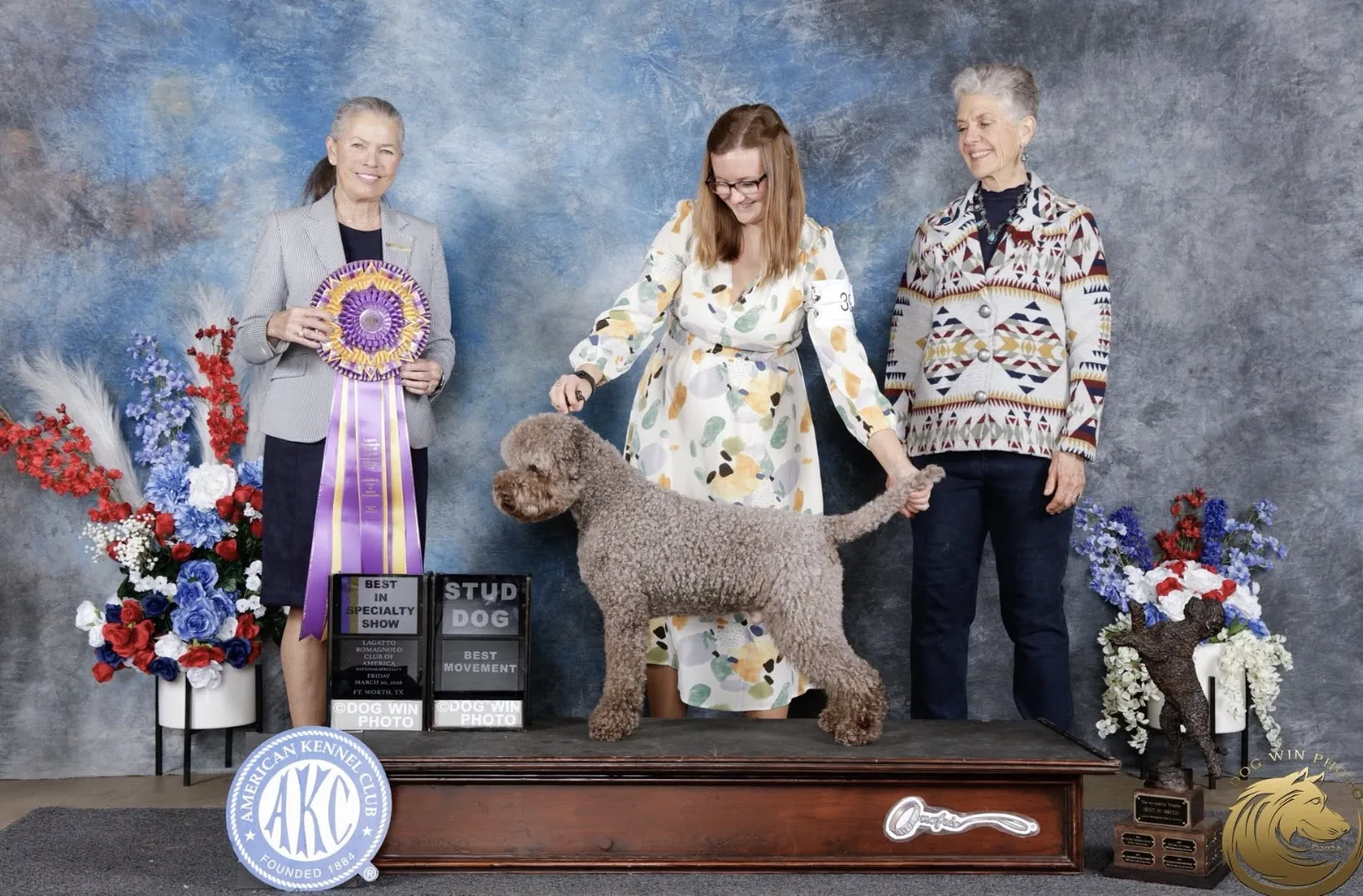
We breed once in a season, at most, and every litter exists to answer a question. The question behind this one has not changed. The dog answering it has.
In June we announced this autumn's litter as Blanca bred to Flocky, and we meant it. Frozen semen from that dog is still in Europe, in transit, and it will not clear in time. Blanca came into season last week. A bitch is bred when she is ready or she is not bred at all, and we were not going to hold a healthy six-year-old dam out of a season, or push a breeding into the wrong week, so that a shipment could catch up with a calendar.
So we went to the dog we had already vetted as the alternative, which is what a backup plan is supposed to be. We are aware of how that sentence usually reads. Read the next section before you decide this one is a step down.
The Sire
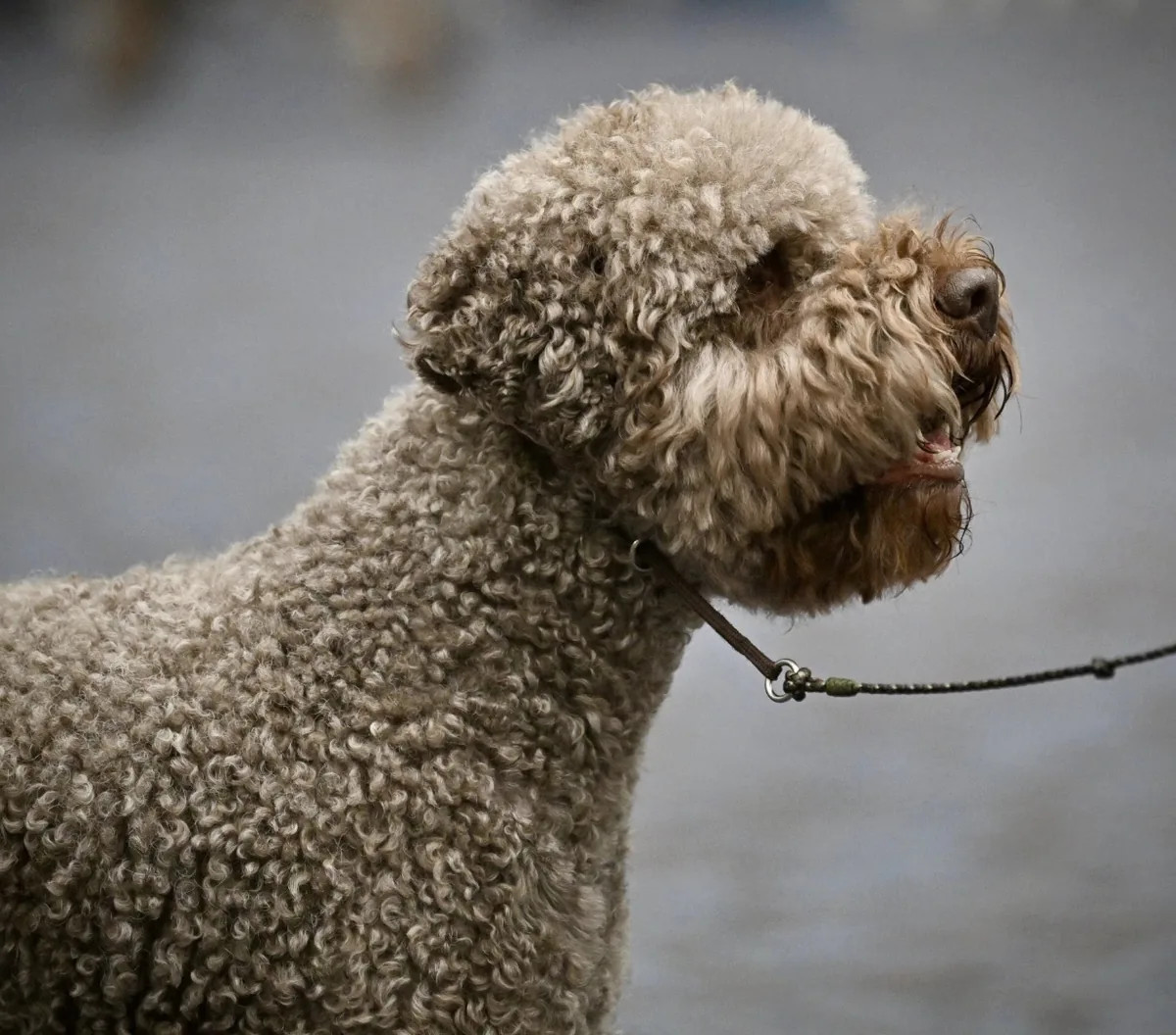
Horizon All American
Chip was bred by Laurin Howard at Horizon Lagotti, with Andrea Shaffer and Bryon Miracle also on the AKC breeder record, and is owned by Bryon Miracle in Boston, Kentucky. He was whelped on April 10, 2019. AKC SS13423001. CHIC 158187. He is one of the most successful American-bred Lagotti in the breed's short history on this continent, and the record is not a close reading:
Set that beside the dog he replaces and the comparison is not the one you were bracing for. Flocky won Best of Breed at Westminster and Best in Specialty Show at the LRCA National. So has Chip, the first a year earlier and the second this March. What Chip has on top of that is Crufts and a win at the Italian breed club’s own national championship.
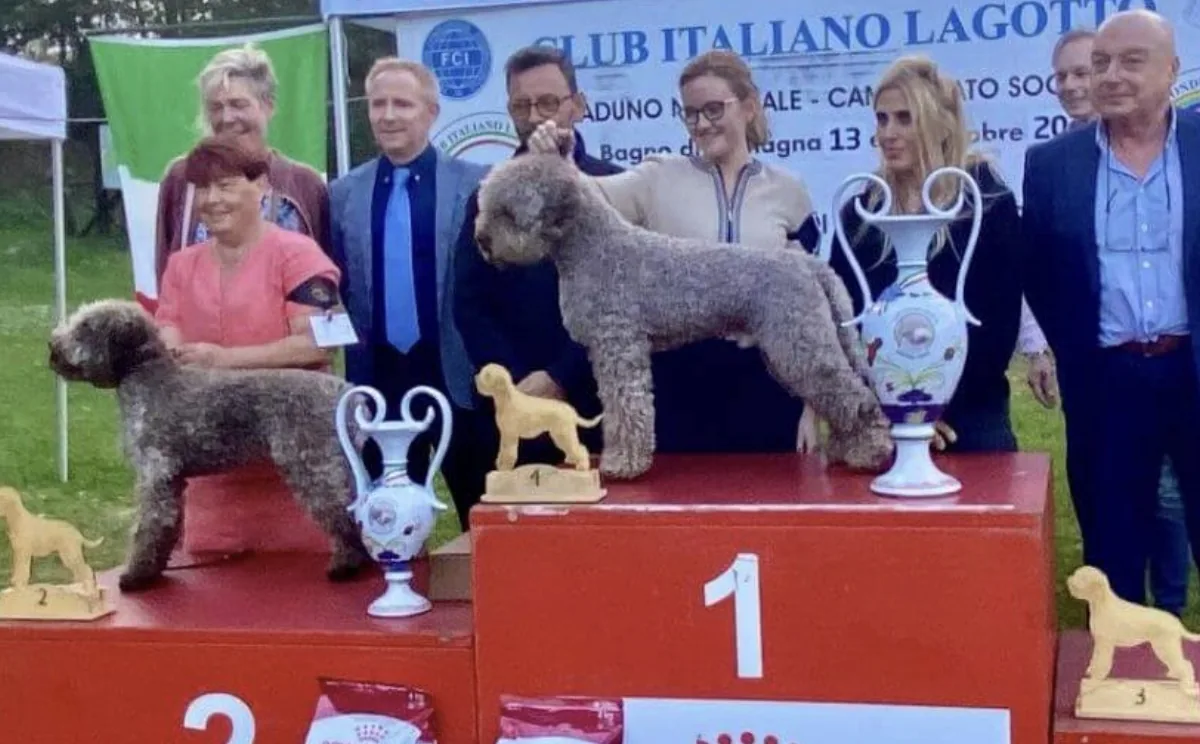
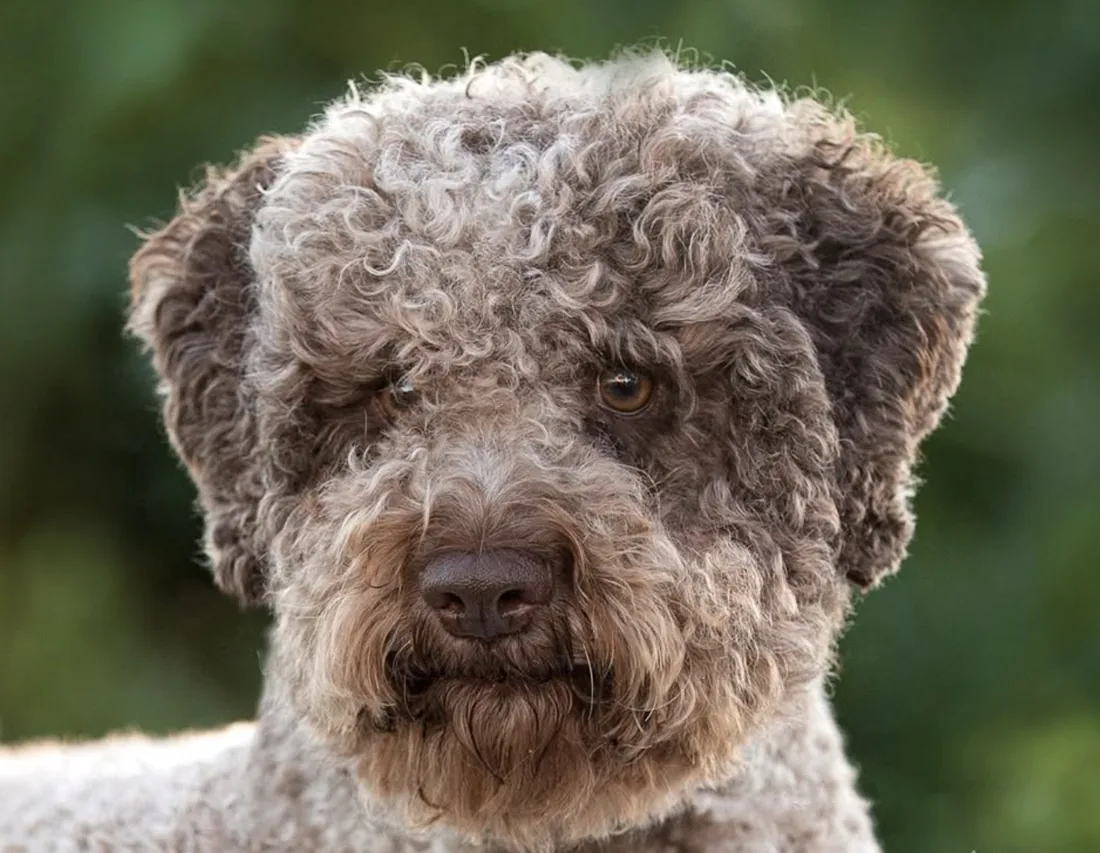
That one deserves its own sentence. Bagno di Romagna sits in the valleys the breed came out of, and the Raduno is the Italian club’s own championship, judged by Italians, in front of the people whose grandfathers bred these dogs to find truffles. An American dog does not win that on a good day and a nice haircut. Neither does Crufts, under a breed specialist, from an entry of a hundred and eleven.
He has won the breed at Westminster, at Crufts, and at the Italian club’s national. Three countries, three of the largest rings the breed has, one dog.
Two things we are stating ourselves
Flocky finished 2023 as the #1 Lagotto Romagnolo in the United States. Chip has not held that ranking. National rankings are a function of how hard and how often a dog is campaigned as much as of the dog, which is why we would not lead with one either way, but it is a line in Flocky's column and not in Chip's, and you would have found it eventually.
At Westminster this year Chip was Select Dog, not Best of Breed. That is the award to the next champion behind the winner. He won the breed there in 2022, and in 2026 was placed behind the Best of Breed winner among the champion dogs, seven years into a career. That is roughly what a long career looks like. We would rather write that plainly than let it turn up as a discovery.
The one that matters for a breeding
At the LRCA National Specialty in March, alongside Best in Specialty Show, Chip won the Stud Dog class. That class is not judged on the stud. It is judged on his get, on the quality and the consistency of the offspring he puts in the ring beside him. Every other line in the table above says a panel liked this dog. That one says a panel liked what he produces, which is the only question a breeding actually asks.
The Dam
Gillenias Elizabeth
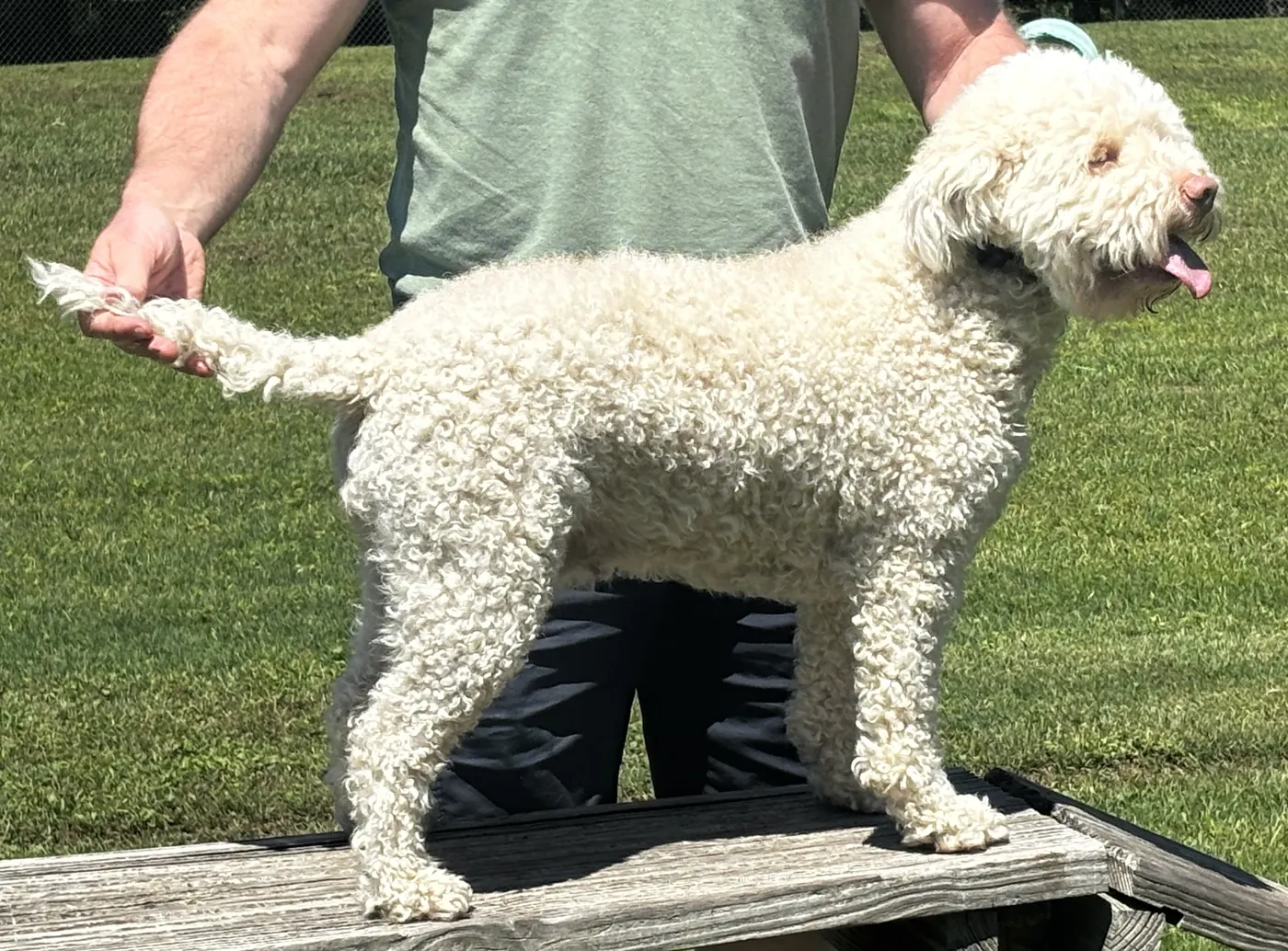
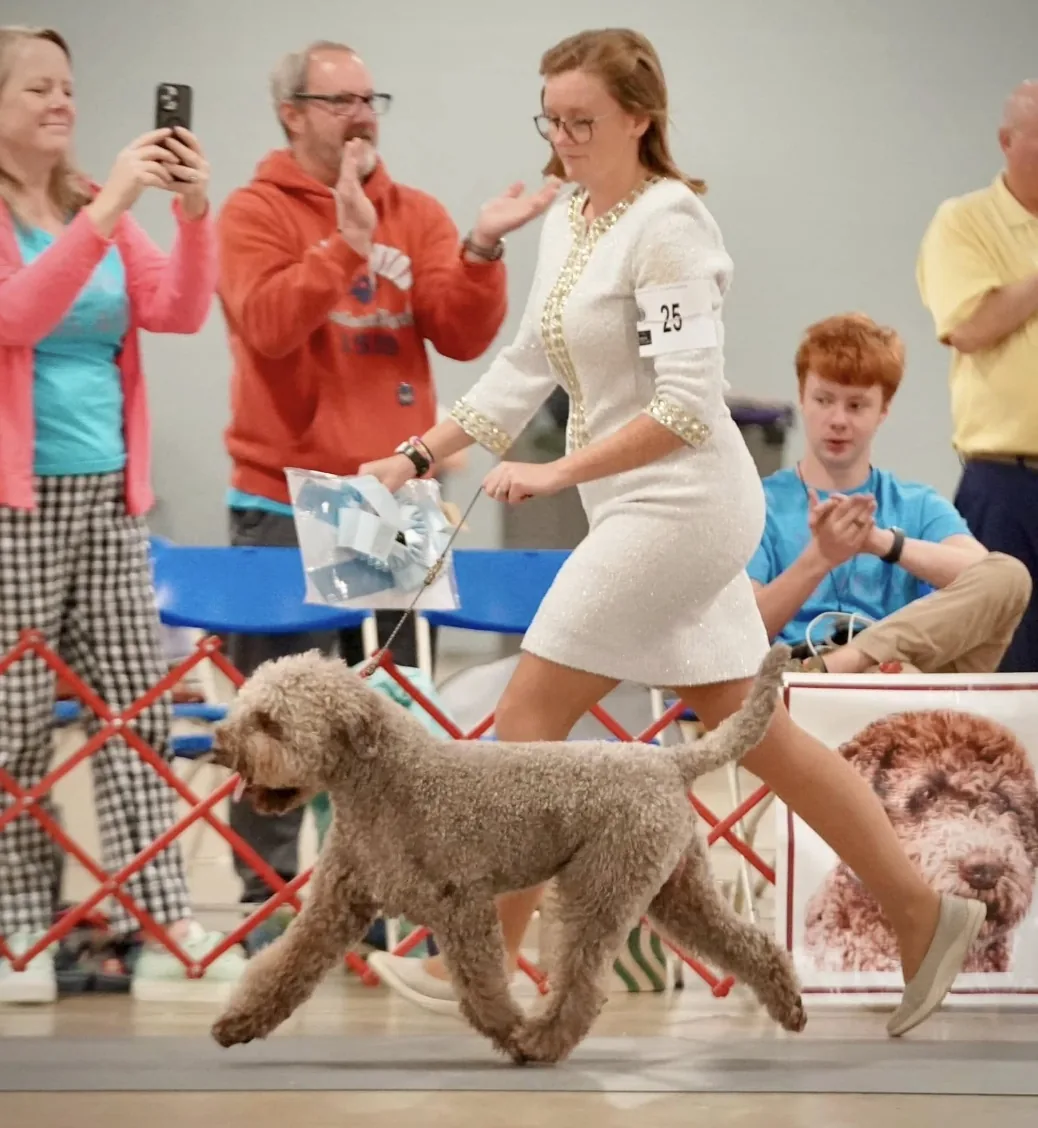
Blanca is unchanged, and she was always the deliberate half of this pairing. Bred by Anna Peterson at the Gillenias kennel in Sweden, she carries a pedigree assembled in parallel to the Italian mainstream rather than derived from it, Scandinavian selection over decades, reaching back through the Dutch Rozebottel line of Katrien van Gemert, one of the first breeders to win at Crufts with a Lagotto. Her documented pedigree coefficient of inbreeding stands at 0.65 percent, which is low for a working pedigree in this breed.
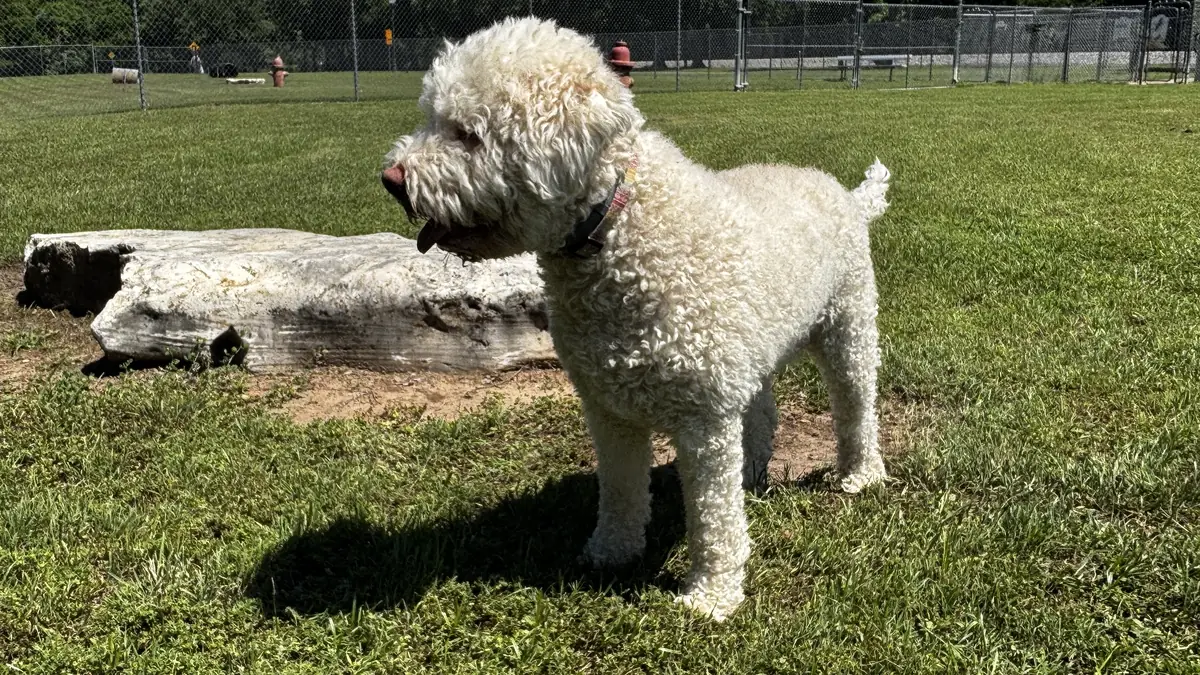
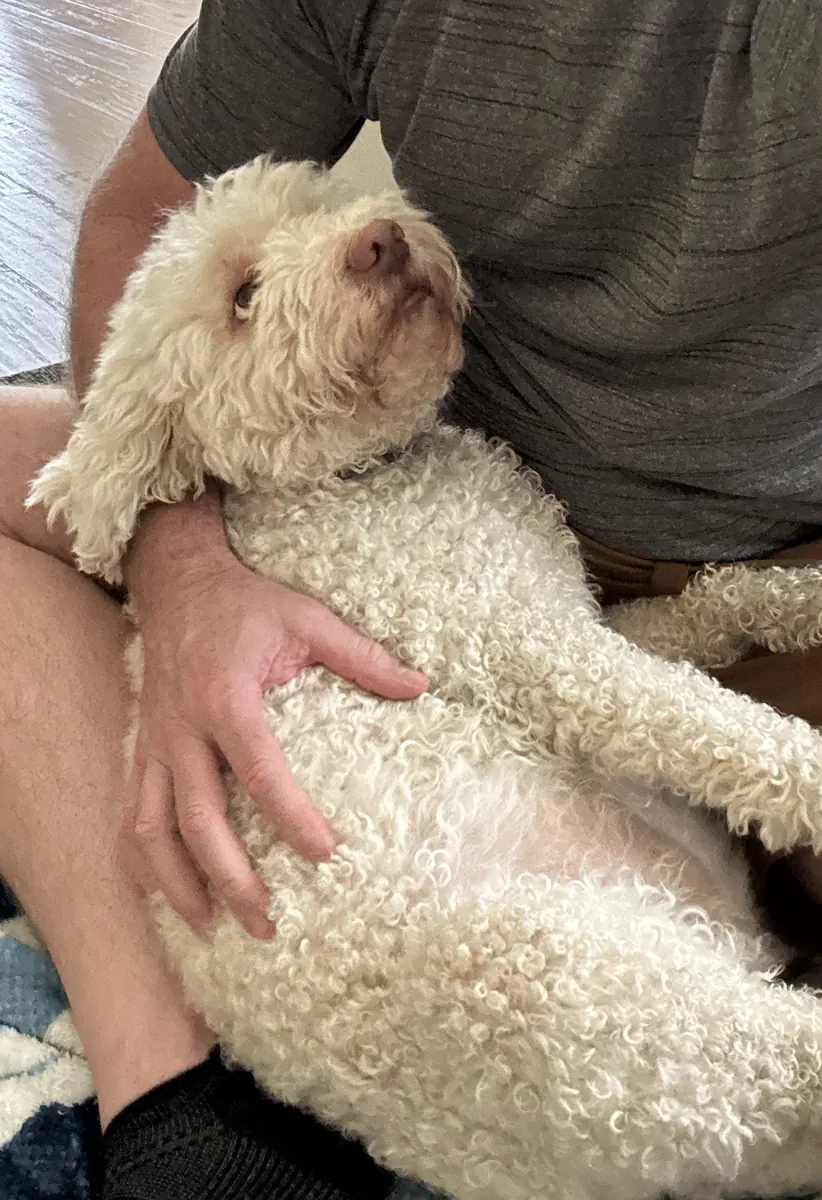
She is six years old, in full health, and entirely typical of what careful Scandinavian breeding produces: calm, curious, deeply bonded, unreactive. In our years with her we have not seen anxiety, sharpness, or instability. Structure can be photographed; temperament has to be lived with. We live with hers, and it is the temperament we want in every puppy that carries our name.
There is a piece of symmetry here that we did not plan. Blanca’s pedigree runs back through Katrien van Gemert’s Rozebottel dogs, and van Gemert was among the first to take the breed at Crufts. Chip is the dog on this page who has now done it as well. The two halves of this litter arrive at the same ring from opposite directions.
Documented Health
Both Parents, In Full
We publish complete panels, including the results a sales page would omit. Breeders read health honestly or not at all. There is a line in Chip's column below that a page selling you a puppy would have left out, and we have put it at the top.
Chip
MBIS NBISS GCHS · CHIC 158187
Blanca
Gillenias Elizabeth · CHIC 220642
Both dogs are searchable on the OFA database: Chip under CHIC 158187, Blanca under CHIC 220642.
The hips, since we put them first
Chip's hips were certified OFA Fair at 27 months. Blanca's are Good. Flocky's were Good. That is the difference, and it deserves more than a footnote.
Fair is a passing OFA rating. The three passing grades are Excellent, Good and Fair, and none of them bars a dog from breeding. A Fair hip is a normally functioning hip with less depth of coverage than a Good one. It is not dysplasia. OFA’s dysplastic grades are Mild, Moderate and Severe, with Borderline sitting between passing and dysplastic as an inconclusive result, and Chip is in none of those. But Fair is the bottom of the passing band, and a breeder who tells you it reads the same as Good is telling you what you want to hear. His own dam graded Fair as well, which you can see in the chart below, and we would rather you read that from us than find it.
Here is a screening the Flocky page does not report. Chip was also screened by PennHIP, at fifteen months, and returned a distraction index of 0.41 on the right hip and 0.42 on the left. PennHIP measures passive joint laxity under load, which is a different property from the coverage an OFA extended-hip view shows. Two things about those numbers, and we will put the unhelpful one first:
They are above 0.30, the value below which PennHIP identifies hips as having very low susceptibility to osteoarthritis. So the PennHIP number does not contradict the Fair grade; it is consistent with it, and we are not going to present a second test as though running it improved the hip. What it adds is context: 0.41 and 0.42 sit below the published breed averages for several comparable water and sporting breeds, among them the Standard Poodle at 0.49, the Labrador at 0.49, the Golden Retriever at 0.55, the Portuguese Water Dog at 0.56 and the Spanish Water Dog at 0.59. That is a comparison against other breeds’ averages, not a percentile within his own, and it should not be read as one. The Lagotto Romagnolo has no published PennHIP breed mean at all, so no true breed percentile exists for him. We would rather tell you that than invent one.
What we would put beside all of it: hip conformation is polygenic and substantially environmental, which is why OFA publishes breed statistics and vertical pedigrees rather than treating one certificate as a verdict. A single parent's grade is a weak predictor for any individual puppy. What matters more is that both parents were screened, that the results are public, that neither is dysplastic, that one of the two was screened twice by two different methods, and that the puppies are raised on the growth-plate protocol we already follow: no stairs or impact above belly height under four months, continued caution through the first year. On the environmental half of the equation, the half a family actually controls, we will give you more support than most breeders offer. Our exercise guidance exists for this reason.
We will also say what we cannot say. We cannot tell you this litter will produce Excellent hips, and neither could we have told you that about the pairing it replaces. What we can tell you is that both parents were tested, both passed, both results are public, and we have put the less flattering one at the top of the table rather than the bottom.
Everything else, and the recessives
On the rest of the panel Chip is the more broadly tested of the two dogs in this pairing: patellas, thyroid, an advanced cardiac by echocardiogram, and eye examinations in three separate years, the most recent this April. Chondrodystrophy and chondrodysplasia both N/N. Copper toxicosis clear on ATP7A and ATP7B. Against Flocky the honest comparison is narrower than we first wrote it: Flocky was patella-normal and cardiac-cleared by a cardiologist too. Thyroid is the line Chip has that he does not.
Blanca carries a single copy of the Lagotto Storage Disease mutation. Chip is clear of it. With one parent clear, no puppy in this litter can be affected by LSD. Some may inherit one carrier copy, which has no health consequence for the dog itself and is simply managed in any future pairing, exactly as it was managed in this one.
Chip carries two copies of the furnishings gene, so every puppy in this litter inherits furnishings and none can be born with the improper smooth-faced coat that occasionally appears in the breed. It is a small thing next to hips and eyes. It is also a certainty rather than a probability, and there are few enough of those in breeding that we will take it.
The Pedigree
Three Generations, Typeset
Read it the way a breeder reads it, left to right, parents to great-grandparents. On the page this one replaces, the same chart carried a highlighted cell, because Flocky and Blanca met at a dog called Zeus (Foianesi) and we said so. Read this chart looking for that cell. There is not one.
No cell is highlighted because no ancestor is shared. Zeus (Foianesi), the single dog the previous pairing had in common, appears nowhere in Chip’s pedigree. Chip’s AKC certified pedigree runs deeper than this chart, to sixteen great-great-grandparents, and none of those names appears on Blanca’s chart either. That is worth less than it sounds, because her pedigree is not documented to the same depth in our sources; the claim we stand behind is the three-generation one. Sources: AKC Certified Pedigree issued 26 September 2023; The Breed Archive and registry records.
The Rationale
Why These Two
The original pairing was made for one reason above all others: to widen a gene pool that American Lagotto breeding has spent a decade narrowing. Flocky brought the Italian mainstream at its best. Blanca brought a Scandinavian line assembled in parallel to it. The two met at exactly one dog, and we called that out on the page rather than hiding it, because a single thread of linebreeding inside a genuine outcross is a defensible structure and we were prepared to defend it.
This pairing does the same job with nothing to defend. Across every ancestor documented on both sides, there is not one name in common. Chip’s AKC certified pedigree runs five generations; Blanca’s documented chart runs three complete generations and part of a fourth, with two of her eight great-grandparents’ parents unrecorded in the sources we hold. The window we can actually verify is therefore three generations deep on both sides, and over that window the two pedigrees do not touch at a single dog. Three-generation coefficient of inbreeding: zero.
We will put the honest boundary on that immediately, because a number that clean invites suspicion and should. A zero here means no shared ancestor inside three verifiable generations. It does not mean these two dogs are unrelated, and we are not going to imply that it does. Chip’s sire line is Sweden-bred and Blanca is Swedish; both sides carry Italian stock behind that. Convergence at the fifth or sixth generation is likely rather than hypothetical, and every Lagotto Romagnolo alive descends from the small group of dogs gathered in the Romagna in the 1970s to bring the breed back from the edge. What we are claiming is narrow and checkable: inside the window a breeder can actually see, these two do not meet, and the pairing they replace did. Pedigree COI and genetic COI are different measurements, and Blanca’s 0.65 percent is calculated over a deeper pedigree than the three generations above, so the two figures are not directly comparable.
Inside that window the structure is unusual. Chip's sire line runs to Sweden through Nillatorps and the St Druon's and Tete Noir dogs; his dam line runs to Italy through the del Pesco, dei Silvanbull and Re d'Abruzzo lines, with an American generation between. Blanca's runs to Sweden and the Netherlands through Gillenias, Lingotto D'oro and Rozebottel, with an Italian generation of her own. Both dogs are outcrosses in their own right. Put together they are an outcross of outcrosses, and that is a genuinely difficult thing to arrange in a breed this small on this continent.
What it costs is worth naming. A pairing this wide gives up some of the predictability that linebreeding buys. Flocky's single thread back to Zeus was doing real work; it concentrated a type the Italian line does reliably well. We are trading a measure of that consistency for genetic room. In a breed with this founder population we think that is the right trade, and there is one piece of evidence that softens the cost: the Stud Dog win in March says that whatever Chip is passing on, he is passing it on consistently enough for a national-specialty panel to reward the group of them together.
We are selecting for what we always select for, in order: temperament, structure, health, coat. What changed this month is which dog is on the left of the chart. What did not change is why the litter is being made.
Placements
Where These Puppies Are Going
Families already on the waitlist keep their place, in their order. Nothing about this change moves anyone up or down, and no one has to do anything to hold their spot. We wrote to every waitlisted family directly before this page went up, because finding out from a website that the sire of your puppy changed is not how we want to treat people who have been waiting.
If a family would rather wait for a different pairing, they may hold their place for a future litter or withdraw and have their deposit returned in full, with no explanation asked for and no awkwardness about it. We would rather place every puppy in this litter with a family who wanted this specific breeding than fill it out with one who felt walked into it.
This litter is also positioned for breeding programs, established kennels and serious people at the beginning of one. The genetic argument above is aimed squarely at them: a sire and dam with no common ancestor inside three verifiable generations, both CHIC certified with results public on OFA, is a rarer thing to be offered in North America than a decorated pedigree is. That the sire also happens to be a Stud Dog winner at the national is the part that should interest them most.
Every puppy, in every placement, is raised identically: whelped in our home, on the Puppy Culture protocol, early neurological stimulation, structured enrichment, deliberate socialization through the developmental windows, with the same health testing, the same documentation, and the same matching process we describe across this site.
Inquiries are open, write Mark & Tracy
The Season
Timeline
Every date after the breeding is a projection from a 63-day gestation, and gestation is a range rather than a number. We publish these dates because families need to plan around them, and we will correct them the day anything moves.
Questions
Asked Already
Why did the sire change?
Frozen semen from Flocky is still in Europe and will not clear in time for Blanca's season, which opened in late July. We were not going to hold a dam out of a season or push a breeding into the wrong week to wait for a shipment, so we moved to the sire we had already vetted as the alternative. Blanca's cycle set the schedule. It always does.
Is Chip as good a dog as Flocky?
On the record he is at least his equal. Both have won Best of Breed at Westminster, Flocky in 2023 and Chip in 2022. Both have won Best in Specialty Show at the LRCA National, Flocky in 2023 and Chip this March. Chip additionally has Best of Breed at Crufts from 111 entries, Best in Show at the Italian breed club’s own national in 2023, and the Stud Dog class at the LRCA National, which is judged on his offspring rather than on him. Flocky finished 2023 as the #1 ranked Lagotto in the United States and Chip has not held that ranking. On hips Flocky graded Good and Chip graded Fair, with a PennHIP screening the Flocky page does not report. On the genetics, which is the reason this litter is being made at all, Chip is the better match for Blanca, because he shares no documented ancestor with her and Flocky did.
When will the litter be born, and when do puppies go home?
Breeding July 31, 2026. Whelp expected around October 2, with a few days' normal variance either side. Puppies go home at eight weeks, around November 27. That falls on Thanksgiving weekend, and any family who would rather collect the following week may do so at no cost.
I am on the waitlist for the Flocky litter. What happens to my place?
You keep it, in the same order, and you do not need to do anything. If you would rather wait for a different pairing you can hold your place for a future litter, or withdraw and have your deposit back in full. We will not ask why, and it will not affect how we treat any future inquiry from you.
What does a coefficient of inbreeding of zero actually mean?
It means that inside three generations, verifiable on both pedigrees, no dog appears on both sides. It does not mean the two are unrelated; every Lagotto alive traces back to the same small group of dogs recovered in the 1970s, and convergence at the fifth or sixth generation here is likely. It is a narrow, checkable statement about the window a breeder can see, and it is the window in which the pairing this replaces did share a dog.
Chip's hips are Fair. Should that worry me?
It should inform you, which is why it is at the top of the table and has its own section above. Fair is one of OFA’s three passing grades, but it is the bottom of the passing band and we will not pretend it reads the same as Good. He was also screened by PennHIP, which measures joint laxity, returning 0.41 and 0.42. Those sit above the 0.30 mark PennHIP associates with very low arthritis risk, so that result is consistent with the Fair grade rather than offsetting it. They are below the published averages for several comparable breeds, but that is a cross-breed comparison and not a ranking within his own, for which no data exists. His dam graded Fair as well. Blanca's hips are OFA Good. Hip conformation is polygenic and heavily environmental, one parent's grade predicts an individual puppy weakly, and the half you control is the growth-plate protocol we will walk you through.
Inquiries
Mark and Tracy handle all correspondence for this litter. Tell us who you are, what you are building or looking for, and where you are. The rest is a conversation.
Write Mark & TracyMark & Tracy Nelson · Northwest Lagotto LLC · Lynden, Washington
More from Northwest Lagotto
Common Questions
Questions families ask
When will the Blanca × Chip litter be born, and when do puppies go home?
The breeding is planned for July 31, 2026, timed by progesterone on Blanca’s cycle. Whelping is expected around October 2, 2026, with the normal window running a few days either side. Puppies go home at eight weeks, in late November 2026, to their matched families.
Who are the parents of this Lagotto Romagnolo litter?
The sire is MBIS NBISS GCHS Horizon All American, call name Chip, AKC SS13423001, CHIC 158187, whelped April 10, 2019, bred by Laurin Howard at Horizon Lagotti. He was Best of Breed at the Westminster Kennel Club Dog Show in 2022, Best of Breed at Crufts in 2025 from 111 entries, Best in Show at the Club Italiano Lagotto Raduno Nazionale in 2023, and Best in Specialty Show plus Stud Dog at the LRCA National Specialty in March 2026. The dam is Gillenias Elizabeth (Blanca), a Swedish-import dam bred by Anna Peterson, CHIC 220642, OFA Good hips, with a documented pedigree COI of 0.65 percent.
Why did the sire change from Flocky to Chip?
Frozen semen from Flocky is still in transit from Europe and will not clear in time for Blanca’s current season, which opened in late July 2026. Rather than delay a breeding to fit a shipment, we moved to the sire already vetted as the alternative. Blanca’s season sets the schedule; a bitch is bred when she is ready or not at all.
How closely related are the sire and dam of this litter?
They are not. Across every ancestor documented on both pedigrees, five generations on Chip’s AKC certified pedigree and four on Blanca’s, there is no name in common. Calculated over the generations both charts document, this litter’s coefficient of inbreeding is zero. Every Lagotto alive converges on the same small founder population if you go back far enough, so this is a statement about documented generations, not about infinity.
I am already on the waitlist for the Flocky litter. What happens to my place?
Nothing changes unless you want it to. Families already on the waitlist keep their place and their order for this litter. Any family who would rather wait for a different pairing may hold their place for a future litter or withdraw and have their deposit returned in full, with no explanation required.