The Lagotto Romagnolo is, by the standard of purebred dogs, a healthy breed. The FCI standard calls for “a rather rustic dog of good health,” a well-bred Lagotto commonly lives 15 to 17 years, and the list of things that go wrong is short. But short is not zero, and the two conditions that matter most are unique to this breed, which means a general-purpose vet may never have seen either one. This is the complete list as we understand it after eleven years in the breed: what each condition is, when it appears, how common it is, and whether a breeder can prevent it before your puppy is ever born.
The single most important fact on this page: the two serious single-gene diseases in the Lagotto, BFJE and LSD, can be avoided by DNA testing both parents. A breeder who tests and never pairs two carriers will not produce a puppy affected by either. A breeder who does not test is choosing not to know.
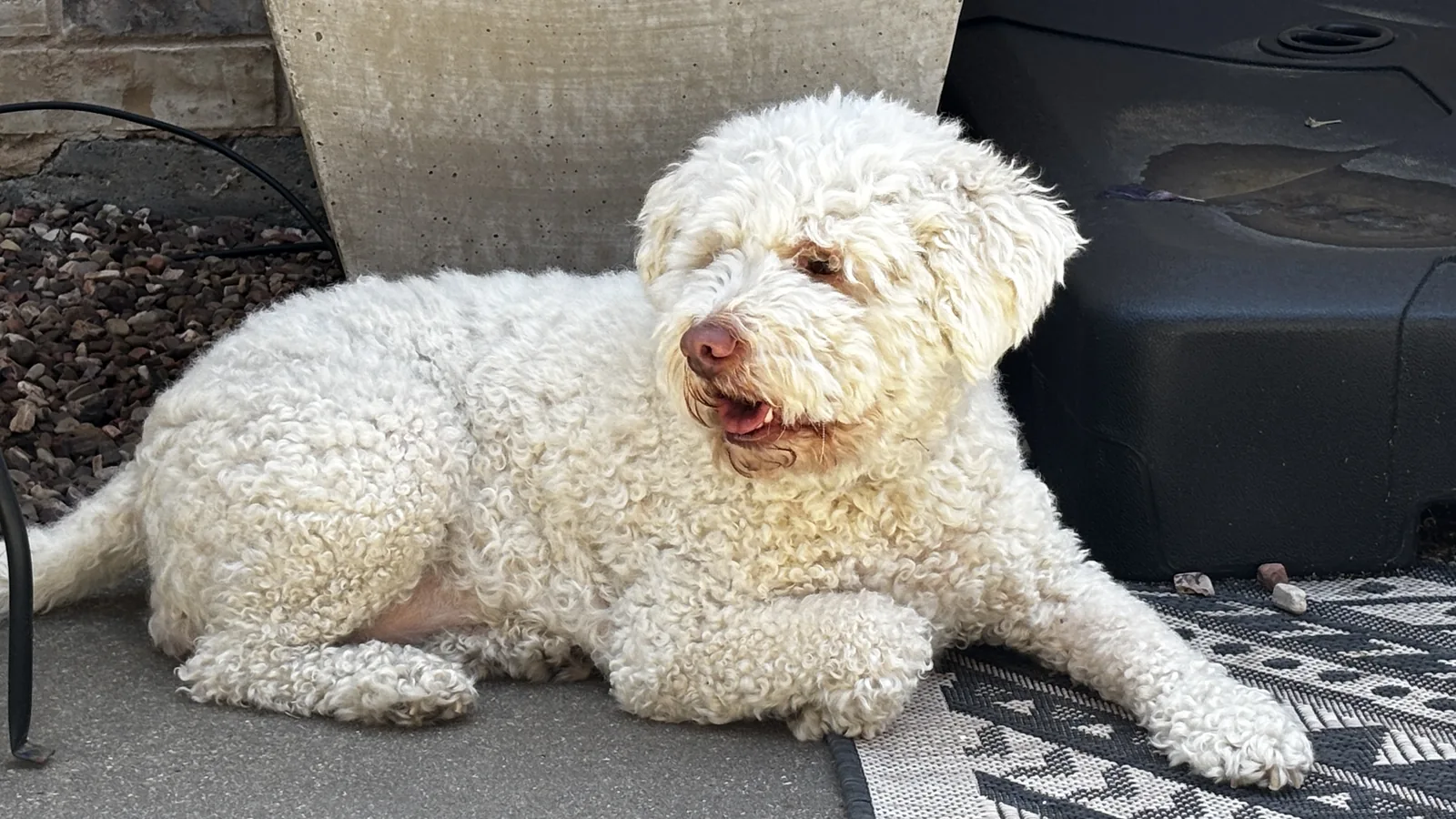
Blanca holds CHIC number 220642. Every result on this page can be verified by name at ofa.org.
The Short Answer
The Lagotto Romagnolo has seven health concerns worth knowing about. Two are neurological diseases found only in this breed and both are caught by a DNA test: Benign Familial Juvenile Epilepsy (BFJE), which is self-limiting, and Lagotto Storage Disease (LSD), which is fatal. One is metabolic and also DNA-testable: hyperuricosuria (HUU), which causes urinary stones. Two are orthopedic and screened by X-ray or examination: hip dysplasia and patellar luxation. One category is inherited eye disease, screened by an annual ophthalmologist exam. The seventh is not hereditary at all and no test catches it: ear infections, the most common reason a Lagotto sees a vet.
The Lagotto Romagnolo Club of America requires five tests for a CHIC number: the two DNA tests, hips, patellas, and eyes. Responsible breeders add HUU. A dog with a CHIC number has every one of those results on public record at ofa.org. That is how you check a breeder in five minutes, and we cover exactly how in our health testing guide.
| Condition | What it is | When it appears | Screening | Preventable by breeding? |
|---|---|---|---|---|
| Benign Familial Juvenile Epilepsy | Seizures and tremors in young puppies; resolves on its own | 5 to 9 weeks; gone by 8 to 13 weeks | DNA (LGI2), CHIC required | Yes, by DNA testing both parents |
| Lagotto Storage Disease | Progressive, fatal neurodegeneration of the cerebellum | 4 months to 4 years; average about 2 years | DNA (ATG4D), CHIC required | Yes, by DNA testing both parents |
| Hyperuricosuria | High uric acid in urine; bladder and kidney stones | Adulthood, variable | DNA (SLC2A9), recommended | Yes, by DNA testing both parents |
| Hip dysplasia | Malformed hip joint; arthritis and reduced mobility | Signs from adolescence to middle age | OFA or PennHIP radiographs at 24 months, CHIC required | Reduced, not eliminated (polygenic) |
| Patellar luxation | Kneecap slips out of its groove | Usually noticed young | Veterinary palpation, CHIC required | Reduced; uncommon in the breed |
| Inherited eye disease | Cataracts, progressive retinal atrophy, other heritable conditions | Variable; some adult-onset | Annual ACVO exam, CHIC required | Reduced by annual clearance |
| Ear infections | Yeast or bacterial otitis in a hairy, drop-eared, water-loving dog | Any age, often recurring | None; it is management | No; prevented by care, not breeding |
The Two Diseases Found Only in the Lagotto
Most breeds share their health problems with a dozen others. The Lagotto has two that are its own, both traced to single-gene mutations by the University of Helsinki, and both the direct result of the breed’s near-extinction in the 1970s, when it was rebuilt from a handful of dogs. Some of those dogs carried these mutations. Every Lagotto alive descends from them.
Benign Familial Juvenile Epilepsy (BFJE)
An affected puppy begins having seizures, tremors, and stiff, uncoordinated movement between five and nine weeks of age, and the episodes stop on their own between eight and thirteen weeks. The word “benign” describes the outcome for the puppy: most go on to live normal lives, though a minority have occasional episodes as adults. It does not describe the experience of watching a seven-week-old seize. The condition was clinically described in 2007 and the causative LGI2 mutation was identified in 2011 (Seppälä et al., PLOS Genetics). Inheritance is autosomal recessive: a puppy is affected only if it inherits the mutation from both parents. One DNA-clear parent guarantees no affected puppies, which is why the LRCA requires the test and does not ask breeders to remove carriers from the gene pool.
Lagotto Storage Disease (LSD)
This is the one that matters most. LSD is a lysosomal storage disease: a mutation in the ATG4D gene disrupts the cell’s waste-recycling machinery, and debris accumulates in the neurons of the cerebellum, the part of the brain that governs balance and coordination. The first signs are clumsiness and abnormal eye movements, progressing to the staggering, wide-based gait of cerebellar ataxia, and often to behavioral change: restlessness, depression, sometimes aggression. Onset ranges from four months to four years, averaging about two. There is no treatment. Affected dogs are euthanized when their quality of life fails.
Roughly one Lagotto in ten carries one copy of the mutation, a carrier rate far above the sub-one-percent typical of breed-specific recessive diseases elsewhere. That is the bottleneck talking, not a failure of modern breeders. Carriers are healthy and can be bred, but only to DNA-clear dogs. The mutation was identified by Kyöstilä et al. in 2015 (PLOS Genetics). Ask any breeder for both parents’ LSD results before you send a deposit; if they cannot show them, walk away. We cover the carrier-versus-affected distinction, which is the most misunderstood idea in dog genetics, in the health testing guide and in our essay on genetics.
Hyperuricosuria (HUU)
Dogs with two copies of the HUU mutation in the SLC2A9 gene excrete high levels of uric acid, which crystallizes into bladder and kidney stones. Stones cause straining, blood in the urine, and in males a life-threatening blockage; treatment usually means surgery and a lifelong prescription diet. The condition is autosomal recessive, appears in Lagotti and a number of other breeds, and is caught by an inexpensive DNA test. It is not part of the CHIC requirement, which is exactly why you should ask about it: it separates breeders who do the minimum from breeders who test for everything that can be tested.
Hips, Knees, and Elbows
Hip dysplasia is a malformation of the ball-and-socket joint that leads to laxity, arthritis, pain, and reduced mobility. It is polygenic, meaning many genes plus growth-period environment shape the outcome, so no DNA test exists and no breeder can promise a puppy will never develop it. What a breeder can do is breed only from dogs whose hips have been radiographed and graded by the OFA (Excellent, Good, or Fair pass) or scored by PennHIP, which lowers the odds substantially. Final OFA certification requires the dog to be 24 months old, so a young dog offered as “preliminarily clear” is not the same as a certified one.
Patellar luxation, the kneecap slipping out of its groove, is inherited and is one of the five CHIC tests, but the LRCA notes it is not a common problem in the breed. Elbow dysplasia is rare enough in the Lagotto that it is not a CHIC requirement; we evaluate elbows anyway. The owner’s half of joint health is real: a lean body, no repetitive high-impact exercise before the growth plates close, and no stairs marathons at four months. The growth-plate rules are in our exercise essay, and the evidence on early neutering and joint disease is in the spay and neuter essay.
Inherited Eye Disease
Cataracts, progressive retinal atrophy, and a handful of other heritable eye conditions occur in the breed at low rates. There is no single DNA test that covers them, so the CHIC protocol requires an annual examination by a board-certified veterinary ophthalmologist (ACVO), repeated every year the dog is in a breeding program. An eye clearance is a snapshot, which is why the requirement is annual rather than once. Ask for the date of the most recent exam, not just whether one was done.
The Everyday Problems No Test Catches
Ask a room full of Lagotto owners what has actually taken their dog to the vet and the answer is rarely a genetic disease. It is ears. The Lagotto has drop ears, a dense curly coat that grows inside the ear canal, and an enthusiasm for water that borders on a compulsion. Warm, damp, hairy ear canals grow yeast. The result is recurring otitis: head shaking, a sour smell, brown debris, a dog that flinches when you touch the ear. It is managed, not cured, by keeping the canal clear of hair, drying the ears after swimming, and checking them weekly. Our grooming guide covers the ear routine.
The coat itself is the second everyday issue. A Lagotto coat that is brushed dry mats into felt against the skin, traps moisture, and produces hot spots and skin infections. The fix is a grooming rhythm, not medicine. Third is weight: this is a food-motivated breed built for a working day it no longer gets, and an overweight Lagotto shortens its own life and loads its own joints. A visible waist is the goal at every age. Fourth, and rarer, are the tail-end reports that show up in breed health surveys without a clear genetic story: cerebellar abiotrophy, alopecia, the occasional autoimmune condition. They exist in the literature; they are not what you should be losing sleep over.
Why the Breed Has These Problems at All
By the 1970s the Lagotto had nearly vanished; the modern breed was reconstructed by a small group of Italian breeders from a few dozen dogs. Every Lagotto alive today traces to that founder group, which is why two single-gene diseases that would be vanishingly rare in a large population run at meaningful rates here, and why genetic diversity is a live concern in every pairing decision. Testing removes the diseases from the equation. Diversity is the longer game: breeding for low coefficient of inbreeding, importing unrelated lines, and refusing the shortcut of doubling up on a popular sire. We wrote about how that shaped our own program in our lineage essay and in the Blanca × Chip breeding, a pairing with no common ancestor across the generations both pedigrees document (that mating did not take; the pairing logic is the same for our 2027 plans).
Lifespan, and What Shortens It
A well-bred Lagotto commonly reaches 15 to 17 years, a long life for a dog of 24 to 35 pounds (females 24 to 31, males 28 to 35). Across eleven years our adults have averaged 32 lb (males 35, females 31), ranging 25 to 36 lb. The things that cut it short are mostly ordinary: obesity, untreated dental disease, and accidents. LSD is the one hereditary disease that ends a life early, and it is the one you can rule out before you buy. Size, growth, and the full lifespan picture are on the size and lifespan page; what changes in the senior years is in the senior Lagotto essay.
How to Check Any Breeder in Five Minutes
Go to ofa.org, search the registered name of each parent, and look for five results: BFJE, LSD, hips, patellas, and an eye exam dated within the last year. A CHIC number means all five are there. Then ask for HUU. If a breeder offers a “vet checked” puppy, a “health guarantee,” or their own word in place of public OFA records, none of those is a substitute. Our dogs’ results are listed on Our Dogs, and the full protocol, with the questions to ask and how to read a record, is the health testing guide. What we watch for in a puppy’s first months at home is in the puppy health essay.
Common Questions
What are the most common Lagotto Romagnolo health problems?
Do Lagotto Romagnolo have a lot of health problems?
What is Lagotto Storage Disease?
Is Benign Familial Juvenile Epilepsy dangerous?
Are Lagotto Romagnolo prone to hip dysplasia?
Why do Lagotto get ear infections?
What health tests should a Lagotto breeder show me?
Mark Nelson
Northwest Lagotto · Lynden, Washington
What We Owe a Puppy Before It Is Born
Every breeding dog in our program is DNA tested for BFJE, LSD and HUU, radiographed for hips, and examined for patellas and elbows. Eye exams by an ACVO ophthalmologist are being scheduled now; Blanca already holds CHIC number 220642, and the others receive theirs once those exams are filed. Every result that matters for a pairing is public on OFA; the rest are available on request. We would rather you check than take our word.
If you are weighing a Lagotto, read the health testing guide, meet our dogs, and see what the puppies and process page says about the eight weeks before a puppy goes home.