Before a Lagotto puppy comes home you need about fifteen things, a crate-and-pen setup in the spot where the crate will stay, and an hour spent walking your house at six inches off the floor. If you only manage three purchases, make them a 30-inch crate with a divider, an enzymatic cleaner, and a heartbeat toy for the first nights.
If your puppy is coming home soon, you are probably feeling a mix of excitement and a low hum of am I actually ready? The honest answer is that nobody is ever fully ready for a puppy, and the people who think they are usually aren't.
What you can do is the work on this page. In our experience it absorbs the nerves in a way that waiting never does.
This started as the preparation guide in our buyer portal. We have opened it up for anyone bringing home a Lagotto, from us or from another breeder. Every item has a reason, and where the breed changes the usual advice, we say so. Tick things off as you go: the page keeps your place in its own link, so you can send your list to whoever is doing the shopping.
Everything to do before pickup, at a glance.
Set the house up before the puppy arrives, not after the first accident. The crate goes where it will stay, the stairs are gated, and everything within six inches of the floor has been looked at by someone on their hands and knees.
Buy before pickup
- A 30-inch crate with a divider panel
- An exercise pen at least 36 inches tall
- Enzymatic cleaner, before the first accident
- A heartbeat toy for the first nights
- Two weeks of the food your puppy already eats
- Baby gates for every staircase
Do before pickup
- Book the vet for 48 to 72 hours after pickup
- Walk every room at puppy height
- Gate the stairs: none before four months
- Agree the house rules with everyone at home
- Save the poison lines in your phone
Your Four-Week Countdown
Where you are in the countdown decides what to do this week. A family reading this a month out has different work from one reading it the night before. Enter the day your puppy comes home and each stage below gets its date. Nothing is stored or sent anywhere; the date lives only in this page's address, so you can bookmark it.
Pick a date to see your calendar.
-
Four weeks out
Make the big decisions
- Choose a vet and book the first visit for 48 to 72 hours after pickup.
- Decide where the crate will live for good. It will not move.
- Buy the big items first: crate, pen, gates.
- Read what Puppy Culture does in the first eight weeks.
-
Two weeks out
Make it physical
- Finish the checklist below.
- Install a gate on every staircase the puppy can reach.
- Walk each room at puppy height and fix what you find.
- Have the household conversation.
-
One week out
The quiet week
- Set the crate and pen up in their permanent spot.
- Freeze a few stuffed Kongs. Check the peanut butter for xylitol.
- Confirm the pickup time, route and weather with your breeder.
-
The day before
Rest
- Buy plain canned pumpkin (not pie filling) in case of soft stools.
- Fill the car and pack a bag for the drive home: towels, wipes, bags, water.
- Save the poison lines to your phone's favorites.
- Go to bed early.
-
Pickup day
The first nights
- The crate stays in its spot, and you sleep close by for the first one to three nights.
- Keep the first three days quiet. Visitors can come at the end of the week.
- The drive and the first night have their own guide: Two Firsts.
- What the first month looks like, day by day: The First Month.
The New Puppy Checklist: Fifteen Things, and Why
These are the fifteen things you will use in the first two weeks. Tap Why this one under any item for the reasoning. Items tagged Lagotto note are where the breed changes the usual advice, and First week marks the ones you will reach for before the puppy has been home a day.
What size crate does a Lagotto need?
A 30-inch crate with a divider panel. Adult Lagottos in our program weigh 25 to 36 pounds,7 so a 30-inch crate fits them for life, and the divider keeps the space puppy-sized until then.
-
Why this one
The divider slides in to shrink the space, so an eight-week-old sleeps in a den about the size of a breadbox and you move the divider back as it grows. A puppy given a whole adult crate picks one end to sleep in and the other as a toilet. A wire crate also folds flat for travel.
-
Why this one
The pen clips to the short end of the crate with the crate door folded open, so the puppy has the run of both: a den to sleep in and a small yard to play in. In our experience Lagotto puppies are nimble and motivated enough to get over a 24-inch pen by about ten weeks, so 36 inches is the minimum. Later the same pen works as a travel barrier or a garden enclosure.
-
Why this one
Ordinary cleaners remove the smell of an accident for your nose, not for a puppy's. The scent that is left tells the puppy this is where it goes, and it goes there again. Enzymatic cleaner breaks the urine compounds down so the marker is gone. You will have at least one accident in the first week; having the bottle under the sink turns it into a five-minute job.
-
Why this one
For eight weeks your puppy has slept in a warm pile of littermates. The first night in a crate is the first quiet night of its life. A plush toy with a battery heartbeat and a warm pack is close enough to a sibling that most puppies settle against it. Warm the pack before bedtime on the first night so it is ready when you need it.
-
Why this one
A new home, new people and a new food all at once is a reliable recipe for loose stools. Keep the diet the same for at least the first two weeks. If you want to change foods later, start no earlier than week three and switch gradually over about ten days. Our feeding guide covers the rest.
-
Why this one
Daily use of stairs in the first three months raised the risk of hip dysplasia in the largest prospective study of puppy housing we know of (see the science note below). Our rule adds a margin: no stairs and no jumping down from above belly height until four months. Gates are far easier to fit in an empty house than around a curious puppy.
-
Why this one
Teething puppies chew beds because the fabric tears and the stuffing is interesting. A plush bed is confetti within a week. Heavy, tightly woven nylon holds up; the foam inside matters less than the fabric. A zipper is the first thing a puppy finds.
-
Why this one
Plastic scratches, and the scratches hold bacteria that washing does not reach. Stainless steel does not scratch and survives the dishwasher. Non-tip matters more than usual with a water dog: Lagotto puppies play in their water, and an upended bowl at 4 a.m. is avoidable.
-
Why this one
A flat collar presses a band into the coat where it sits, and over time the curl there flattens. A rolled collar touches the coat along one thin line instead. Put your phone number on the tag the day the puppy comes home. A long line of 15 to 30 feet is worth adding later for recall practice in open spaces.
-
Why this one
A puppy that is not given things to chew finds its own. Stay with your puppy while it works on a bully stick or yak chew, and take the last small piece away. A Kong stuffed with wet food and frozen overnight is the best crate-training tool we know: the crate becomes the place where the good thing happens. Check every jar of peanut butter for xylitol before it goes in; some brands now contain it, and it is acutely toxic to dogs.
-
Why this one
Small, because you will hand out dozens in a session. Soft, because chewing breaks the link between the behavior and the reward. Single-ingredient, because young stomachs are sensitive and a long ingredient list is the first suspect when stools go soft.
-
Why this one
A click marks the exact moment a puppy does the right thing, and that precision teaches faster than a "good!" that arrives two seconds late. It is one of the cheapest and most useful things on this list. Our training guide covers how to use it.
-
Why this one
Many checklists list a slicker brush. For a Lagotto, use a wide-tooth comb to check the places where felting starts: behind the ears, the chin and collar line, the armpits and the groin. Combing or brushing the whole coat out ruins the curl the breed is known for. This is the rustic approach taught by Katrien van Gemert, the Dutch breeder who first won Crufts with a Lagotto.6
-
Why this one
Harsh, heavily foaming shampoos strip the oils that hold the Lagotto curl. Conditioner coats each hair and relaxes the corkscrew into a wave. Buy a gentle shampoo made for curly or wool-type coats and leave the conditioner on the shelf. Plan on a professional trim every six weeks to three months; the grooming guide explains the routine.
-
Why this one
A loose puppy in a moving car distracts the driver every minute and is a projectile in a collision. Not every product sold as a dog seat belt has been crash-tested. A secured crate or a carrier strapped in on the floor behind a front seat is the simple answer. The drive itself is covered in Two Firsts.
Set Up the Puppy Apartment
The crate and the pen are not two purchases. They are one system, which we call the puppy apartment. The pen clips to the short end of the crate, the crate door folds open, and the puppy has free run of both. Water, a bed and a chew go in the pen. In the first two weeks this is where your puppy will spend more waking time than anywhere else.
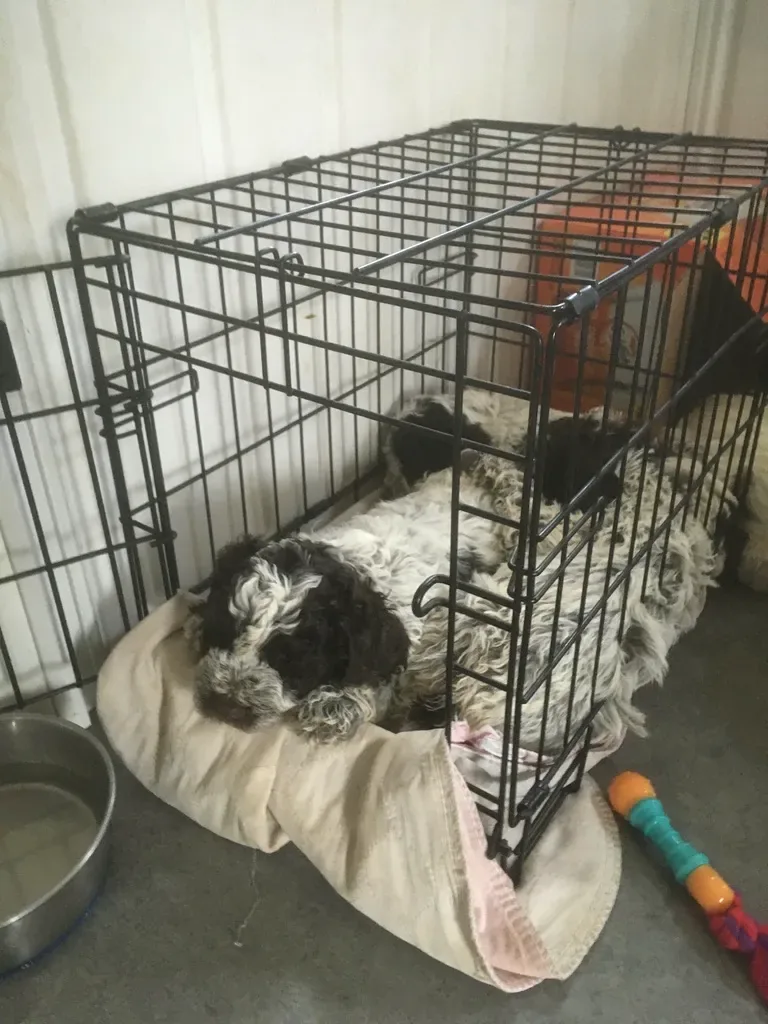
Choose the spot once. A quiet, low-traffic corner of the room you use most, out of direct sun, away from heating vents, and far enough from the front door that arrivals do not wake a sleeping puppy. This corner is where the crate stays, day and night. Moving it after the first nights undoes some of what those nights built.
For the first one to three nights, sleep on a sofa nearby. Your sound and smell in the dark settle a puppy that has just left its littermates, and the night bathroom trips are much easier from two feet away than from down a hallway. Once the puppy is settling, usually by the second or third night, you go back to your own bed. The crate does not move.
At night, cover the crate on three sides (top, back and one side) and leave the door side open for air. Take the water up about two hours before bed. Put the heartbeat toy in, warmed.
Puppy-Proofing, Room by Room
Puppy-proofing is less a list than a change of view. Get down to six inches off the floor and look at each room the puppy will be allowed into. What is obviously dangerous at eye level can be invisible from down there, and things you have never thought about become the most interesting objects in the house. Do it before pickup, not after the first incident.
The rule in every room: if it is within six inches of the floor, it is fair game. Tap a room on the plan to jump to its list; the plan shows how many items are left in each.
Kitchen
Living room
Bedroom
Bathroom
Garage & laundry
Yard
A Lagotto was bred to find fungi underground, and a puppy spends much of the day with its nose on the ground. In the wet months, mushrooms come up in lawns across the Pacific Northwest overnight. A Washington emergency hospital that treated a six-month-old puppy after it ate one notes that the Amanita species involved are common here.2 Pick mushrooms as they appear, bag them, and call a poison line if you think any were eaten.
Krontveit and colleagues followed 501 puppies of four large breeds in Norway from birth and screened their hips by radiograph. Puppies that used stairs daily in their first three months had a higher risk of hip dysplasia; puppies with daily off-leash exercise in parks over the same period had a lower one.1 The study did not include Lagottos, which are a medium breed, so we apply it with a margin: no stairs and no jumping down from above belly height until four months, and continued care through the first year while the growth plates close. Movement is not the problem. Repeated hard impact on joints that are still forming is. The full picture is in our essay on exercise and growth plates.
The Household Conversation
Before pickup, sit down with everyone in the house for ten minutes and settle these seven things out loud. Puppies learn the rules you enforce, not the rules you meant to have, and three days of inconsistency takes weeks to undo. Print the card and use it as the agenda.
- Who takes the puppy out first thing in the morning? Name the person. "Whoever is up first" means nobody.
- Who does the midday meal and outing? Decide now, so nobody is quietly resentful on day three.
- Who does the last trip before bed, and who gets up in the night? The night shifts are the hardest part of the first week. Assign them.
- What rules does the puppy meet on day one? Couch or no couch, feeding from the table, jumping on guests. Decide the rules you want at a year, and start them now.
- Which rooms are off-limits, and how? A gate, a closed door, or a cue every adult uses the same way.
- When can visitors come? At the end of the first week. Decide how you will say "not yet."
- Who takes the first vet visit? It is booked for 48 to 72 hours after pickup. Name the person.
Save These Numbers
Put these in your phone before the puppy comes home. The worst time to look up a phone number is the moment you need it. Both poison lines are staffed around the clock by veterinary toxicologists, and both may charge a consultation fee.5 If you think your puppy ate something toxic, call before you do anything else, and do not make it vomit unless a veterinarian tells you to.
- Pet Poison Helpline855-764-7661
- ASPCA Animal Poison Control888-426-4435
- Your veterinarianAdd yours
- Nearest 24-hour emergency vetAdd yours
The Hardest Preparation Is Done
When the checklist is full and the house has been walked at six inches, the work you can do ahead of time is finished, and the rest of the waiting is the easy part. If you are bringing home a puppy from us, your breeder portal has the parts of this that are specific to your own puppy: the match profile, the pickup schedule and the trackers. If you are still deciding on a Lagotto, our puppies page explains how our program works and what to expect.
Sources
- Krontveit RI, Nødtvedt A, Sævik BK, Ropstad E, Trangerud C. Housing- and exercise-related risk factors associated with the development of hip dysplasia as determined by radiographic evaluation in a prospective cohort of Newfoundlands, Labrador Retrievers, Leonbergers, and Irish Wolfhounds in Norway. Am J Vet Res 2012;73(6):838–846.
- BluePearl Pet Hospital (Renton, WA). Beware the mushroom: puppy saved after eating deadly fungus.
- VCA Animal Hospitals. Metaldehyde (slug and snail bait) poisoning.
- Cummings School of Veterinary Medicine at Tufts University. Ingestion of popular house plant can be fatal to pets (sago palm).
- National Pesticide Information Center, Oregon State University. Emergency numbers, including the ASPCA Animal Poison Control Center and Pet Poison Helpline.
- Katrien van Gemert. Lagotto Grooming by Katrien van Gemert (YouTube), and Lagotto Romagnolo Grooming: The Art of Keeping It Rustic.
- Northwest Lagotto breeding records, eleven years and more than 125 puppies: adult weights and litter data.
If You Have Read This Far
If our program sounds like what you are looking for, the next step is a conversation. No commitment. No pressure. Just two people talking about whether the timing, the fit, and the dog are right. Our current and planned litters page shows where things stand.
Common Questions
Questions families ask before pickup
What do I need to buy before bringing a puppy home?
A crate with a divider panel, an exercise pen, baby gates for any stairs, enzymatic cleaner, a heartbeat toy for the first nights, two weeks of the food the puppy already eats, a durable bed, stainless steel bowls, a collar, leash and ID tag, chews, small soft training treats, and a safe way to ride home. For a Lagotto, add a wide-tooth metal comb and a gentle shampoo for curly coats, and skip the conditioner.
If you only manage three things before pickup, make them the crate, the enzymatic cleaner and the heartbeat toy.
What size crate does a Lagotto Romagnolo need?
A 30-inch crate with a divider panel. Adult Lagottos in our program weigh 25 to 36 pounds, so a 30-inch crate fits them for life. The divider keeps the space small while the puppy is young, which helps with housetraining, and moves back as the puppy grows.
How do I puppy-proof my house?
Get down to six inches off the floor and look at each room the puppy will use. Move or cover electrical cords, put medications, cleaners and laundry pods out of reach, use a lidded trash can, gate the stairs, and close the bathroom and garage. Outside, walk the fence line at puppy height, remove toxic plants and slug bait, and pick up mushrooms after rain.
What should I puppy-proof first?
Electrical cords and anything medicinal or chemical within reach of the floor, then the stairs. A chewed live cord, a dropped pill or an open bottle of cleaner can cause serious harm in minutes. Gates on the stairs protect developing hips: we keep puppies off stairs until four months.
Where should a new puppy sleep the first night?
In its crate, in the spot where the crate will stay. Plan to sleep on a sofa nearby for the first one to three nights so the puppy can hear and smell you; once it is settling, you go back to your own bed and the crate stays where it is. Our guide to the ride home and the first night covers the details.
What is the 3-3-3 rule for new puppies?
It is a rule of thumb that began with rescue dogs: about three days to decompress, three weeks to learn the routine, and three months to feel at home. It is not a research finding, but the first part matches what we see with puppies: keep the first three days quiet and predictable, and let visitors wait until the end of the first week. Our guide to the first month covers those days in detail.
Do I need to brush a Lagotto puppy's coat?
No. Brushing or combing the whole coat out ruins the curl. Use a wide-tooth metal comb to spot-check the places where felting starts, behind the ears, along the collar line, in the armpits and the groin, and tease small tangles apart there. This is the rustic approach taught by Katrien van Gemert.
Are wild mushrooms in my yard dangerous to a puppy?
Some are, and you cannot tell which by looking. Amanita species, which include some of the most toxic mushrooms, are common in the Pacific Northwest and come up in lawns after rain. Pick and bag mushrooms as they appear, and call your veterinarian or a poison line right away if you think your puppy ate one.