Two Families, Two Outcomes
I have placed puppies with first-time owners who had never raised a dog in their lives. They came in knowing nothing except that they were willing to learn. They read what I sent them. They followed the socialization guidance. They attended puppy classes. They gave the dog a voice through manding, through clear communication, through patience. Those puppies became extraordinary companions.
I have also placed a puppy with a family who had owned dogs for fifty years. They knew dogs. They had always had dogs. And they returned that dog to me at ten months because they could not manage him. They had intimidated him rather than communicated with him. They had not been sensitive to the breed’s needs or to my guidance. Fifty years of experience with other breeds had not prepared them for a dog that requires a partnership rather than obedience.
The difference between those outcomes was not the dogs. It was what the owners understood about how a puppy’s brain develops, and whether they were willing to work with that development rather than against it.
The Lagotto Romagnolo is a sensitive, intelligent, emotionally complex breed. It does not respond to force. It does not respond to intimidation. It responds to communication, clear, consistent, gentle, and steady. That is why we drive Early Neurological Stimulation, manding, the communication trinity from Puppy Culture, and giving the puppy a voice so hard from the first days of life. When you do this work, living with a Lagotto is a genuine joy. When you do not, you can find yourself in a battle of wills with a dog that is smarter than the methods being used on it, and a bored or neglected Lagotto will find less desirable ways to entertain itself.
This essay is the science behind why that matters. It is about what happens in a puppy’s brain during the first weeks and months of life, why certain experiences during certain windows shape the adult dog permanently, and what you, as an owner, need to understand to get this right.
The Critical Window: What the Science Established
In 1965, John Paul Scott and John L. Fuller published the results of a thirteen-year longitudinal study at the Jackson Laboratory, examining social behaviour across five dog breeds. Their book, Genetics and the Social Behavior of the Dog, established what is now the foundation of developmental canine science: there is a critical period, running from approximately three to fourteen weeks of age, during which a puppy’s brain is uniquely receptive to social information.
During this window, the brain produces elevated levels of neurotransmitters that promote curiosity and suppress fearfulness. Novel experiences, people, sounds, surfaces, other animals, are processed and encoded as normal. Part of the expected world. After this window begins to close, somewhere around twelve to fourteen weeks, the brain shifts. New things become suspicious rather than interesting. Caution replaces curiosity as the default response to the unfamiliar. This shift is an evolutionary survival mechanism. It cannot be fully reversed.
Scott and Fuller found that the behavioural makeup of the adult dog was approximately 35% genetic and 65% environmental, socialization, nutrition, training, and management. That ratio should stop every breeder and every owner in their tracks. It means that nearly two-thirds of who the adult dog becomes is shaped by experience, and the most consequential experiences happen in a window that is functionally closed before the dog is four months old.
Behavioural problems, not infectious disease, are the number one cause of death for dogs under three years of age. Fear, aggression, and anxiety from poor socialization lead directly to surrender and euthanasia. Ian Dunbar’s research on timing is sobering: shyness in a two-to-three-month-old puppy takes days to weeks to resolve. By five to six months, it takes several months. By eight months, rehabilitation takes one to two years, or the damage may be permanent.
The Developmental Windows
The precision of these windows is what makes early socialization both powerful and demanding. An experience at four weeks produces a fundamentally different neurological outcome than the same experience at twelve weeks. The programme is not arbitrary. It is timed to the biology.

What We Do Before You Get Your Puppy
I want to be specific about what happens at Northwest Lagotto during the first eight weeks, because the work a breeder does before the puppy goes home determines the foundation everything else is built on. The full protocol is documented in our Puppy Culture essay, but the summary matters here.
Days 3–16: Every puppy receives Early Neurological Stimulation once per day. Five exercises, three to five seconds each, documented in our whelping log. This happens regardless of litter size, schedule, or convenience. The exercises are never doubled, never extended, and never skipped. We also introduce novel scent objects during this period, herbs, fabric from different environments, items carried by other animals. For a breed with 300 million scent receptors and a heritage as truffle hunters, early scent work has both research support and breed-specific logic.
Days 14–21: As eyes and ears open, we introduce novel surfaces beneath the puppies, textured mats, cool tile, soft fleece, crinkled foil. These are sensory calibration tools, placed in the whelping area so the puppies encounter them in the natural course of exploring their expanding world.
Weeks 3–5: Startle recovery protocols begin. We introduce unexpected sounds, a dropped pan, a clap, a novel noise, and observe the puppy’s response. The goal is not to prevent the startle. It is to build the recovery. A puppy that startles and recovers in two seconds is developing resilience. A puppy that startles and shuts down needs a smaller stimulus and more distance.
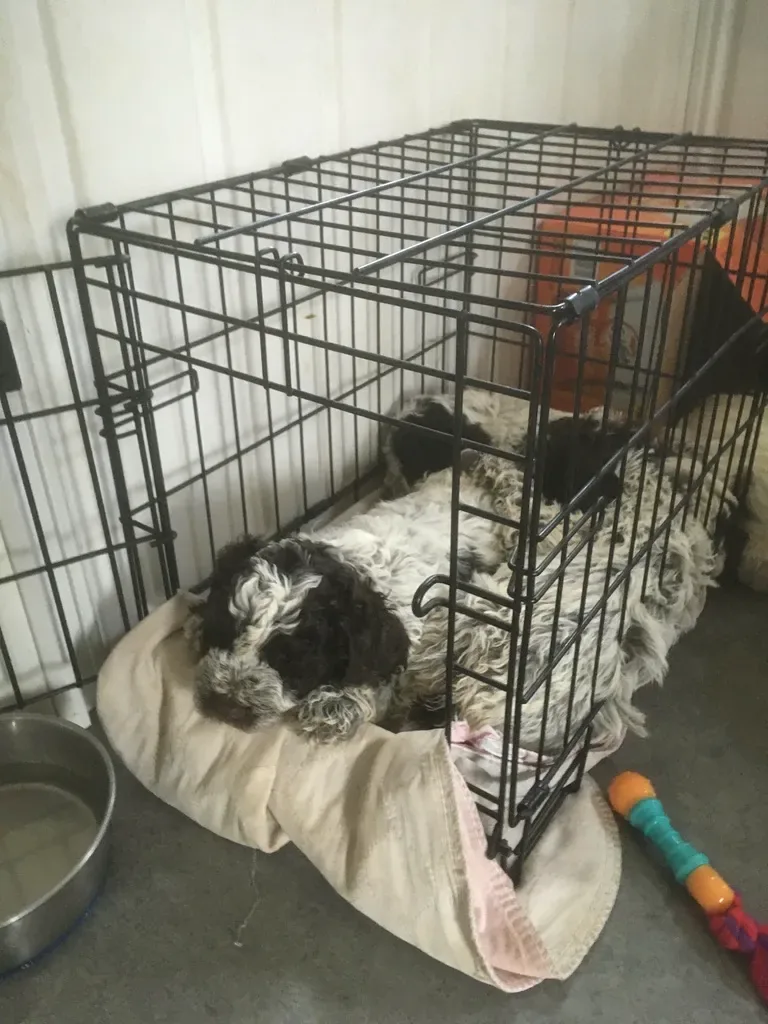
Week 4: Manding is introduced, the formal beginning of communication. The puppy learns that sitting and making eye contact is a language that produces results. This is the foundational skill that everything else builds from.
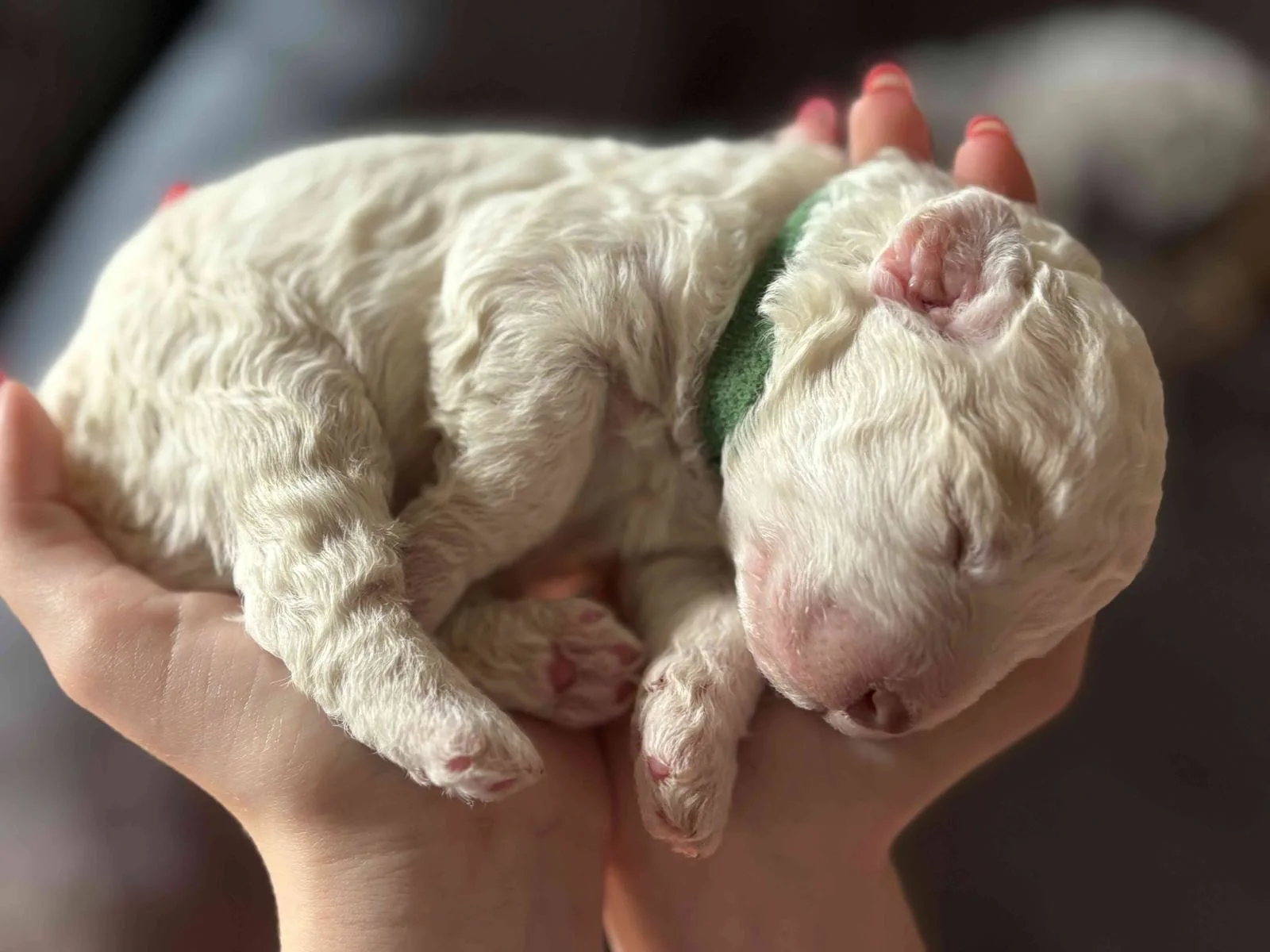
Weeks 5–8: The full socialization surge. Novel people, surfaces, sounds, environments, handling, and mild challenges. By the time your puppy comes home at eight weeks, it has a nervous system that has been exercised, a brain that has been socialised, and the beginning of a language. The first weeks at home are about continuing what was started, not beginning from scratch.
The research on Early Neurological Stimulation shows mixed to contradictory results. A 2023 study on puppies in commercial breeding kennels found that welfare benefits of ENS were not confirmed. The scientific consensus is that it is not possible to definitively prove the benefits.
Here is what I can tell you from eleven years of doing it with every litter: gentle daily handling is well-supported by research and likely accounts for much of whatever benefit ENS provides. The specific exercises are low-risk when done correctly. We do them because the potential upside is meaningful and the downside is negligible, but I will not overstate what the science has proven. The enriched environment, the surfaces, the sounds, the scent work, the human interaction, has the strongest evidence base of any early intervention.
The First Fear Period: 8–11 Weeks
The first fear period falls squarely within the critical socialization window, and it coincides almost exactly with when the puppy goes to its new home. This is not a design flaw. It is why breeder guidance to new owners is so essential, and why this essay exists.
Beginning roughly at seven to eight weeks and lasting until approximately eleven weeks, puppies enter a neurological transition from exploratory behaviour to cautious assessment. The amygdala, the brain’s fear-processing centre, is activating in a new way. At approximately two weeks of age, stress-induced cortisol rises to adult-like levels for the first time, enabling the formation of fear memories. What was a stress-hyporesponsive period gives way to a brain that can now encode danger.
The evolutionary logic is straightforward. In wild canids, fear periods appear at around nineteen days; in domestic dogs at approximately forty-nine days, a result of domestication shifting the developmental timeline. The mechanism exists because a young animal encountering a predator cannot afford to require multiple near-death experiences to learn avoidance. One lesson must be sufficient.
In your living room, this means that the car ride home, the first vet visit, the first encounter with your other animals, and the first night alone all carry more neurological weight at eight weeks than they would at five months. This is not a reason to isolate the puppy. It is a reason to ensure that every early experience is set up to succeed.
What You Will See
The hallmark of a fear period is that responses are sudden and unexpected, not a gradual change. A previously confident puppy may suddenly show trembling, hiding, cowering, or a refusal to walk. You may see a startle response to things the puppy was fine with last week. Around ten weeks, Lagottos in particular often show a brief increase in sensitivity. It is breed-typical and usually lasts a week or two. It passes.
What you do while it is happening determines whether it leaves a mark or dissolves naturally.
Single-Event Learning
One negative experience during a fear period can create an intense, permanent emotional response to that trigger. The brain is exquisitely sensitive, a single traumatic pairing enters long-term storage immediately.
— The concept every new puppy owner needs to understandThis is the most important concept in this essay. During fear periods, normal learning rules do not apply. Outside these windows, a puppy that has a mildly unpleasant experience typically needs multiple repetitions before it develops a lasting fear association. During a fear period, one bad experience is enough.
Fear memories formed during these windows can generalise far beyond the original trigger. A single frightening encounter with a person wearing a hat can spread to fear of all people wearing hats, then to unfamiliar people generally. A painful vet visit during the first fear period can create a dog that panics at every clinic for the rest of its life. A single aggressive encounter with another dog while on leash can produce lasting leash reactivity, because the restraint prevents escape, intensifying the fear and creating learned helplessness.
Once imprinted, these fear memories are extraordinarily difficult to extinguish. Some behavioural researchers describe them as permanent, manageable, perhaps, but never fully erased.
Never force interactions. Pressure to engage with scary stimuli compounds fear rather than building confidence. Allow choice and self-paced exposure.
No harsh corrections. Any aversive training method during a fear period carries a serious risk of creating long-term behavioural damage. This includes e-collars, physical corrections, and invisible fence training.
No overwhelming social situations. Large gatherings, excessive visitors, and busy training environments can trigger fear consolidation rather than confidence.
No on-leash encounters with unknown dogs. If it goes wrong, the puppy cannot escape, and the memory will persist.
What to Do Instead
Give space. Allow the puppy to explore at its own pace without pressure. Be present. Be calm.
Build positive associations. Pair the thing that worries the puppy with something it loves, a treat, a favourite toy, your quiet presence. And distance. Distance is the most underused tool in socialization.
Never punish fear. Punishment adds fear-of-punishment on top of existing fear. The puppy learns that being afraid makes things worse.
Be the safe base. Move the puppy away from scary things. Demonstrate, every single time, that you are the person who makes the world manageable. This is what builds trust. Trust is what makes a Lagotto extraordinary.
The Second Fear Period: Adolescence
The second fear period occurs during adolescence and catches most owners off guard because the puppy looks physically mature. For medium breeds like the Lagotto, it typically falls between eight and eleven months, though it can appear anywhere from six to fourteen months. It correlates with sexual maturity, growth rate, and the ongoing remodelling of the prefrontal cortex.
You will know it when you see it. Your well-trained, confident six-month-old may suddenly refuse to walk past something it has passed every day for months. It may bark at a familiar person. It may lose impulse control that seemed firmly established. This is not defiance. It is developmental. The adolescent brain is undergoing structural changes that temporarily reduce the dog’s capacity to regulate its emotional responses.
Each fear period typically lasts two to three weeks but can extend to four to six weeks in naturally more cautious individuals. The management is the same as the first fear period: do not force, do not punish, do not flood. Continue confidence-building at the individual dog’s pace. Avoid introducing significant new challenges during this window. Be patient. Be consistent. It passes.
A major study published in Nature Scientific Reports (2025), analysing 4,497 dog owners, confirmed that adverse experiences in the first six months of life significantly predict adult aggression and fearfulness. The effects persisted even when controlling for acquisition source, sex, and neuter status. Some breeds showed more vulnerability than others, suggesting genetic predisposition to trauma sensitivity.
The neurobiological mechanism: through mammalian stress physiology, early adverse experiences can result in toxic stress that alters HPA axis function, affecting lifelong behaviour and resilience.
Proper Socialization vs. Flooding
There is a critical distinction between socialization and flooding, and getting it wrong produces the opposite of what you intend.
Habituation: The Goal
Habituation is a decreased behavioural response to repeated, benign stimuli. The puppy’s brain learns to filter irrelevant environmental cues. Startle reactions diminish over time. This is what proper socialization produces: a dog that can walk through the world without being overwhelmed by it.
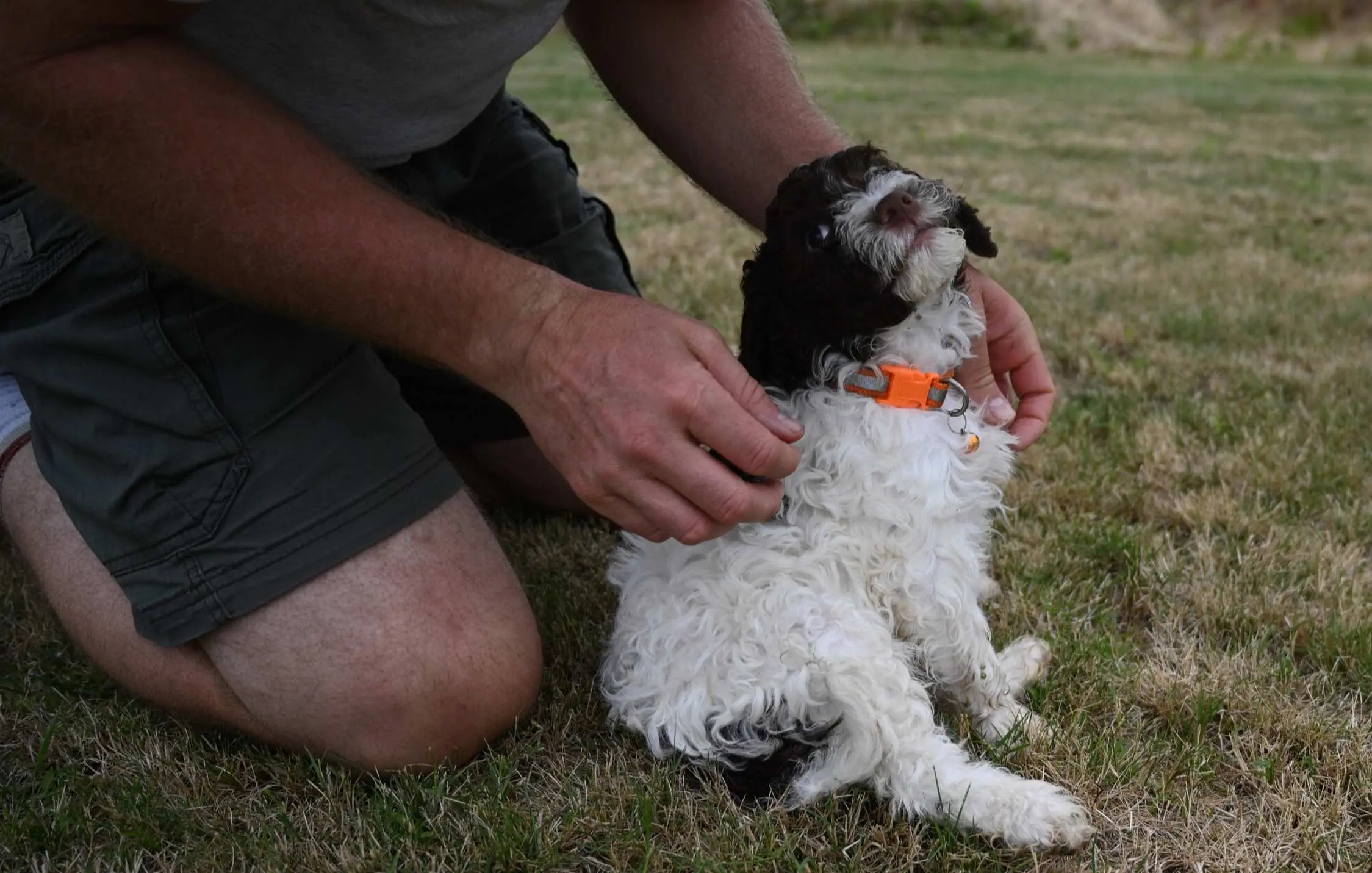
Proper socialization means gradual, controlled, positive exposures where the puppy maintains choice and distance control. Short, pleasant experiences. Progressive confidence building. One calm person before a group of children. A quiet street before a farmers’ market.
Sensitization: The Consequence of Getting It Wrong
Sensitization is an increased response to strong or noxious stimuli. Repeated frightening experiences create more fear, not less. The common mistake: taking a nervous puppy to a dog park with unknown dogs, believing exposure will fix the nervousness. What it produces is a dog that associates other dogs with uncontrollable chaos, and the fear deepens with every visit.
Never force your puppy to interact. Forced interactions cause sensitization, increasing fear, rather than habituation, decreasing fear. The puppy must always lead.
— The rule that governs everything in this essayThe difference is not subtle, but it is easy to miss in practice. A puppy that is quietly observing from a distance is habituating. A puppy that is being carried toward a group of barking dogs while trembling is being flooded. One builds resilience. The other builds trauma.
The Vaccination Debate
There is a persistent belief that puppies should be kept isolated until their vaccination series is complete. This belief is wrong, and both the AVSAB and AVMA have said so explicitly.
The American Veterinary Society of Animal Behavior’s position is unequivocal: “It should be the standard of care for puppies to receive socialization before they are fully vaccinated.” The AVMA published an updated literature review in 2024 reinforcing this position. The risk of behavioural problems from missed socialization far exceeds the risk of infectious disease when basic precautions are taken.
The main infectious concern is canine parvovirus. The risk is real and the disease is serious. But the risk is manageable with sensible precautions, and the cost of waiting until sixteen weeks to begin socialization, when the critical window is functionally closed, is a dog whose behavioural foundation has gaps that may never be filled.
What Is Safe Before Full Vaccination
This is a conversation to have with your vet. Professional bodies including the AVSAB and AVMA take the position that the behavioural risk of under-socialising a puppy during this window outweighs the disease risk of thoughtful, controlled early exposure, and support socialisation beginning before the vaccine series is complete. Your vet knows your puppy, your region, and your local disease pressure, and their guidance takes priority over any general recommendation here. With that framing: puppy classes that require proof of vaccination in all attending dogs are generally considered a lower-risk setting than uncontrolled environments, and a well-run class with appropriate disease controls is, for most breeds, an excellent early socialisation tool. Meetings with known, vaccinated adult dogs. Home visits with friends and family.
A word specific to Lagotto Romagnolo: this is a breed that processes social input deeply and can find group settings with unfamiliar, excited dogs genuinely overwhelming in the early weeks home. The cost of one overstimulating session, a room full of bouncing puppies at eleven weeks, can be weeks of set-back in confidence that is difficult to recover. Our conservative recommendation is to prioritise one-on-one controlled exposures in the first weeks home, building individual confidence before introducing a group setting. When a Lagotto is ready for a puppy class, typically once they are settled, more confident, and have some positive dog-to-dog experience under their belt. The experience will be far more productive for them. That readiness is an emotional question as much as a vaccination one, and it is usually answered around six to seven weeks after the puppy comes home.
Car rides exposing the puppy to varied sights and sounds. Outdoor areas not frequented by unknown dogs. Pet-friendly stores with the puppy in a cart. Controlled home environments with varied people.What to Avoid Before Full Vaccination
Dog parks with unknown dogs. Uncontrolled public areas where unknown dogs eliminate. Any situation exposing the puppy to faeces or urine of unknown dogs. These are sensible, limited restrictions, not a reason to keep the puppy indoors for four months.
We provide detailed, week-by-week socialization guidance to every family we place with. Have questions about the process?
Start the Conversation →Or read our Training Guide for practical next steps
Your Socialization Checklist
This is not a list to rush through. It is a guide for the experiences your puppy should have, positively, at its own pace, between eight and sixteen weeks. Check items off as you complete them. Every one is an investment in the adult dog.
Remember: this checklist is not a speed challenge. (See also our essay on Lagotto temperament.) Every item should be experienced positively, at the puppy’s pace. If the puppy shows hesitation, create distance, add treats, and try again another day. A neutral experience is fine. A frightening experience is worse than no exposure at all.
The Breed That Rewards the Owner Who Listens
The Lagotto Romagnolo is not a difficult breed. It is a communicative one. It tells you what it needs, through its body language, its energy, its willingness or reluctance to engage. The owners who succeed are the ones who learn to hear what the dog is saying.
Every piece of the science in this essay points to the same conclusion: the puppy’s early experiences shape the adult dog permanently, the most consequential window is shorter than most people realise, and the quality of those experiences matters more than the quantity. A puppy that is listened to, respected, gently challenged, and never overwhelmed becomes a dog that trusts. And a Lagotto that trusts its person is one of the finest companions any family will ever have.
That is why we do this work. Every litter. Every time.
Sources & Further Reading
- Scott, J.P. & Fuller, J.L. (1965). Genetics and the Social Behaviour of the Dog. University of Chicago Press
- Canine Socialisation: A Narrative Systematic Review, PMC, 2022
- AVSAB Position Statement on Puppy Socialization, AVSAB
- AVMA Literature Review on Socialization, 2024, AVMA
- Influence of early life adversity on aggression and fear, Nature Scientific Reports, 2025
- Breed-dependent differences in onset of fear-related avoidance, ScienceDirect
- Effect of ENS on Puppy Welfare in Commercial Breeding Kennels, PMC, 2023
- Environmental Enrichment and Brain Development, PMC, 2021
- Optimising Puppy Socialisation, PMC, 2022
- Assessment of Early Experience and Human-Directed Aggression, MDPI Animals, 2023
- Puppy parties and beyond: the role of early age socialization, PMC, 2018
- Habituation vs. Sensitization, AVSAB